


The diplomatic tension between Turkey and Greece is turning into a humanitarian crisis as migrants are pushed back in the Aegean. The second part of the Wild West series asks why pushbacks happen.
Just 45 days earlier, the foreign ministers of the two neighbouring countries had got into a verbal quarrel live on air at a joint press conference. One claimed that his country’s sovereign rights were being disregarded, while the other found this claim “insincere” and accused his counterpart of “treating minorities inhumanely”.
Contrary to expectations, the joint press conference in Ankara of Turkish Foreign Minister Çavuşoğlu and Greek Foreign Minister Dendias heightened tension rather than softening relations between the neighbours.
The date was 31 May 2021… It was Çavuşoğlu’s turn to visit.
Before Athens, Çavuşoğlu stopped in Western Thrace and met opinion leaders of the “Turkish minority”.
While the Greek press said that “Çavuşoğlu aimed to stir up tension even before the official talks”, the Greek Foreign Ministry stated in an official declaration that “Çavuşoğlu was distorting the truth, and that the people living in the region were not a ‘Turkish minority’ but a ‘Muslim minority’”.
After these developments, the Dendias–Çavuşoğlu meeting, expected to be even tenser, turned out “contrary to expectations”, just as in Ankara. Greek Foreign Minister Dendias welcomed Çavuşoğlu at the door and they greeted each other with a hug. They agreed on a list of 25 items. Everyone looked very happy.
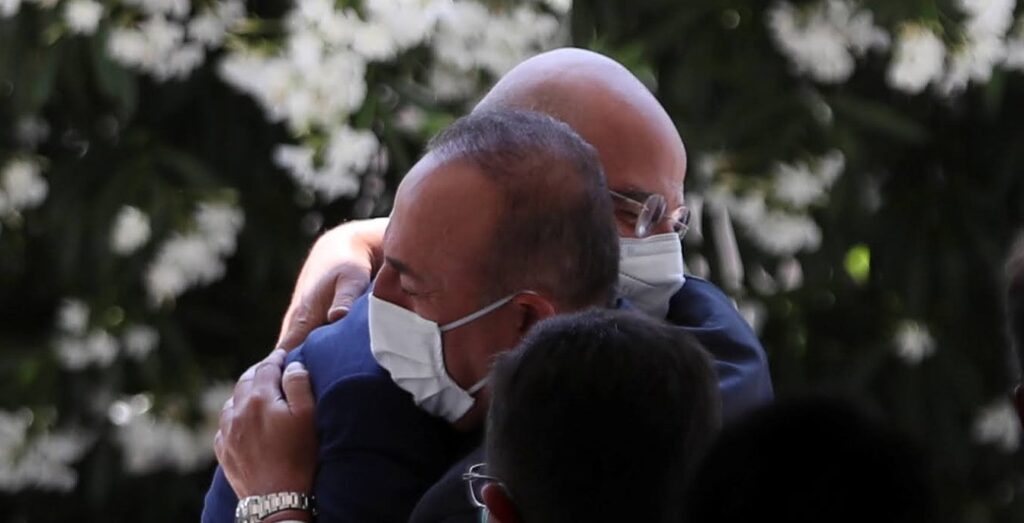
The Greek media, which had run stories of “tension” the day before, would cover the visit the next day with headlines such as “Friendly and warm” and “A small but important step”.
A Historic Joint Ministerial Decision
Less than a week later, a joint decision of the Greek Ministries of Foreign Affairs and of Migration and Asylum was published in the Government Gazette. With this decision a decision was taken that Turkey would not like at all. The winds of friendship that had been blowing only a week earlier were likely to give way to tension. After all, the Erdoğan government would voice even tiny news clippings from Greek newspapers at its rallies and summon the Greek ambassador in Ankara to the Foreign Ministry.
But once again the expected did not happen. The Erdoğan government and Erdoğan’s media ignored this decision and practically played the three wise monkeys. So what did the decision contain?
Under the decision, Turkey was designated a “safe third country” for nationals of Syria, Afghanistan, Pakistan, Bangladesh and Somalia. This opened the way for the asylum applications of such nationals arriving in Greece via Turkey to be declared inadmissible and for them to be returned to Turkey.
Pushbacks Increased
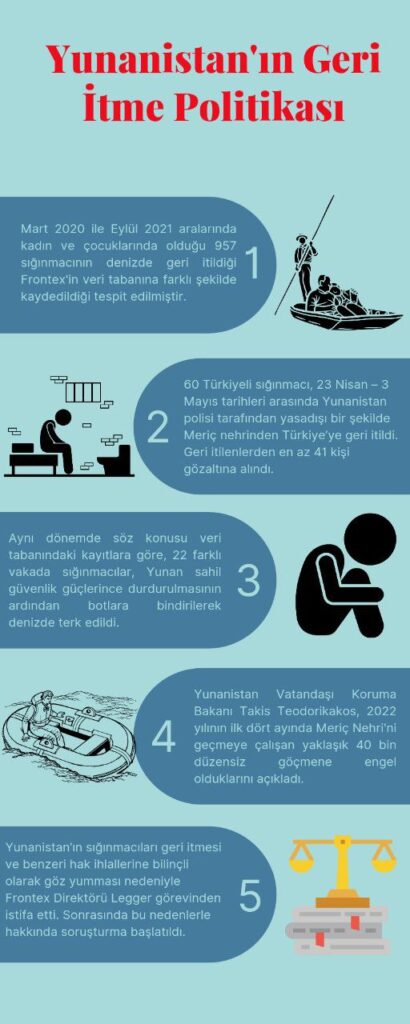
After this decision, reports multiplied of pushbacks being applied not only to nationals of the five countries listed but also to Turkish citizens seeking asylum in Greece. Almost every day, people being pushed back began to be seen, especially on social media. These images drew attention to the fact that, before the pushbacks, asylum seekers were subjected to physical and verbal torture and robbed of their mobile phones and money.
Many asylum seekers from Turkey were also affected by the pushbacks. The silence of Erdoğan’s Turkey on the Greek Cabinet decision, and Greece’s unlawful treatment of these people opposed to the AKP government, brought to mind Çavuşoğlu’s visit and the possibility that the two sides had reached an agreement on this matter.
A Resignation of Shame
Fabrice Leggeri, Executive Director of the European Border and Coast Guard Agency (Frontex), resigned from his post on 28 April 2022. The reason given for the resignation was that Greece pushed back asylum seekers and that he knowingly turned a blind eye to these and similar rights violations.
Before this resignation, the European Anti-Fraud Office (OLAF) had opened an investigation into Frontex over allegations including the pushback of migrants, harassment and misconduct.
What Does the Law Say?
On the right to asylum, the Universal Declaration of Human Rights states: “Everyone has the right to seek and to enjoy in other countries asylum from persecution.”
Article 19 of the Charter of Fundamental Rights of the European Union, in turn, provides: “No one may be removed, expelled or extradited to a State where there is a serious risk that he or she would be subjected to the death penalty, torture or other inhuman or degrading treatment or punishment.”
European Civilisation!
In recent years the number of Machiavellian leaders like Erdoğan has grown in Europe too. This gives Erdoğan more room to manoeuvre. The covert agreement between Greece and Turkey is one example. Erdoğan, who beats the drums of war against Greece, and Greek officials, who criticise Erdoğan at every opportunity, can meet at some point in an inhumane practice.
In my previous article I wrote about what Europe did and did not do in Ukraine, and that its current stance did not match the European idea of civilisation. On pushbacks, too, Europe’s stance unfortunately does not look very different.
As a result of the pushbacks carried out by Greece and allowed by the European Union, hundreds of people who were trying to escape torture, ill-treatment or unlawful practices in Turkey have recently ended up in prison, and thousands of children have been left without a mother or father.
Many of them lost their lives before they even made it to prison…
The countries of the European Union must return as soon as possible to the legal and humanitarian values enshrined in the Charter of Fundamental Rights of the European Union. People who suffered lawlessness in various parts of the world saw Europe as their salvation and went to Europe. If the European Union does not return to its core values, Europe will be no different from the places from which people come to it in search of salvation. The worst of it is that, in such a case, there is nowhere for the people of Europe to go.
Monthly · free
Compass of the Month
PUGAT’s monthly newsletter.
Read next


What is PUGAT? A non-profit community publishing independent analysis from Europe on security, migration and society in Turkish, German and English.
Go to the homepage
