

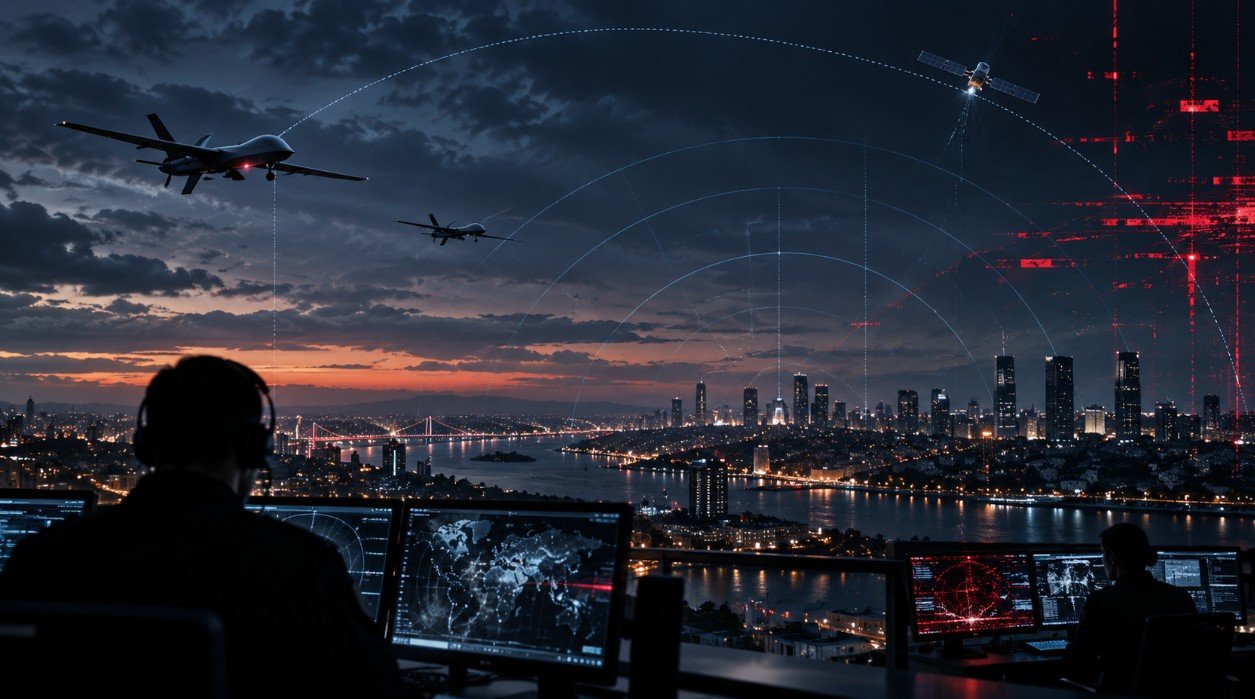
When the Soviet Union collapsed, NATO lost its enemy. The alliance redefined itself through new missions stretching from the Balkans to Afghanistan and through eastward enlargement, while relations with Russia swung from partnership to confrontation.
NATO’s Transformation after the Cold War
On the evening of 25 December 1991, one of the most powerful states in history quietly left the stage in Moscow. In a televised address, Soviet President Mikhail Gorbachev announced his resignation. A few hours later, the red Soviet flag that had flown over the Kremlin for some seventy years was lowered and replaced by the tricolour of the Russian Federation.
An empire had collapsed…
The Soviet flag over the Kremlin had come down, and the Soviet Union, which had stood opposite NATO for more than forty years, had passed into history. From that day on, a question began to take hold, one that remains unanswered to this day:
If the Soviet Union no longer existed, why did NATO?
The fundamental reason for the alliance founded in 1949 was to deter Soviet expansion. For more than forty years, NATO’s military plans, bases, armies and nuclear strategy had been shaped largely around a possible attack from Moscow.
Now the enemy was gone.
What is more, the Warsaw Pact, which the Soviet Union had set up against NATO, had dissolved a few months earlier. The Cold War was over, the Berlin Wall had fallen, Germany had reunified and the Iron Curtain that divided Europe had disappeared. Logically, one might have expected NATO, too, to have completed its historical mission.
But that is not what happened.
Far from dissolving, over the next thirty years NATO would carry out the largest enlargement in its history, bring former Warsaw Pact countries into its ranks and launch military operations in regions probably never imagined in its founding years.
In a process stretching from Bosnia to Kosovo and from Afghanistan to Libya, NATO’s remit changed too. While the common defence of its members remained the alliance’s core task, regional crises, terrorism, peacekeeping operations and, later, cyber attacks also became part of NATO’s understanding of security.
This change raised questions about the new face NATO took on after the Cold War:
Was NATO securing Europe by adapting to new threats, or was it creating new tasks for itself in the vacuum left by the disappearance of its old enemy? Or had the Soviet threat served NATO mainly as a convenient public justification for its existence?
In fact, NATO had begun debating its future before the Soviet Union fully collapsed. It was becoming ever harder to speak of a Soviet army millions strong, waiting at the border to invade Western Europe.
The new Strategic Concept adopted in 1991 reflected this changing perception of threat. Alongside the possibility of a large-scale, direct Soviet attack, regional conflicts, political instability, ethnic tensions and the proliferation of weapons of mass destruction began to be treated as security problems.
The question was thus no longer only “Who could attack NATO territory?”
“What could threaten the security of NATO countries?” also entered the alliance’s field of interest. This understanding of security would become one of the justifications for the operations NATO would carry out beyond its own territory a few years later.
NATO’s First Major Military Operation
The end of the Cold War did not bring Europe the peace that had been hoped for. Shortly after the collapse of the Soviet Union, it was Yugoslavia’s turn to fall apart. Slovenia and Croatia declared independence, followed by Bosnia and Herzegovina. In Yugoslavia, where ethnic and religious differences were intertwined, political fragmentation soon turned into a bloody war.
The measures taken by the United Nations in the face of the massacres in Bosnia were not enough to stop the war. NATO, which had prepared for years to stop Soviet armies entering Western Europe, now faced a different situation.
Bosnia was not a NATO member.
An attack on Bosnia did not engage NATO’s Article 5.
Even so, NATO first supported the implementation of United Nations resolutions and then carried out air strikes on Serb targets. In 1995, in Operation Deliberate Force, NATO aircraft heavily bombed Bosnian Serb forces.
NATO, which had prepared for almost half a century to fight the Soviet Union, carried out its first major military operation not against the Soviet Union but on the territory of the former Yugoslavia. With the intervention in Bosnia, NATO, almost half a century after its founding, for the first time used military force directly in a war in a non-member country. After the war ended with the Dayton Agreement, NATO-led troops were deployed in the region. Among them were Russian soldiers. American and Russian soldiers who only a few years earlier had been preparing to fight each other were now serving in the same peacekeeping force in Bosnia. The Cold War really did seem to be over. But relations between NATO and Russia would soon face another test.
Partnership with the Old Enemy
In its early years, the newly founded Russian Federation sought cooperation with NATO rather than confrontation. In 1994, Russia joined NATO’s Partnership for Peace programme.
On 27 May 1997, NATO and Russia signed the Founding Act on Mutual Relations, Cooperation and Security in Paris.
NATO and Russia, which only a few years earlier had been preparing to fight each other, declared in the document that they no longer regarded each other as adversaries. One of the military camps that had once divided Europe had disappeared, and a new era had begun in which the other could work with its former enemy.
At the same time, however, NATO was preparing to expand eastwards.
Poland, Hungary and the Czech Republic were on the road to NATO membership. This was one of the issues Moscow would raise more and more in the years that followed:
If the Warsaw Pact had dissolved, the Soviet Union had disappeared and Russia was no longer NATO’s enemy, why was NATO expanding towards former Warsaw Pact countries?
The countries of Central and Eastern Europe saw things differently. Having only just escaped Soviet domination, they saw NATO membership as a safeguard against the possibility of falling back into Moscow’s sphere of influence.
While the Eastern European countries saw NATO membership as a security guarantee against Russia, Moscow saw the same process as NATO moving closer to its borders. This difference of views would become one of the fundamental problems of NATO–Russia relations in the years ahead.
The Shadow of the Old Days in Pristina
One of the first places where these problems came seriously into the open was Kosovo.
In 1999, NATO launched an air campaign against Yugoslavia. The bombing, launched to stop the repression and violence against Kosovo Albanians, lasted 78 days.
Unlike in Bosnia, NATO this time had no explicit authorisation for military intervention from the United Nations Security Council.
Russia strongly opposed the operation. Moscow objected to NATO going beyond the defence of its own members to intervene militarily in non-member countries. NATO countries, for their part, argued that military intervention was necessary in the face of what was happening in Kosovo.
An incident in the last days of the war brought NATO and Russian soldiers face to face.
On 11 June 1999, around 200 Russian soldiers serving in Bosnia unexpectedly set off. Covering hundreds of kilometres, they reached Slatina Airport in Pristina ahead of NATO troops.
When NATO troops arrived the next day, Russian soldiers were at the airport.
Eight years had passed since the collapse of the Soviet Union. Yet NATO and Russian soldiers were now facing each other at an airport in Pristina.
The American General Wesley Clark did not want the Russians to strengthen their position at the airport. General Mike Jackson, commander of the British troops in the area, wanted to avoid a direct clash with the Russian soldiers.
Jackson would later be credited with a remark that became synonymous with the crisis:
“I’m not going to start the Third World War for you.”
No shots were fired. Talks led to an agreement on the role of Russian soldiers in Kosovo.
But what happened in Pristina also showed that the disagreements between NATO and Russia, who had declared a few years earlier that they were no longer adversaries, had not gone away.
NATO Moves East
Only a few months before the Kosovo crisis, NATO had carried out its first major eastward enlargement.
On 12 March 1999, Poland, Hungary and the Czech Republic joined NATO. For the first time, former Warsaw Pact members had become part of NATO.
In 2004, Bulgaria, Romania, Slovakia and Slovenia joined NATO, together with Estonia, Latvia and Lithuania.
The last three were different from the others. Estonia, Latvia and Lithuania were not just former Eastern Bloc countries; they were former republics of the Soviet Union.
NATO had thus reached Russia’s border directly in the Baltic region as well.
Moscow argued that, in the final years of the Soviet Union, Western leaders had given assurances that NATO would not expand eastwards. Western countries countered that those talks had essentially concerned German reunification and the military status of the former East German territory, and that there was no binding agreement that NATO would not admit other countries in future.
The two sides still disagree on this today.
While the debate went on, so did NATO’s enlargement. Russia, for its part, increasingly came to see the alliance’s approach to its borders as a security problem.
The Enemy No Longer Had to Be a State
The next development to change NATO’s understanding of security came neither from Russia nor from Europe.
On the morning of 11 September 2001, after hijacked passenger planes struck the World Trade Center towers in New York and the Pentagon, NATO’s Article 5 was invoked for the first time in its history.
But the attack had not been carried out by a state. It was the work of a terrorist organisation called al-Qaeda.
The threat envisaged in NATO’s founding years and the threat it faced in 2001 were very different. It was no longer necessary to mass tanks on Europe’s borders to threaten the alliance’s security. A terrorist organisation operating thousands of kilometres away could also trigger the common defence mechanism. This new struggle took NATO thousands of kilometres away from its original area.
From the North Atlantic to Afghanistan
In 2003, NATO took command of the ISAF force in Afghanistan.
An alliance founded to defend the North Atlantic was, half a century later, running a military operation in Afghanistan.
The 11 September attacks also brought Russia and the West closer for a time. Russia under Vladimir Putin saw radical groups as a threat to its own security as well. During the Afghanistan operation, there was cooperation with the United States and NATO in certain areas.
In 2002, the NATO–Russia Council was established.
Two sides that had once aimed thousands of nuclear warheads at each other were now discussing terrorism, military security and crisis management at the same table. In this period there was even occasional talk of whether Russia might one day join NATO.
But the problem that had persisted since the early 1990s had not gone away:
Where would NATO’s enlargement stop?
The development that put this question back on the agenda was the 2008 Bucharest Summit. NATO leaders declared that Georgia and Ukraine would become members of the alliance in the future.
Both were former Soviet republics. Ukraine’s historical, military and geopolitical position in particular set the question of its NATO membership apart, for Moscow, from earlier enlargements.
The same year, war broke out between Russia and Georgia. The Russian army entered Georgian territory. After the war, Moscow recognised the independence of Abkhazia and South Ossetia.
Formal talks between NATO and Russia were suspended for a while, but relations were not completely broken off. Talks resumed in 2009. In the early 2010s, the idea that NATO and Russia could work together on some common security problems still persisted. The real break would come a few years later, in Ukraine.
Crimea: The Old Enemy Returns
In 2014, the political crisis in Ukraine strained relations between Russia and the West again.
After the change of government in Kyiv, Russian soldiers took control of Crimea. Following a referendum held under Russian control and not recognised by Western countries, Russia announced that it had incorporated Crimea into its territory. Western countries and NATO regarded this as annexation and did not recognise it.
In the same period, fighting broke out in eastern Ukraine between pro-Russian separatists and the government in Kyiv.
NATO suspended all practical civilian and military cooperation with Russia.
Eastern Europe once again moved to the forefront of NATO’s military planning. NATO’s presence in Poland and the Baltic states was strengthened and the number of exercises increased. Russia, too, built up its military capacity on its western borders.
NATO and Russia, which in 1997 had declared that they did not regard each other as adversaries, were some twenty years later once again taking military measures against each other.
Withdrawal from Afghanistan
While all this was happening, NATO was also approaching the end of the longest military operation in its history.
In Afghanistan, the Taliban regime had been toppled, but lasting stability had not been achieved. Despite years of military operations, billions of dollars in spending and programmes to train the Afghan security forces, the Taliban could not be eliminated.
In 2021, following the US decision to withdraw, NATO troops also left Afghanistan.
Shortly after NATO troops withdrew, the Taliban entered Kabul again.
The era that had begun twenty years earlier with the fall of the Taliban ended with the Taliban taking power in Afghanistan once more.
This development reopened the debate on how successful NATO’s long-term operations outside its own borders had been.
But soon Europe and Russia would once again move to the centre of NATO’s agenda.
The Bells of a Third World War
On the morning of 24 February 2022, Russian troops launched a full-scale attack on Ukraine.
Because Ukraine was not a NATO member, Article 5 was not invoked and NATO did not join the war as a direct military party. NATO countries did, however, provide Ukraine with weapons, training, intelligence and financial support. The alliance’s military presence in Eastern Europe was also increased.
In the NATO Strategic Concept adopted the same year, Russia was no longer described as a partner or potential partner. It was seen as “the most significant and direct threat” to the security of NATO members.
In 1991, the collapse of the Soviet Union had removed the main threat NATO faced. Thirty years later, Russia, under a different political system, was once again at the centre of NATO’s definition of the main threat.
Russia’s attack on Ukraine had another consequence.
Finland and Sweden, which had long pursued a policy of military neutrality, applied for NATO membership. Finland joined the alliance in 2023 and Sweden in 2024.
NATO, founded in 1949 with 12 countries, now had 32 members.
From an Alliance Without an Enemy to the Old Enemy
It would not be enough to assess the thirty years after the end of the Cold War only through the struggle between NATO and Russia.
In this period, NATO’s remit also widened.
An alliance founded to deter a possible attack on Western Europe by Soviet armies intervened in the wars in the Balkans. It made terrorism a matter of collective defence. It ran a long military operation in Afghanistan. It took part in the air campaign in Libya. New issues such as cyber attacks, energy security and hybrid threats were included in NATO’s understanding of security.
In the same period, ways of building a relationship with Russia were also explored. Russian soldiers served alongside soldiers from NATO countries in the same peacekeeping forces in Bosnia and Kosovo. The NATO–Russia Council was established. Joint work was carried out on terrorism and other security problems.
But as NATO expanded eastwards, it increasingly collided with Russia’s view of security in the former Soviet space.
The countries of Eastern Europe saw NATO membership as a safeguard against Russia. Russia saw the same enlargement as a problem for its own security.
For this reason, explaining what happened after the Cold War simply as “NATO finding itself new tasks after losing its enemy” does not seem sufficient. But ignoring the part that the expansion of NATO’s remit and geographical reach played in Russia’s security concerns about the West would be an equally incomplete assessment.
As NATO grew, Moscow’s objections increased. Russia’s military interventions in Georgia and Ukraine, in turn, strengthened the argument of a Russian threat that Eastern European countries put forward when seeking NATO membership.
From this point on, the answer to the question of which was cause and which was effect began to depend on which side one was looking from.
In 1991, as the Soviet flag over the Kremlin came down, it was thought that NATO’s great enemy had disappeared.
More than thirty years have passed since then.
NATO has expanded eastwards. Russia has again come to see the West as a threat to its own security. NATO, for its part, has defined Russia as “the most significant and direct threat” to the security of its members.
The alliance that lost its enemy and the heir of that old enemy had, thirty years later, come face to face once again.
Sources
- NATO – Strategic Concept 1991 nato.int
- NATO–Russia Founding Act (1997) nato.int
- NATO – Strategic Concept 2022 nato.int
Monthly · free
Compass of the Month
Once a month: five points from Europe’s security and migration agenda and the month’s PUGAT articles, in your inbox.
Newsletter sign-up opens soon.
Read next

What is PUGAT? A non-profit community publishing independent analysis from Europe on security, migration and society in Turkish, German and English.
Go to the homepage
