

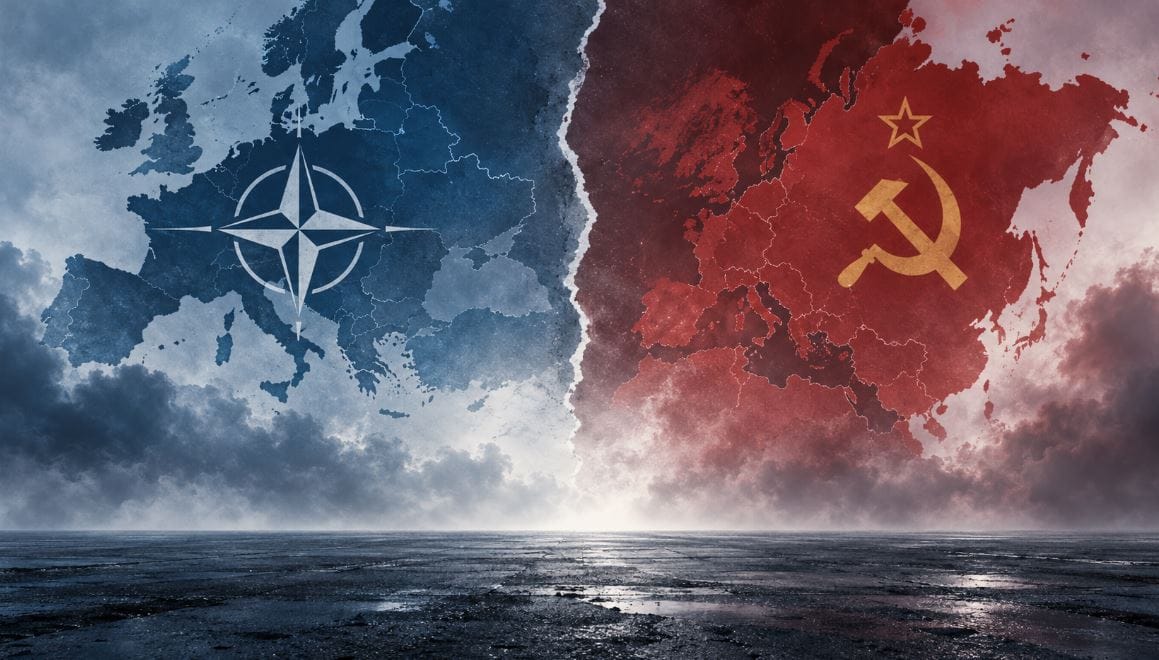
For forty years Europe was divided between two armed blocs, yet the great war never broke out. NATO’s role in the Cold War lies in the logic of deterrence that created this strange balance.
NATO’s Role in the Cold War
On 27 October 1961, what looked like a routine passport check at Checkpoint Charlie, a small border crossing in Berlin, turned into one of the most dangerous crises in human history. When East German officials stopped an American diplomat, first armed American soldiers and then American tanks were sent to the crossing. The Soviet Union was quick to respond. Within a short time, the tanks of the two superpowers were aiming their guns at each other in the middle of Berlin.
For about 16 hours, the fate of the world depended on the composure of tank crews waiting a few metres apart. A single misunderstanding, a wrong order or a panicking soldier touching a trigger could have dragged not only Berlin but the whole world into nuclear war.
In fact, the incident was like a miniature of the entire Cold War. For some forty years, the struggle between NATO and the Soviet Union was fought mostly not on battlefields but in the shadow of tanks, nuclear missiles, spies and diplomatic stand-offs. The world came to the brink of a major war again and again, but each time pulled back at the last moment. That is why the Cold War became the name not only of a political rivalry between two blocs but also of the longest and most fragile balance of power in human history.
“War Impossible, Peace Unattainable”
On 29 August 1949, only four months after NATO was founded, the Soviet Union showed that it too had the atomic bomb, creating a new balance in the arms race between the two superpowers. Both the United States and the Soviet Union now possessed weapons that could bring about not only the other’s end but also their own. This made direct war ever more dangerous, almost impossible; yet their diametrically opposed ideologies, political goals and economic systems also made lasting peace extremely difficult. Here lay the basic contradiction of the Cold War: the cost of war was so great that the two sides could not fight, and their rivalry was so deep that they could not build real peace either.
It was no coincidence that NATO’s founding coincided with the Cold War. The world’s rapid division into two great blocs created a new security problem, especially for countries outside the direct spheres of influence of the United States and the Soviet Union. These countries would either become a direct target of one of the two superpowers or have to rely on one of them for their security.
In this setting, NATO came into being as an alliance of countries that wanted to come together under one roof out of a shared security concern, even if they did not agree with the United States politically or economically on every issue. Naturally, this structure would soon face the Warsaw Pact formed by the Eastern Bloc countries. Founded in 1955 under Soviet leadership, the Warsaw Pact brought together socialist countries such as East Germany, Poland, Czechoslovakia, Hungary, Romania, Bulgaria and Albania under a single military roof. Europe was thus divided into two great blocs not only politically and ideologically but also militarily.
The basic character of the Cold War can therefore be described as a system of rivalry in which the two blocs closely watched each other’s moves, often developed tools similar to the other side’s, and waged their struggle less through direct war than through security, intelligence, propaganda, technology and deterrence.
Because the United States provided a large part of NATO’s military capacity, because Washington’s weight was clearly felt in the alliance’s leadership and decision-making, and because the United States took the lead in the struggle against the Soviet Union, NATO came over time to be seen in many quarters as a “US-centred” structure. Although decisions were taken by the common will of the allies, US influence was decisive for most of the period in terms of military power, funding, intelligence capacity and strategic direction. It can therefore be said that Washington’s political and military priorities were strongly felt in many of the steps NATO took during the Cold War.
It was in exactly this environment that NATO grew.
Its purpose was not only to bring member states together under a common defence. It was also to create a joint military structure that would deter Soviet expansion, to improve intelligence sharing among members and to be able to act as a single army in the event of an attack.
Throughout the 1950s, NATO took the steps that formed its present institutional identity. Supreme Headquarters Allied Powers Europe (SHAPE) became operational. A system of joint military planning was set up. Countries began holding joint exercises. Weapons systems and operating procedures were standardised. NATO thus turned from a purely political alliance into an integrated military organisation.
The Soviet Union responded to these developments by founding the Warsaw Pact in 1955. East Germany, Poland, Czechoslovakia, Hungary, Romania, Bulgaria and Albania were brought under a single military command. Europe was now divided not only on maps but also in military doctrine.
Crises Shaped NATO
Almost every major crisis during the Cold War changed NATO’s structure a little more.
The Korean War, which began in 1950, was not a front on which NATO fought directly. But Western countries feared that the Soviet Union might launch a similar attack in Europe. As a result, NATO’s military capacity was rapidly increased. Turkey’s success in Korea, meanwhile, paved the way for its NATO membership in 1952.
The building of the Berlin Wall in 1961 and the Checkpoint Charlie crisis of the same year showed that the division of Europe had become permanent. NATO was now seen not just as a defence organisation but as the guarantor of Western Europe’s security.
The Cuban Missile Crisis of 1962 completely changed thinking about nuclear deterrence. The stand-off between the United States and the Soviet Union went so far that the Jupiter missiles in Turkey became a bargaining chip. Both sides stepped back at the last moment. After this crisis, early-warning systems, nuclear planning and joint crisis management gained even greater importance within NATO.
The Soviet invasion of Czechoslovakia in 1968 showed that Moscow would not give up its control over Eastern Europe. NATO did not intervene directly, but it raised its level of military readiness in Europe.
With the Soviet invasion of Afghanistan in 1979, the Cold War entered a new phase. NATO troops did not fight in Afghanistan, but member states, above all the United States, supported the groups resisting the Soviets and drew Moscow into a costly war that would last for years. In the same period, NATO also increased its defence spending and strengthened its military presence in Europe.
An Alliance in America’s Shadow
Throughout the Cold War, the United States provided most of NATO’s military power. In nuclear capability, air power, naval power, military technology and intelligence resources, Washington was by far the strongest member of the alliance.
This led NATO to be seen in many quarters as “America’s military wing”. Although decisions were taken by consensus and every member state had an equal say, US weight was felt above all in setting strategy against the Soviet Union. Washington therefore played a decisive role in shaping many of the military and political policies NATO pursued during the Cold War.
Forty Years of Balance
All these crises, from Berlin to Cuba and from Prague to Afghanistan, were in fact different scenes of the same struggle. NATO and the Soviet Union never fought each other directly. But they constantly tested each other’s resolve in different parts of the world.
What kept the Cold War “cold” was not that the two sides reached an understanding. Both knew there would be no winner in a hot war.
Perhaps this was NATO’s greatest achievement over some forty years: while seeking to deter Soviet expansion, the purpose for which it was founded, it was one of the key actors in a balance of power that also prevented the world from sliding into all-out nuclear war.
Sources
- NATO – A short history nato.int
- NATO – Strategic Concepts (1949–1991) nato.int
- Office of the Historian – Berlin Crisis 1958–1961 history.state.gov
Monthly · free
Compass of the Month
Once a month: five points from Europe’s security and migration agenda and the month’s PUGAT articles, in your inbox.
Newsletter sign-up opens soon.
Read next

What is PUGAT? A non-profit community publishing independent analysis from Europe on security, migration and society in Turkish, German and English.
Go to the homepage
