

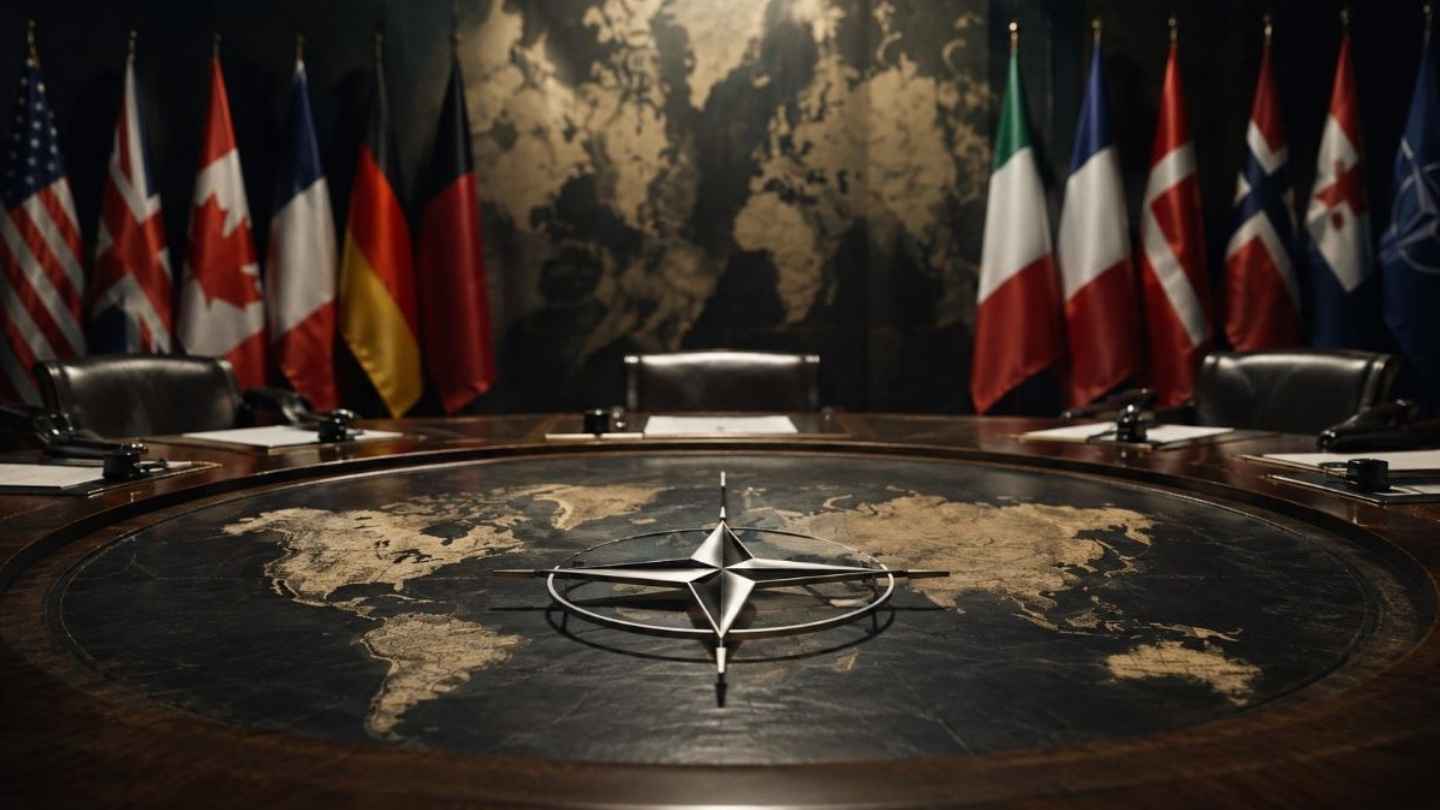
A physicist who carried the secrets of the atomic bomb to Moscow, promises made at Yalta and a city fed from the air for months. Within four years, yesterday’s allies split into two camps and NATO was born.
From the secrets of the atomic bomb to the Berlin Blockade: the years that drove wartime allies into opposing Cold War camps, and the birth of NATO
In July 1945, a secret project in the New Mexico desert of the United States bore its bitterest fruit, one that would change the course of humanity: the atomic bomb. The world’s brightest scientists had been brought together to make the project succeed. One of them was Klaus Fuchs, a German-born physicist who had fled the Nazi regime because of his communist identity and anti-Nazi political activities, reaching Britain and from there the United States.
Fuchs feared that Nazi Germany would get the atomic bomb before other countries. But his passing of information to the Soviet Union did not begin after the war ended. A communist, Fuchs had made contact with Soviet intelligence even before joining the Manhattan Project and had begun secretly passing on information in 1942. He would later explain this with his belief that the secrets of the atomic bomb should not be the monopoly of a single state.
Documents that came to light years later would show that the information Fuchs passed on played an important role in speeding up the development of the Soviet atomic bomb.
This chain of events was more than a spy story; it heralded the new era that would begin right after the Second World War. Allies who had fought on the same side only yesterday were on the brink of a confrontation that would trigger the greatest arms race in history.
In February 1945, before the war had even ended, one of the most important summits in history was held in Yalta in Crimea. Three leaders sat at the table: US President Franklin D. Roosevelt, British Prime Minister Winston Churchill and Soviet leader Joseph Stalin.
The official agenda was reshaping post-war Europe. Behind the scenes, however, a much bigger struggle was under way.
Stalin wanted Eastern Europe to remain a Soviet sphere of influence. Poland in particular was seen as indispensable for Soviet security. Stalin demanded a pro-Soviet government in Poland and that the country become part of Moscow’s security belt.
Churchill and Roosevelt, by contrast, argued for free elections after the war and for occupied countries to decide their own futures freely. They believed this would also help the West preserve its political influence in Eastern Europe.
Although the official communiqués of the Yalta Conference gave an impression of agreement, it became increasingly clear once the leaders left the table that they did not envisage the same future.
From Darkness into Haze
When the war ended, these concerns quickly began to materialise. A Soviet-backed government was installed in Poland. Moscow’s influence then grew steadily in Romania, Bulgaria, Hungary and Czechoslovakia. Europe was drawn, as if by an invisible line, into two different political worlds.
At the same time, an important assessment was being made in Washington. The analysis written by the American diplomat George Kennan, known as the “Long Telegram”, argued that Soviet expansion could only be stopped by a long-term, determined policy of “containment”. This approach soon became the foundation of American foreign policy.
American public perceptions of the Soviet Union, seen as an ally during the war years, also began to change. One of the strongest expressions of this change came from the former British Prime Minister Winston Churchill. On a visit backed by US President Truman, Churchill went in 1946 to the town of Fulton in the US state of Missouri. In his speech there he used the words that went down in history:
“From Stettin in the Baltic to Trieste in the Adriatic, an iron curtain has descended across the Continent.”
These words meant more than a striking metaphor. Western states were beginning to believe that the Soviet Union was not just a country trying to secure itself, but one that aimed to spread its ideological and political influence across the whole of Europe.
In 1947, in a speech to Congress, US President Truman announced the policy that would later be known as the “Truman Doctrine”. In European countries still struggling to recover from the war, poverty and hunger were at their peak. Fearing that Stalin would turn this situation into an opportunity to spread communism, the United States announced that it would provide economic and military support to countries threatened by communist expansion.
In the same year, the Marshall Plan was launched to rebuild the war-ravaged economies of Western Europe. The plan also had an important pay-off for the American economy. The recovery of European economies meant the revival of foreign markets for US producers, which had shrunk after the war.
But economic aid alone would not be enough.
The year 1948 saw developments that fundamentally changed Western Europe’s sense of security. In February, a Soviet-backed communist coup took place in Czechoslovakia.
The most concrete regional example of the Cold War now unfolding worldwide came in Berlin. After the war, Germany had been divided into four occupation zones, and Berlin into four sectors controlled by the United States, Britain, France and the Soviet Union. The Soviet Union, which had suffered the greatest losses in the war, dismantled many industrial plants in its own zone as war reparations and moved them to the Soviet Union. In West Berlin, backed by the United States, Britain and France, prosperity and development gathered pace. The 1948 currency reform in the Western zones, which brought the Deutsche Mark into circulation, further increased tension between the two sides. As tensions between the Western powers and the Soviet Union escalated, Stalin blockaded overland access to West Berlin and tried to cut off supplies to the city. For months, a city of millions could only be kept alive by an airlift.
One of the first great trials of strength in the struggle between capitalism and communism, which would later spread across the whole world, had taken place in Berlin. Stalin failed to force the Western powers out of the city, and the Soviet Union lifted the blockade in May 1949. This first great showdown had ended in a political success for the West.
“If We Are Next, Who Will Protect Us?”
This question laid the groundwork for the birth of one of the greatest military alliances in history.
Throughout history, when states felt they could not stand alone, they formed alliances against common threats. The Delian League in ancient Greece, the defensive leagues of the Middle Ages, the Concert of Europe after the Napoleonic Wars, and the Triple Entente and Triple Alliance before the First World War all emerged to preserve the balance of power or to act together against a common enemy. But most of these alliances either dissolved at the end of a war or could not survive changing political balances. NATO, founded after the Second World War, took a different place in history: not a temporary military coalition formed to win a particular war, but a long-lived security organisation that institutionalised collective defence and brought political and military structures together under one roof.
On 4 April 1949, twelve countries met in Washington. The United States, Canada, the United Kingdom, France, Belgium, the Netherlands, Luxembourg, Norway, Denmark, Iceland, Italy and Portugal founded NATO by signing the North Atlantic Treaty.
The alliance’s core idea was extremely simple but its effect was great: an armed attack on one member would be considered an attack on them all.
This principle was set out in the treaty’s famous Article 5. Each member would assist an ally under attack by taking the action it deemed necessary. The aim was to act together on the basis of collective defence. The real goal, however, was to deter a potential attack before it happened.
NATO’s structure was built on this idea. The alliance’s highest political decision-making body became the North Atlantic Council, in which all member states are represented. Decisions were taken by consensus, so that every member state, whatever its size, had an equal say in decision-making.
But the integrated military command structure of NATO as we know it today did not yet exist at its founding. After the outbreak of the Korean War, the development of the alliance’s military structure accelerated, and in 1951 Supreme Headquarters Allied Powers Europe (SHAPE) became operational. The alliance’s military planning and defence preparations would be run through this structure. One of its most striking features was that the Supreme Allied Commander Europe (SACEUR) was traditionally an American general. This arrangement became a symbol of the long-term US commitment to European security. Or it meant that Europe had handed the reins of its security to the United States. It was essentially a win-win relationship. Thanks to it, many European countries, helped by the American security umbrella, could direct part of the resources they would otherwise have spent on defence towards development and social policies. The United States, in turn, made its military presence in Europe against the Soviet Union permanent and built bases and a wide security network. The NATO order also tied the security structures of Western European countries together in a common system, reducing the likelihood that rivalry between European states would turn into military conflict again.
At this point, NATO’s comprehensive security architecture, built on intelligence sharing, joint planning, standardised military training and the ability to operate together, was proof that it was more than just an attempt to create a common army.
The treaty signed in 1949 covered twelve countries at the time. In the decades that followed, however, NATO grew into the world’s largest military alliance and one of the most important international institutions shaping the course of the Cold War.
The story of a scientist who carried the secrets of the atomic bomb to the Soviets and the diplomatic promises made at Yalta were parts of the same great transformation. States that had fought the same enemy only yesterday had, within just a few years, come to see each other as the greatest threat. The borders of the new world that had appeared in the New Mexico desert in the summer of 1945 had become a little clearer four years later with twelve signatures in Washington.
Sources
- NATO – Founding treaty nato.int
- The North Atlantic Treaty (1949) nato.int
- Office of the Historian – Berlin Airlift history.state.gov
Monthly · free
Compass of the Month
Once a month: five points from Europe’s security and migration agenda and the month’s PUGAT articles, in your inbox.
Newsletter sign-up opens soon.
Read next


What is PUGAT? A non-profit community publishing independent analysis from Europe on security, migration and society in Turkish, German and English.
Go to the homepage
