


Since the 1990s we have been living in the “age of the UAV”. Unmanned aerial vehicles reduce the asymmetric advantage of terrorist organisations and give security forces the upper hand in intelligence.
Guest Author – Salih Ergün
| Part 2
In the previous part we examined the role of intelligence in counter-terrorism. In this part we will try to examine the subject on a broader plane by looking at the fields in which unmanned aerial vehicles are used in this context.
With the beginning of the shift in counter-terrorism from traditional manpower-intensive techniques to the use of unmanned platforms, the systems that have come most to the fore are unmanned aerial vehicles (UAVs).
The importance of UAVs is growing steadily because they minimise the asymmetric advantage terrorist organisations initially held and give control of information and intelligence superiority. Because they expand the battlefield and make it possible to carry out reconnaissance and surveillance with less risk and greater accuracy, the period beginning in 1990 is regarded as the “Age of the UAV” in terms of security practice. It is also predicted that in the coming period UAVs will replace many military systems and technologies, including piloted aircraft[i].
We can say that UAVs integrated into the force structure of security forces are a force multiplier in terms of combat capability. UAVs play a dominant role by making decision-makers’ tasks easier, requiring fewer forces and causing fewer casualties, and giving a new face to reconnaissance and surveillance, especially in building intelligence. In addition, through the imagery intelligence provided by their electro-optical cameras, sensors and radar systems, they allow decision-makers to establish a more flexible and faster decision-making mechanism[ii].
What Is an Unmanned Aerial Vehicle?
Unmanned aerial vehicles (UAVs) can be defined as aircraft that take off using aerodynamic force under automatic or remote command, are flown without a pilot and can carry a payload. The structure formed by adding the Ground Control Station (GCS), Ground Data Terminal (GDT) and other infrastructure units that enable UAVs to carry out their missions is called an Unmanned Aircraft System[iii].
Fields of Use of Unmanned Aerial Vehicles
UAVs, the first examples of which appeared in the late 19th century, have been used in the modern sense in conventional and asymmetric conflict environments since the 1970s. UAVs are mostly used in the world’s armies for intelligence purposes such as surveillance and target detection, and in advanced armies, including the Turkish Armed Forces, there is also a marked increase in the tendency to use armed versions[iv]. Some of the current and anticipated capabilities of UAVs are:
- Intelligence, reconnaissance and surveillance
- Counter-terrorism
- Border control and protection
- Mine detection and clearance
- Combating smuggling
- Chemical, biological and radiological screening[v]
When the mission areas of UAVs and their functions for these areas are classified, five main headings stand out: Intelligence and Reconnaissance/Surveillance, Attack, Electronic Warfare, Target Simulation and Special Missions. The sub-functions of the mission areas listed under the main headings are presented in Figure 1[vi].
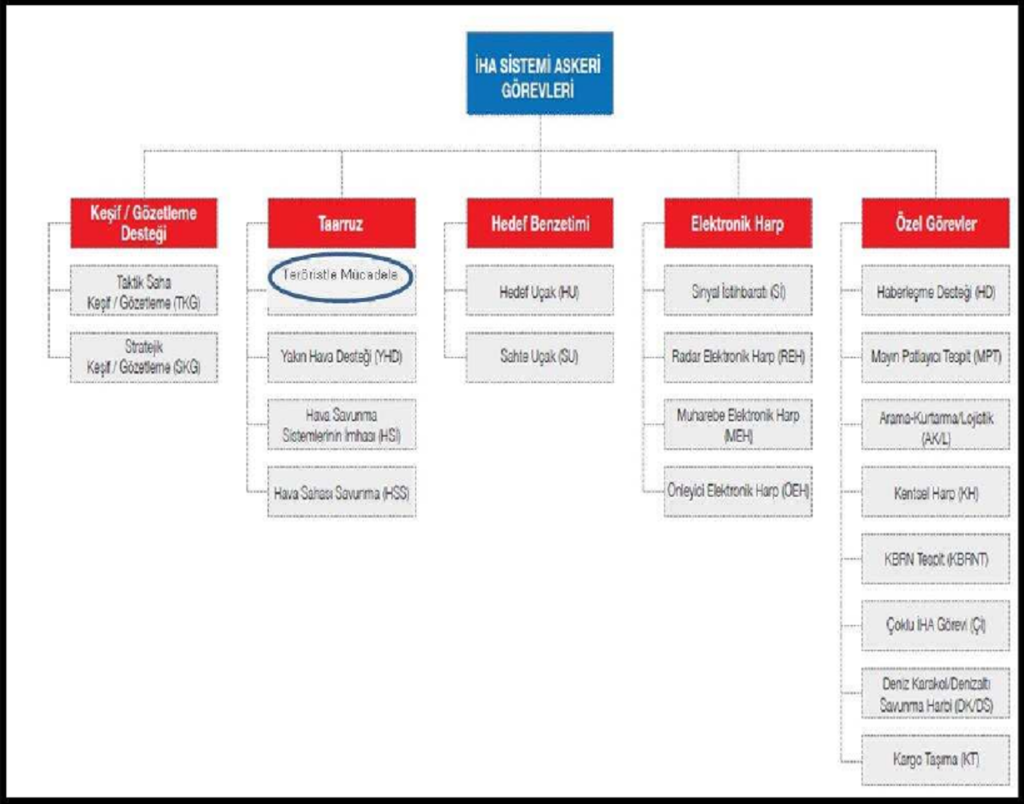
The Use of Unmanned Aerial Vehicles in Counter-Terrorism
The asymmetric advantages terrorist organisations hold against conventional forces, such as using the terrain, moving in small groups and thus remaining hidden, began to be minimised with the use of UAVs in counter-terrorism from the 2000s onwards. Today UAVs are indispensable components of counter-terrorism operations in many advanced countries fighting terrorism. Thanks to their developing technology, UAVs can meet the need for reconnaissance and surveillance in real time during operations and when deployed at bases[vii]. UAVs can also be used to detect mines and improvised explosive devices. The main advantages UAVs offer their users, which explain why they have been used so widely and effectively in counter-terrorism in recent years, are as follows:
- Thanks to their small size and lower noise levels, they are hard to detect.
- They can stay airborne for long periods over the area being reconnoitred,
- They allow low-altitude flight and can carry out their missions even under enemy fire.
Despite all their advantages, the most important disadvantage of UAVs is their vulnerability to air defence systems. Depending on the weapons systems terrorist organisations possess, this vulnerability is open to exploitation with surface-to-air missiles. For this reason, UAVs are systems that allow the technologically superior side to minimise the advantages of the asymmetric enemy facing it, if not in a struggle between equal and symmetric forces[viii].
Armed UAVs, widely used in counter-terrorism in advanced countries, are regarded as the most effective system yet produced for neutralising the leadership cadre, the centre of gravity of terrorist organisations. At the same time, in countries with armed UAV technology, operations against the leadership cadres of organisations have also caused civilian casualties as a result of errors in identifying detected threats and in “target verification” (McManus, 2009). It can therefore be said that, with current technology, UAVs’ target identification capability is not sufficient. After all, the fact that a group of people is detected by UAVs in an area, and that the area is known to be one civilians do not generally use, does not necessarily mean that the people there are always and entirely terrorists. For this reason, target detection and identification systems need to be developed to reveal whether detected threats are armed and whether they carry explosives. The evidence obtained in this way will prevent terrorist organisations from using the security forces’ struggle as a propaganda tool and will highlight its legitimacy in the eyes of national and world public opinion. The rising use of UAVs (Hellmore, 2009) has led to the prediction that piloted warplanes will in future give way to unmanned versions, and the first products of work towards this vision have begun to appear[ix].
The Concept of Payload in Unmanned Aerial Vehicles
Unmanned aerial vehicles carry out their missions by means of the payloads they carry, and these systems are the real reason UAVs exist. Payloads are generally camera systems used in reconnaissance and surveillance missions and, in more advanced examples, weapons systems. In reconnaissance/surveillance missions, target detection can be carried out by UAVs thanks to laser subsystems added to the camera systems. Radar sensors using Synthetic Aperture Radar (SAR) and Moving Target Indicator (MTI) technologies are the systems needed to carry out reconnaissance and surveillance activities. Electronic warfare and signals intelligence subsystems are also among the basic payloads used in UAVs[x].
The most important capability needed to ensure the most effective target detection and identification in UAV reconnaissance and surveillance missions is the verification of detected threats as targets, that is, their identification. In this respect, the most important indicators for defining detected threats as targets and for taking preventive or neutralising measures against them are the detection of weapons, explosives and similar illegal items on individuals.
Built-up areas are places terrorist organisations use intensively to obtain supplies and spread propaganda. Target detection and identification in built-up areas, which requires greater care, is a task terrorists make harder by dressing like civilians and hiding their weapons or the explosives they carry in order to protect themselves from reconnaissance/surveillance assets. Crossing the border by hiding among groups smuggling in border regions is also a method frequently used by terrorist organisations. UAVs therefore need technology that allows not only the detection of threats but also the confirmation and identification of detected threats as targets. In this way the distinction between “innocent and terrorist” can be made more objectively and with greater accuracy.
In the next article we will take a closer look at the concept of terahertz and try to broaden the subject towards the use of this technology as a payload in UAVs.
[i] Center for Security Studies (CSS), (2010). The Military Utility of Drones, ETH Zurich, No.78
[ii] The U.S. Air Force, (2005). The U.S. Air Force Remotely Piloted Aircraft and Unmanned Aerial Vehicle Strategic Vision
[iii] Gertler, J. (2012). U.S. Unmanned Aerial System, Congressional Research Service Report
[iv] Cole, C, Dobbing,M and Hailwood, A, (2010). Convenient Killing: Armed Drones and the Playstation Mentality Report
[v] Akyürek, S, Yılmaz, M.A. and Taşkıran, M. (2012). İnsansız Hava Araçları, Muharebe Alanında ve Terörle Mücadelede Devrimsel Dönüşüm [Unmanned Aerial Vehicles: A Revolutionary Transformation on the Battlefield and in Counter-Terrorism], BİLGESAM Report No. 53, Ankara
[vi] Undersecretariat for Defence Industries, (2011). Türkiye İnsansız Hava Aracı Sistemleri Yol Haritası (2011- 2030) [Turkey Unmanned Aerial Vehicle Systems Roadmap], accessed 1 June 2013, http://www.ssm.gov.tr/_layouts/ images/iha_ ekatalog_web/ index.html
[vii] Akyürek, S, Yılmaz, M.A. and Taşkıran, M. (2012). İnsansız Hava Araçları, Muharebe Alanında ve Terörle Mücadelede Devrimsel Dönüşüm, BİLGESAM Report No. 53, Ankara
[viii] Center for Security Studies (CSS), (2010). The Military Utility of Drones, ETH Zurich
[ix] Gayle,D. (14 May 2013). dailymail, 17 May 2013, http://www.dailymail.co.uk/news/article- 2324571/U-S-Navys-X-47B-stealth-drone-launches-aircraft-carrier-time–critics-warn-heralds- rise-killer-robots.html
[x] Fahlstrom, P.G. and Gleason, T.J (2012). Introduction to UAV Systems, England
Monthly · free
Compass of the Month
PUGAT’s monthly newsletter.
Read next


What is PUGAT? A non-profit community publishing independent analysis from Europe on security, migration and society in Turkish, German and English.
Go to the homepage
