

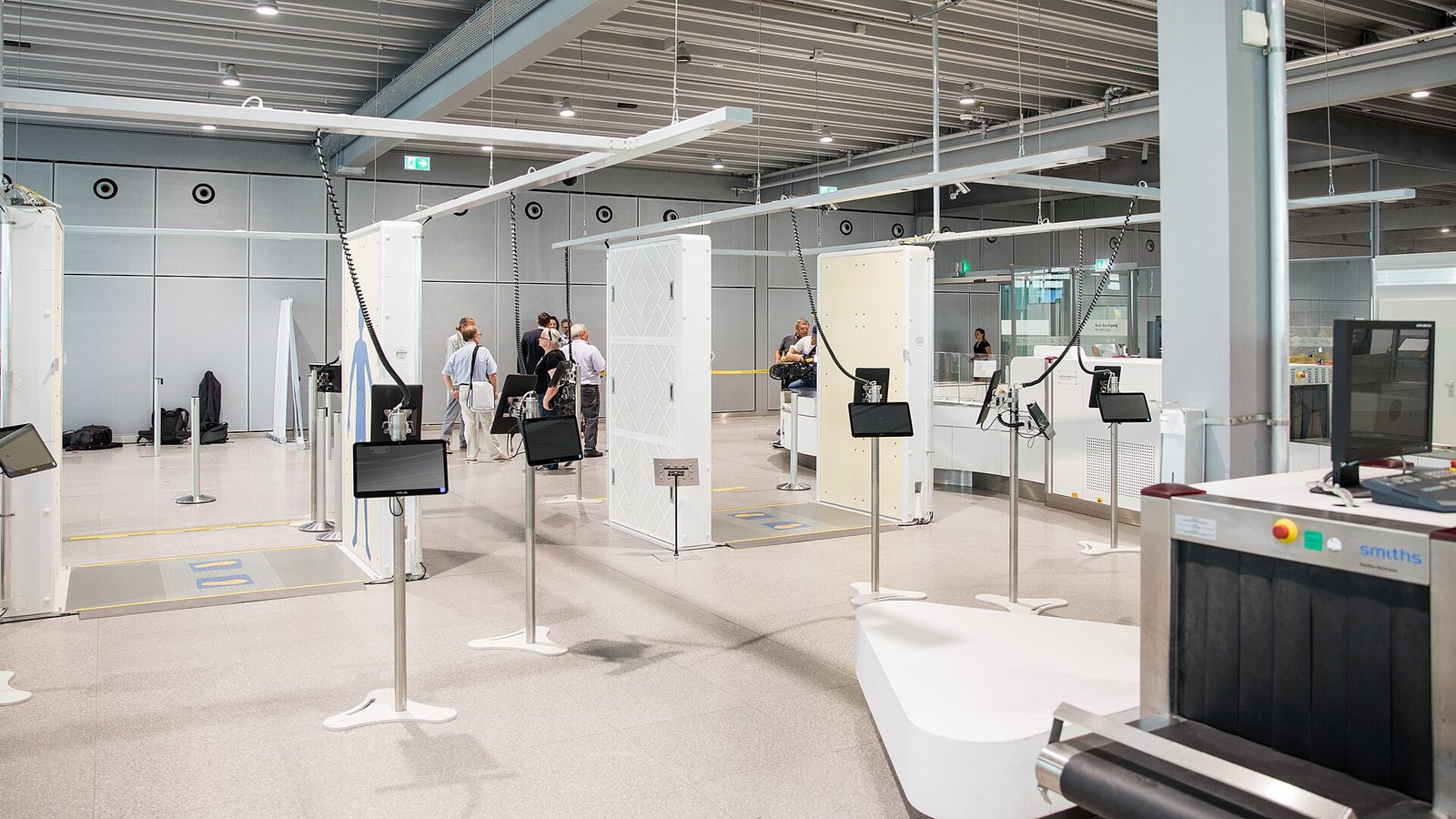
The terahertz band, lying between microwaves and infrared, can, under suitable measurement conditions, read the “spectral fingerprint” of certain explosives. This part explains the physics of the technology and its fields of application.
Guest Author – Salih Ergün
| Part 3
After our previous articles, in which we tried to shed light on the use of UAVs and their payloads within imagery intelligence, one of the methods of gathering intelligence in counter-terrorism, in this article we examine terahertz technology and its fields of application.
What Is Terahertz?
Terahertz (THz) radiation is the name given to radiation lying between the microwave and infrared regions of the electromagnetic spectrum, serving as a bridge between electronics and photonics. The THz band is commonly defined as 0.1 to 10 THz, although some sources extend the upper limit to 30 THz. Research on the terahertz (THz) region of the electromagnetic spectrum has recently intensified[1].
For many years the THz band remained largely unexplored because of the lack of the necessary sources and detection devices. The detection and generation of electronic and photonic radiation differ considerably in their theoretical and technical frameworks. The region between electronics and photonics, known as the THz gap, has a hybrid character because it is where the two fields meet[2]. Figure 1 shows the position of the THz band in the electromagnetic spectrum[3].
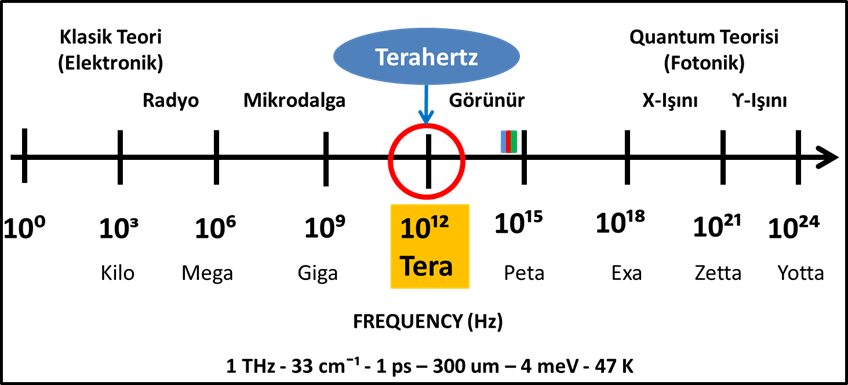
Among the theoretical approaches, classical theory in the electronic field focuses on electromagnetism and communication theory dealing with the electron and its emission mechanisms, while the photonic field concentrates more on the quantum mechanisms of light–matter interaction. Both fields support major industries worth billions of dollars. In the THz region, where the two meet, a wide variety and large number of industrial products have not yet been produced.
In this context, the development, production and trade of devices using the THz band also hold an important place in industry[4]. There are two main approaches in THz systems: continuous (continuous wave, CW) THz radiation and pulsed (time domain) THz radiation. The characteristics of both groups are presented in Table 1.
| Continuous THz Radiation (Continuous Wave) | Pulsed THz Radiation (Time Domain) |
| Narrowband, No instantaneous spectral data, High power possible, High sensitivity, Fast data acquisition, Active and passive applications | Broadband, Instantaneous spectral data possible, Low power, Time and thickness information (time of flight) Active applications only |
What Makes the Terahertz Band Special?
Four basic properties make THz waves important.
- First, THz radiation shows a unique signature for different materials. This property is like the uniqueness of a fingerprint[5].
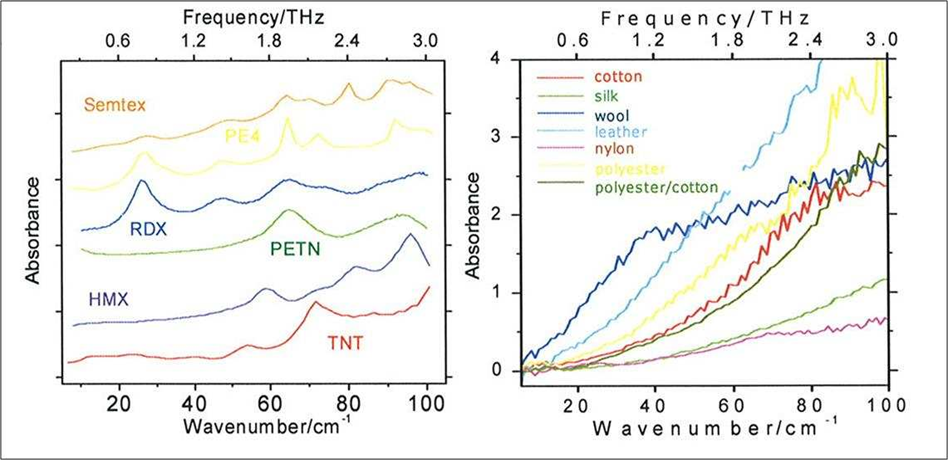
- Second, THz radiation can pass through non-metallic and non-polar materials and interacts strongly with polar materials. Thanks to this property it can pass through many materials, and air pollution, cancer cells and explosives can be detected by means of THz radiation. Terahertz radiation can penetrate many dry, non-metallic substances other than water and metal to a certain degree, depending on their composition and thickness, and it lies in the frequency range corresponding to the vibrational motion of most chemical and biological molecules. According to Dobroiu[6], THz rays pass through most materials such as plastic, cardboard and fabric, are absorbed by water and water vapour and are reflected by metals. Spectroscopic measurements have revealed that most explosives have a characteristic structure in the THz band that distinguishes them from other substances. Many explosives, including TNT, RDX, HMX, PETN and tetryl, have been detected with THz spectroscopy. Figure 2 shows the different spectral structures of explosives and the THz frequency of various coverings[7]. Detection was achieved even though the explosive was covered with materials such as paper, plastic and fabric.[8]
- Third, THz involves very low energy levels. (Unit: meV. 1 millielectronvolt: 1.6×10⁻²² joules) For this reason it does not ionise biological tissue and does not cause the direct tissue damage associated with X-rays. Safe use nevertheless depends on power, frequency and exposure time. This property allows it to be used in health and security.
- Fourth, an object at room temperature emits energy in the THz region[9]. This further widens its range of use.
Fields of Application of Terahertz Technology
The fields of application of THz technology have developed in parallel with advances in photonics and nanotechnology. Today THz technologies are used in areas such as:
- Information and communication technologies (ICT),
- Biology and health sciences,
- Non-destructive testing,
- National security,
- Quality control of food and agricultural products,
- Global environmental monitoring and
- Ultrafast computers (some of these fields are still at the research stage)[10].
THz imaging is used to detect explosives, drugs and weapons, and it is being investigated experimentally as a way to distinguish basal cell carcinoma from healthy tissue. Since THz wavelengths also form the fingerprint spectrum of most chemical and biological materials, they can be used to identify hazardous substances. THz waves are expected to offer new advantages in very fast wireless communication, medical imaging and the remote detection of landmines, although absorption by soil remains a major limitation. In addition, T-rays (terahertz) carry far less risk than X-rays because they do not ionise biological tissue. This does not mean that unlimited exposure is safe, however. When they are used on living beings for medical imaging or other purposes, power and exposure time must be taken into account. Looking at the fields of application, they are generally intended for use in the areas listed in Table 2[11].
| Spectroscopic Identification of Concealed Objects | Non-Destructive Evaluation | Content Inspection |
| Detection and identification of explosives, | Corrosion investigation, | Security screening, |
| Detection of chemical and biological weapons, | Detection of cracks, voids and structural defects, | Spectroscopic imaging. |
| Characterisation of pharmaceuticals. | Thickness measurement. |
As the table shows, the non-ionising nature of THz radiation, the fact that its adverse effects on the human body are almost negligible compared with similar technologies such as X-rays already widely used in security, and its ability to reveal concealed substances by passing through objects make this technology unique. In particular, the ability to image objects hidden behind other objects is increasing interest in the security applications of THz radiation.
Sources
- Clothier, R. H., Bourne N., (2003). Effects of THz Exposure on Human Primary Keratinocyte Differentiation and Viability, J. Biol. Phys. 29, (179)
- Lee Yun-Shik, (2009). Principles of Terahertz Science and Technology, Springer, USA, p. 1-3
- Zomega Terahertz Corporation, The Terahertz Band, (2012). The Terahertz Ebook, Technical Overview, p. 2-9
- Zomega Terahertz Corporation, The Terahertz Band, (2012). The Terahertz Ebook, Technical Overview, p. 2-9
- Zomega Terahertz Corporation, The Terahertz Band, (2012). The Terahertz Ebook, Technical Overview, p. 2-9
- Dobroiu A., Yamashita M., Ohshima Y. N., Morita Y., Otani C., and Kawase K., (2004). Terahertz Imaging System Based on a Backward-wave Oscillator, Applied Optics Vol. 43, (30)
- TeraView, (2010). Technology Update, January 2010, http://www.teraview.com.html. p. 2
- Zomega Terahertz Corporation, The Terahertz Band, (2012). The Terahertz Ebook, Technical Overview, p. 2-9
- Hauser M. G. & Dwek E., (2001). The Cosmic Infrared Background: Measurement and Implications, Ann. Rev. Astronomy and Astrophysics, 39, (249)
- Kısa, F., Teraherts Teknolojisi ve Kullanım Alanları [Terahertz Technology and Its Fields of Use], Savunma Teknolojileri Bülteni, February 2013, p. 39
- Zomega Terahertz Corporation, The Terahertz Band, (2012). The Terahertz Ebook, Technical Overview, p. 2-9
Monthly · free
Compass of the Month
PUGAT’s monthly newsletter.
Read next


What is PUGAT? A non-profit community publishing independent analysis from Europe on security, migration and society in Turkish, German and English.
Go to the homepage
