

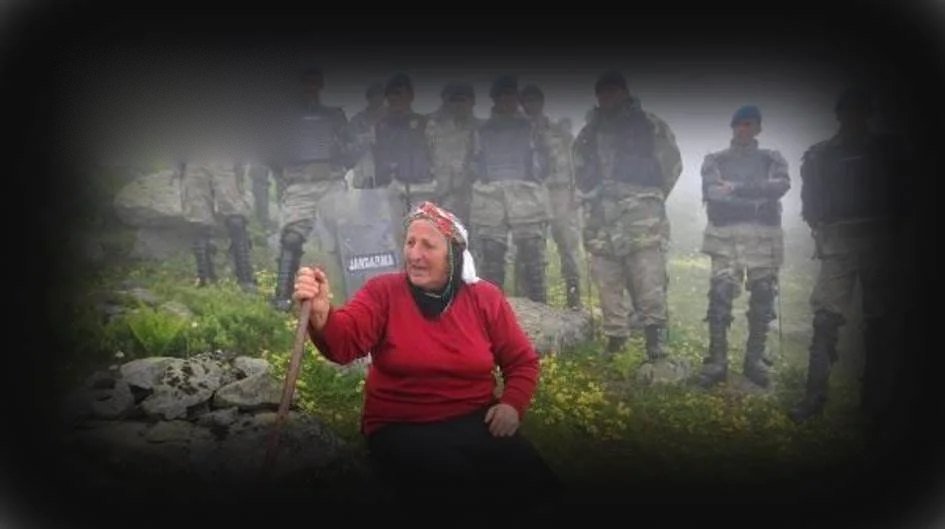
The photograph of Havva Bekâr resisting the plateau road in Çamlıhemşin has not faded from memory. The author questions the gendarmerie's recent PR campaigns and its relationship with citizens.
If I say Havva Bekâr, perhaps none of you will remember. But there is no one among you who will not remember this photograph, which made the press during the struggle of the people of Çamlıhemşin against the road that was to be built to their plateau pastures.
Lately we have started to see the Gendarmerie in the press and on social media over all sorts of matters. Some of these are shaped by a so-called PR (public relations) campaign, while others, unfortunately, are posts stemming from the misconduct of poorly trained personnel.

As security legislation requires, the Gendarmerie should be in a position to solve its citizens’ problems, not to confront them. This, of course, does not mean excusing crime or criminals.
Law enforcement is an institution shaped and developed as the result of a society’s entire accumulated experience. Especially the Gendarmerie of the Republic of Turkey. Pushing aside the institutional culture and experience gained over the years is unthinkable. Nor is it possible to slip out of it by the shortcut of defending oneself with “I did whatever I was ordered, whatever the laws commanded”.
As a debt to the society from whose bosom it came, law enforcement should add to that society the value it deserves and provide the service it needs. In its actions and procedures it should not lose sight of lawfulness any more than of usefulness. Besides, in recent years the lawfulness of many procedures carried out by law enforcement has unfortunately been called into question.
Years ago, at the War Academies, I asked Prof. Dr. Feridun Yenisey, who attended one of our seminars, “Is every law the executive passes lawful?” Professor Feridun said, “This is a fine line that lawmakers must watch.” For every law prepared, the legislative and executive powers must comply with the Constitution and the sensitivities of the international conventions to which we are a party. Whether this has been applied soundly to date should be debated. In periods when politics strays onto such winding paths, law enforcement must stay within the bounds of the law for the sake of citizens’ peace and security.
Under no circumstances is law enforcement, nor should it be, a tool for politicians to use in achieving their aims. When this rule is broken, we have seen time and again that whoever seizes power uses these institutions as a stick against his rivals. In recent years the State of the Republic of Turkey has reached a point where torture and violations of law have occurred on a scale unprecedented in its history. The most fundamental reason is that law enforcement units have set their conduct according to politics rather than the law.
In developed countries you do not see law enforcement units so often in the media and in politics. In these countries people sometimes even forget that law enforcement exists. Until they need it. This is never considered strange. On the contrary, frequent contact with law enforcement personnel disturbs citizens in countries where law and human rights are advanced.
The point Turkey has reached on this road can be seen in the 2020 report of Freedom House, a civil society organisation that researches democracy, freedom and human rights. According to the report, Turkey has fallen into the category of “not free” countries. With a score of 32 out of 100, Turkey has unfortunately dropped to 146th place in the “freedom” ranking of 195 countries.
While I was preparing this article, an incident made the press that makes you say “you couldn’t make this up”: This time in İspir, Erzurum, a Gendarmerie specialist sergeant swore at the public. That a law enforcement officer sees himself so far above the people, and carries that authority as far as swearing at the public, is something everyone should stop and think about.
Not only those who hold office, but everyone who bears responsibility must decide what kind of country they want to leave to their children in the future and show the will to take the right steps with regard to democracy, human rights and fundamental rights and freedoms.
Every approach indexed to protecting the powerful is wrong. No power can stand above the people. Actions must be taken only so that the people may live better, more safely and more peacefully. Not in spite of the people.
Havva Bekâr’s words, “There is no state, there is the people! The state is a state thanks to us”, should be engraved in the minds of all of us, and especially of public officials.
Monthly · free
Compass of the Month
PUGAT’s monthly newsletter.
Read next


What is PUGAT? A non-profit community publishing independent analysis from Europe on security, migration and society in Turkish, German and English.
Go to the homepage
