

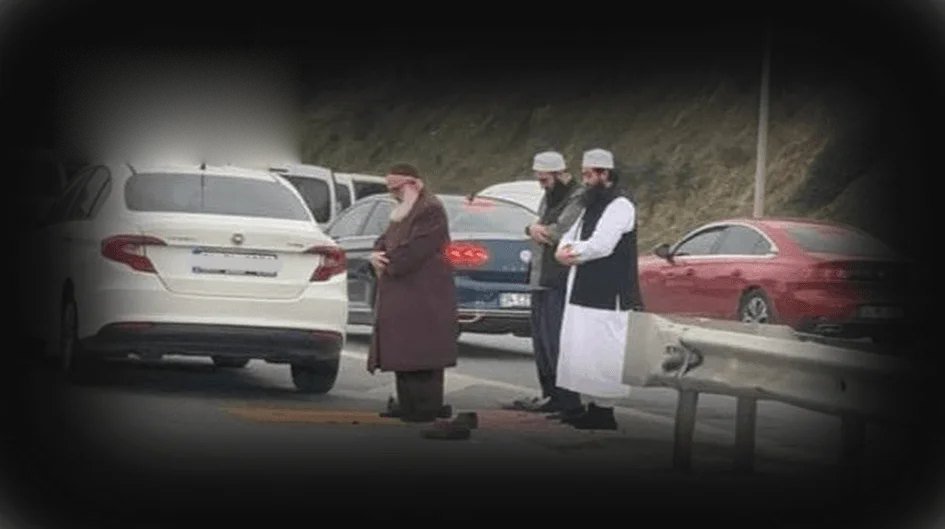
Footage of people stopping to pray in the middle of a motorway spread on social media. The author argues that an understanding of religion stripped of spirituality is an individual and social security problem.
The actions that arise from an understanding of religion stripped of spirituality are a serious security problem with not only individual but also social dimensions.
Those who performed “prayer on the motorway”, whose footage circulated on social media in recent days, endangered not only traffic but also religious and spiritual security. To dismiss those who stood to pray in the middle of the traffic as “lunatics” and move on is to ignore the motivation that pushed them to this act and the reasons behind it.
Responsibility for the picture that has emerged does not lie only with the people who found the nerve to do this, whom some of us dismiss as “lunatics”. What gave this picture its body is the hand of politics; it is the power of political Islamist fanaticism, which smothers politics in a religious sauce and makes religion a tool of its political ambitions.
The footage passed from hand to hand on social media. All of the criticism is justified.
Those who defend the footage, meanwhile, do not realise what they are saying.

As with every distorted image that emerges in connection with religion and religiosity, emotional reactions are once again being built on the individual attitudes of those caught on camera, and the dose of anti-religious rhetoric is being raised, sometimes by a subconscious reflex, sometimes by conscious choice. And so everyone with religious sensitivities is offended.
Yet the matter has very little to do with religion and individual culture of belief. The picture that has emerged is almost entirely a manifestation of “the politicisation of religion”, which causes religious faith to be seen as a daily ritual stripped of spirituality.
The ruling power, which uses religion as political material, feels no discomfort at all about the abusive use of concepts from the theological literature.
The government and the security bureaucracy, which shamelessly and ruthlessly use every legal lever in force to suppress a feeble dissenting voice, do not see as a security problem any deviation, any movement or act that serves the perception of religion they have politicised, whether or not it has a counterpart in legal literature.
Yet governments are obliged to ensure the security not only of their own cadres and ideologies but also of the people and of the persons, institutions and concepts that the people hold in esteem. As things stand, the emotional and intellectual worlds of those who strive to fulfil their religious duties, of civil society organisations within an institutional community of faith, and of those who have developed sensitivities around concepts such as theology, ethics and spirituality are not safe.
We can readily call the problem that has emerged “the problem of spiritual security”.
Remember the 28 February process, with what came before and after it. Or open the media archives and take a look at the news. You will come across similar images. Remember the Ali Kalkancıs, the Müslüm Gündüzes, the Fadime Şahins. Picture the bearded, stick-carrying, robed Aczmendis appearing in groups in parks and on motorways.

Through those images, Turkey’s agenda suddenly shifted to debates about sharia, and within a short time these debates evolved into the 28 February (postmodern coup) process. In the eyes of large sections of the public, serious suspicion arose towards religion, the religious and the concepts of the relationship between the individual and religion found in the theological literature. For large sections of the public with no spiritual grounding beyond traditional religious culture and moral instruction, the concepts of religion, faith and spirituality began to be seen as a rotten, putrid field to be avoided.
No! I will not ask, on the basis of the present footage of prayer on the motorway, “is preparation being made for another coup or memorandum?” I will say that this footage has put the problem of spiritual security on our agenda in connection with religion and religiosity.
Many individuals, whether or not they feel they belong to a religious community, a neighbourhood or a culture, whether or not they have a religious or conservative background, but who were raised in the traditional Islamic faith handed down in the family, may perceive the reactions built on this footage as a threat to their own spiritual security. Aware of this, the political Islamist crew that exploits religion may abuse the perceptions that have formed in order to close and swell its ranks, and force open the door to new turmoil in the country.
When you open a debate about faith on a political plane, the parties join in with data they deem suited to their political views, and the sentences they utter are aimed at proving the speaker right and, very often, the legitimacy of his disproportionate reactions. This turns the differences of opinion and feeling that already exist in society into material for a mental, emotional and even physical conflict.
But can a few isolated images of “prayer on the motorway” really produce such a security crisis in society?
I would very much like political scientists, sociologists and social psychologists to answer this question. But I can say this much: The life experience our country has lived through, from the past to the present, has shown us many examples proving that much of what we were told could never happen was “made to happen” headlong.

Those who stopped to pray on the motorway endangered traffic safety. True. But they also caused a more serious security threat: They both provoked and damaged the positive or neutral feelings that large masses hold towards religion, and they dumped onto society’s agenda the problem of spiritual security, which has not yet been named. It is only a matter of time before this footage is followed by new images. And our archives, as everyone knows, are quite rich.
I fear that this problem, a threat graver than memoranda and military coups, will drag society from within into a crisis that will take a very long time to cure.
Monthly · free
Compass of the Month
PUGAT’s monthly newsletter.
Read next

What is PUGAT? A non-profit community publishing independent analysis from Europe on security, migration and society in Turkish, German and English.
Go to the homepage
