

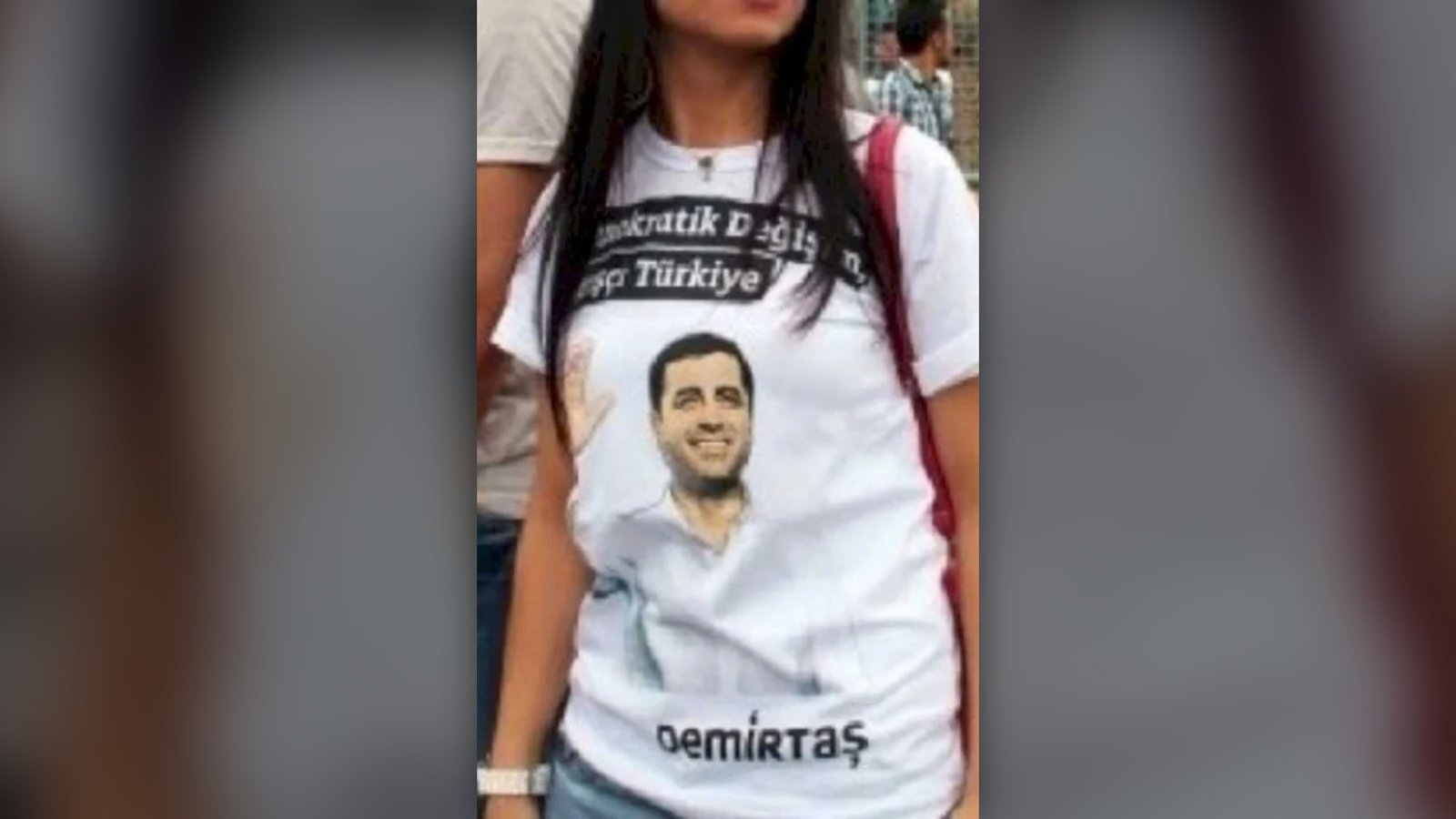
Reports that a child in Van was detained for wearing a T-shirt printed with Demirtaş’s image brought the limits of freedom of expression back onto the agenda. The author interprets Demirtaş’s detention from a different angle.
On 16 June, some media outlets reported that a child walking in the street in Van with his pregnant mother had been detained for wearing a T-shirt printed with Selahattin Demirtaş’s image.
As is well known, on 4 November 2016 Selahattin Demirtaş was arrested together with HDP Co-Chair Figen Yüksekdağ and nine HDP MPs on charges under the Turkish Penal Code of “establishing an organisation to commit crimes”, “membership of a terrorist organisation”, “membership of an armed terrorist organisation” and “committing crimes on behalf of an organisation”, and was sent to Edirne F-Type Prison.
Many claim that Selahattin Demirtaş was arrested because of his words to Erdoğan, “We will not make you president!”, but I see it differently. It is a fact that for years no leadership figure has emerged, or been able to emerge, within the terrorist organisation to rival Öcalan. In recent years Selahattin Demirtaş has undeniably risen in the eyes of the people of the region. The person most disturbed by this is Öcalan himself. In the most recent Istanbul mayoral election, Demirtaş called on HDP voters to go to the polls despite Öcalan and played a significant role in the AKP’s defeat in Istanbul.
The AKP, which had the letter of the terrorist organisation’s leader read out to the public to win elections, broadcast on TRT an interview with Osman Öcalan, for whom an arrest warrant on charges of membership of a terrorist organisation was outstanding. Against such political manoeuvres aimed at the people of the region, the police practices that violate human rights and the law, seen on 16 June in Van and in incidents in other cities of Türkiye, truly deserve attention.
What must be noted here is the claim that these measures are taken within the scope of counter-terrorism. On the contrary, it is an undeniable fact that many of the counter-terrorism activities of recent years have completely reversed and wiped out the gains achieved.
In the fight against terrorism waged for more than 40 years, the security forces have achieved very significant successes and gained great experience. That is true. But all this experience has also shown that counter-terrorism has four components: legal, political, economic and armed. It is now accepted all over the world that conclusive success cannot be achieved through operations by the armed forces alone.
A look at how separatist movements around the world have been resolved shows that these problems were not solved by armed struggle alone, but, as in the examples of Spain (ETA) and the United Kingdom (IRA), by drawing the groups concerned into politics and taking legal and economic steps. Against this background, it is highly telling that Erdoğan threw away in one stroke all the efforts governments had made for years to draw the Kurds into politics.
Since the day it was founded in 1978 in the village of Fis in Lice by Abdullah Öcalan and 21 supporters, the terrorist organisation PKK has been led by a single leader and almost the same leadership, while the Republic of Türkiye has been governed by 16 prime ministers and 1 president (under the presidential system) and 27 governments. While the terrorist organisation immediately adapted to developments in the world, the state fought terrorism with the different political programmes of different governments in each period. Even under AKP governments, contradictory action plans were implemented.
The AKP, which boasted of launching a struggle against the Ergenekon and JİTEM practices of the 1990s in its first years in power, underwent a rupture with the 7 June 2015 election and went backwards in its counter-terrorism policies. The white Toros cars of the 1990s were replaced by black Transporter minibuses, and JİTEM by the special operations unit set up by MİT. Abductions in broad daylight and incriminating statements extracted under torture returned, and human rights and the law were shelved.
We have reached the point where the power of Interior Minister Soylu, who at every opportunity threatens to “bring Qandil down on their heads!”, now extends only to children wearing T-shirts, pregnant women holding charity bazaars or citizens marching for their friends.
During the well-known peace process, we witnessed some practices this country was not at all used to and that we did not approve of. Despite its many mistakes, trying to resolve the problem through politics was perhaps the only right thing. But because the AKP pursued the process solely to win votes, it did not involve the rest of the country. In the end the policy produced no results, and it was Erdoğan himself who put the process on ice.
As a new election approaches, perhaps the most important thing for the whole opposition and the intellectuals of Türkiye to watch for and keep in mind is that Erdoğan and his supporters may once again manipulate terrorism and the people living in the region to win the election. It must not be forgotten that all the components that took part in the founding of the Republic of Türkiye have a say in determining the destiny of this country. Turks, Kurds, Laz, Circassians… are all part of this mortar. That is why embracing all its components will be the only key to a solution.
Update (November 2026): Following Abdullah Öcalan’s call in February 2025, the PKK announced its dissolution in May 2025. The first disarmament ceremony took place in July 2025. Despite European Court of Human Rights judgments finding violations of his rights, Selahattin Demirtaş was still being held in Edirne as of September 2026.
Monthly · free
Compass of the Month
PUGAT’s monthly newsletter.
Read next

What is PUGAT? A non-profit community publishing independent analysis from Europe on security, migration and society in Turkish, German and English.
Go to the homepage
