

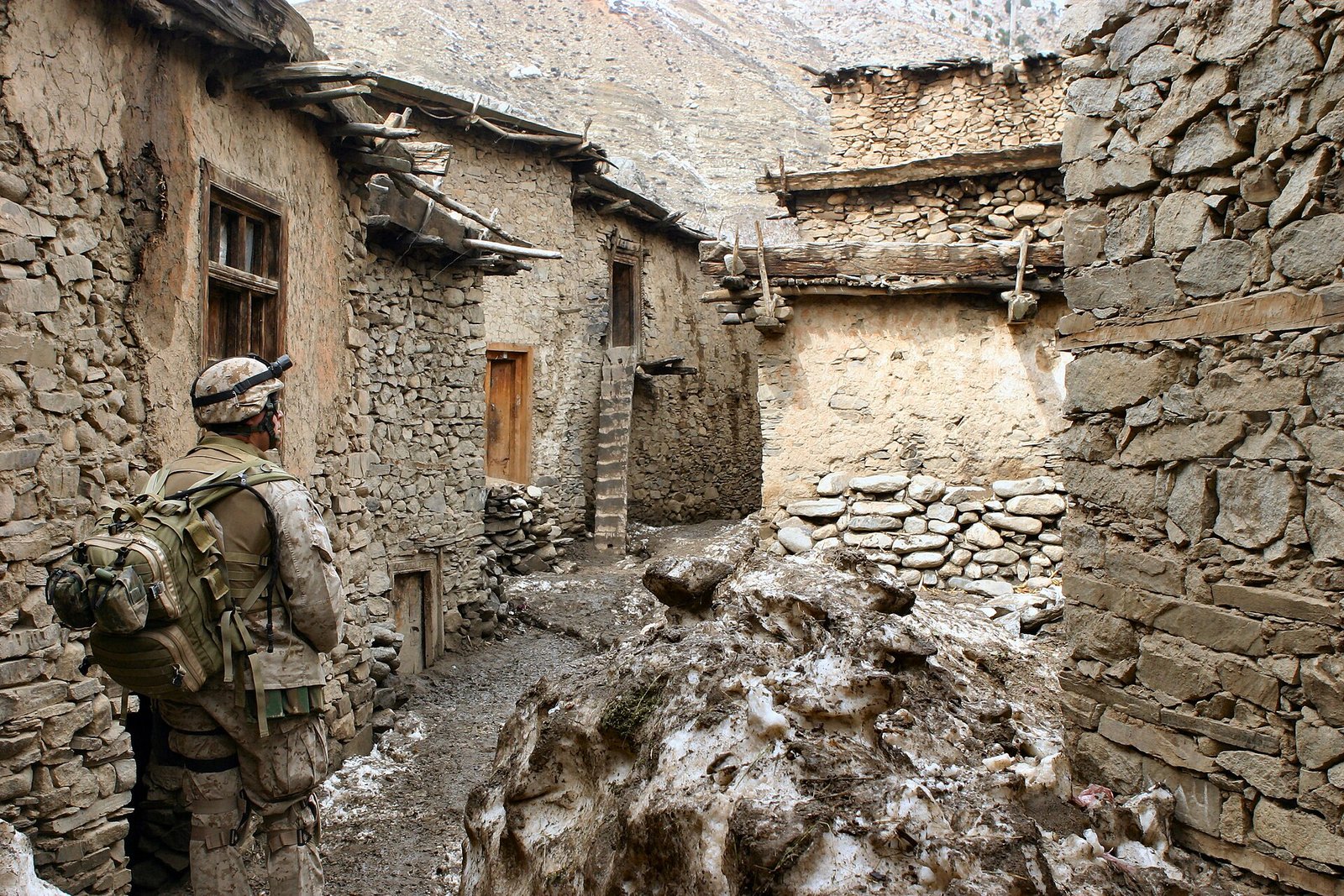
According to former CIA Director David Petraeus, urban warfare in Kyiv was inevitable. The author assesses the difficulties of combat in built-up areas through the examples of Aleppo and Grozny.
Former CIA Director General David Howell Petraeus gave some very striking information in an interview with CNN.
David Petraeus, known to the Turkish public as the “hood general” because of the hooding of Turkish soldiers in northern Iraq, was, as commander of the 101st Airborne Division during the invasion of Iraq, the commander of the unit that seized the bridges over the Tigris and critical points with air assault operations.

Assessing the invasion of Ukraine, Petraeus says that urban warfare in particular is inevitable. He compares Kyiv with the battles of Aleppo and Grozny. What the battles of Aleppo and Grozny have in common is that both went down in military history as wars in which the weaker of the warring sides defeated the stronger. In this context, as a former soldier who has seen the difficulties the Turkish Armed Forces faced in operations in built-up areas against lightly armed militants in cities booby-trapped with improvised explosives, I can say that hard days await the Russian army.
Urban warfare is the form of operation that regular armies attacking to reach a goal within a certain time frame would not choose. The Russians wanted to reach their political goals and change Ukraine’s legitimate government through a surprise offensive, without waging a large-scale ground war that would start a blood feud with the local population. But this did not happen.

An examination of the Russian army’s method of operation shows that Russia did not expect this level of resistance in Ukraine and planned to end the war in its favour with a fait accompli, as it did in Crimea in 2014. Let me open a parenthesis here to stress that since the Second World War there have been only three major cases in which Russia used its elite paratroopers so extensively: Hungary 1956, Czechoslovakia 1968 and, most recently, Ukraine 2022.
So why is this important? With developing weapon systems in particular, the first condition for being able to use paratroopers, who become open targets in the air, is that the country being attacked does not respond or lacks the strength to do so. Many experts agree that Ukraine gave such an impression before the war. Of course, there are also claims that the UK/US duo was behind this tactic. In the end, in its operation to invade Ukraine, Russia dropped its most elite units into the midst of the Ukrainian army with airborne operations. Footage of Russian soldiers captured deep inside Ukraine was published on social media. Reportedly, they lost control so badly at one point that word spread that a senior officer responsible for planning and dispatch behind the front had entered the battle line and been killed. I should also point out that even the most reliable source can be misleading. The war is being fought in the print and visual media through propaganda and disinformation as much as on the ground. But a different development that strengthened the claims took place on the sixth day of the operation. According to a Russian military expert, Chief of the Russian General Staff Valery Gerasimov had been dismissed. Moscow gave no response, true or false, to this claim.
Another issue is the information about Russian communication systems that has fallen into open sources. Open sources reported that officers communicating by mobile phone were being listened to by Ukrainian and Western intelligence, and that Russian radio codes were easily broken and freely monitored by Russian-speaking Ukrainian soldiers. Britain’s Telegraph newspaper shared radio conversations of Russian soldiers at the front. According to the recordings, Russian units are operating in complete confusion, most soldiers are demoralised, and some were even crying during the fighting.
It is inevitable that an army that neglects the basic principles of counter-intelligence will suffer heavy losses on the battlefield.
In conclusion, it is obvious that the Russian army is, contrary to expectations, unprepared in terms of planning, logistics and training. But despite the shortcomings of the Russian army, a Ukraine without Western support has no chance against Russia. And Putin has no option of turning back anyway.
To return to General Petraeus’s statements: he says that 90% of the force Russia set aside for Ukraine is in the field and that, in clashes that turn into urban warfare, the Russian side will not have enough troops. I think this is an accurate assessment. In other words, to drag the war out, one must be ready for urban warfare.
Monthly · free
Compass of the Month
PUGAT’s monthly newsletter.
Read next
What is PUGAT? A non-profit community publishing independent analysis from Europe on security, migration and society in Turkish, German and English.
Go to the homepage
