


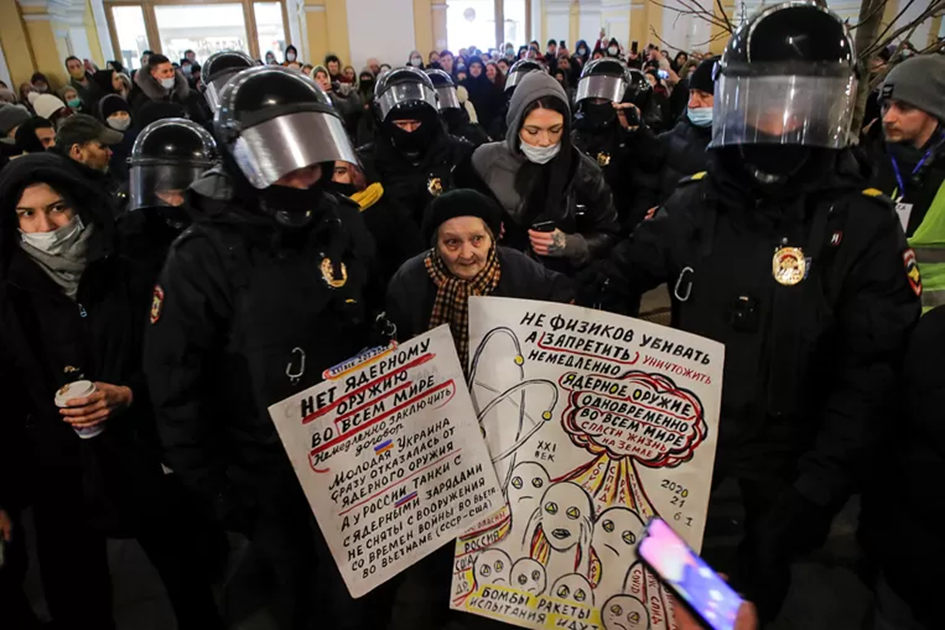
Yelena Osipova, a survivor of the siege of Leningrad detained with her anti-war placard, became a symbol of the individual who will not stay silent under repression. The author discusses the dynamics of conformity and courage through social psychology experiments.
Every day humanity witnesses a different form of violence, war, repression or lawlessness. Everyone has had their own interpretation of Russia’s attempted invasion of Ukraine, which is now on all our minds. The general reaction, however, has been: “How, in the 21st century, can anyone launch, in full view of everyone, a war so ruthless that it will cause people’s deaths?” To understand how those who hold power can dare, in full view of everyone, to speak of ballistic nuclear weapons, we need to understand people and communities.
People behave in certain patterns in certain situations. Especially in environments where repression and punishment are common, people tend to avoid this repression and punishment at all costs. The psychology experiments of Asch and Schachter show how individuals and groups, avoiding repressive and punitive power, can knowingly do what is wrong if necessary.
In Asch’s study, despite an obvious truth, many people knowingly conformed to the wrong choice under group pressure. When these individuals were asked after the study why they had behaved as they did, it emerged that most had conformed to the group so as not to be mocked or looked down on by it. These individuals assumed that the group would not accept anyone who thought differently.
In Schachter’s experiment, individuals who had not known each other before were brought together to discuss an event and reach a joint decision. Three of the researcher’s assistants were also present in the role of group members. One assistant conformed entirely to the group’s view, the second constantly opposed it, and the third first opposed the group’s view but then changed his mind and conformed. In this situation, group members were seen to communicate little with the first and to talk most with the second and third, who thought differently from them, putting pressure on them. When the third later conformed, the group pressure on him decreased, and all the pressure turned to the second person, who resisted the group’s view. When they could not persuade him, the group resorted to threats and even force. When, despite all this, that member still did not accept the group’s view, the group gave up talking to him entirely, rejected him and, ignoring him, moved to reach a decision among themselves. These studies showed that group members dislike members they perceive as different from themselves, give them difficult tasks, even bully them, and finally reject them. (Çiğdem Kağıtçıbaşı, Dünden Bugüne İnsan ve İnsanlar, Evrim Yayınevi, 2014, pp. 93-94)
In daily life, looking after their individual interests, people can remain silent in the face of lawlessness, intimidation of certain groups, repression, violence, human rights violations and even torture. In recent days more than 900 Russian citizens who staged anti-war demonstrations in Russia were detained by the police. One of the most concrete examples of the Putin government’s repression was the detention of Yelena Osipova, a 77-year-old victim of the Second World War loved by all the Russian people, who took part in anti-war demonstrations, by two police officers who held her by the arms although she could barely stand.
Because of the prison sentences and serious penalties for those who join the demonstrations, turnout at anti-war protests is very low, which leads Putin to wage the war even more ruthlessly and to the belief that he is supported by the Russian people. Looking at the reality, the opposite is true. Russians to whom microphones are held out in the streets say they feel more ashamed than ever in their lives, but they hesitate to comment further. For not only taking part in anti-war protests but also criticism of the Putin regime counts as grounds for a prison sentence. Journalists speaking to international media say that all media institutions that should inform the public and be impartial have been cowed by pressure, journalists have been fired and media outlets closed. Listeners of Echo of Moscow, one of the country’s independent and leading news stations, can now hear only static because the station has been shut down.
All this repression, intimidation and lawlessness may sound familiar to us from somewhere. The cowing of television and radio channels with fines, the imprisonment of hundreds of thousands of people, the re-imposition of life sentences on military cadets of child age despite the Court of Cassation’s reversal: all this stems from people staying silent although they know about the lawlessness, from office-holders’ fear of “losing my post”, and from individuals’ avoidance behaviour of “as long as they don’t touch me…”.
That being so, there are lessons to be drawn from the situation Russian citizens are in now, and much to learn from Yelena Osipova. What does Yelena Osipova, a 77-year-old victim of the Second World War, tell us? She says: “I saw the world war; let our children never see war again, let people not die in wars.” She believes that peace at home will bring peace in the world, and tries to achieve this by holding out olive branches to those around her.
Being a Yelena Osipova means not knowingly supporting what is wrong out of individual interest, but being able, despite repression, to say at 77 “Peace at home, peace in the world” and to defend what one believes to be right.
Monthly · free
Compass of the Month
PUGAT’s monthly newsletter.
Read next



What is PUGAT? A non-profit community publishing independent analysis from Europe on security, migration and society in Turkish, German and English.
Go to the homepage
