

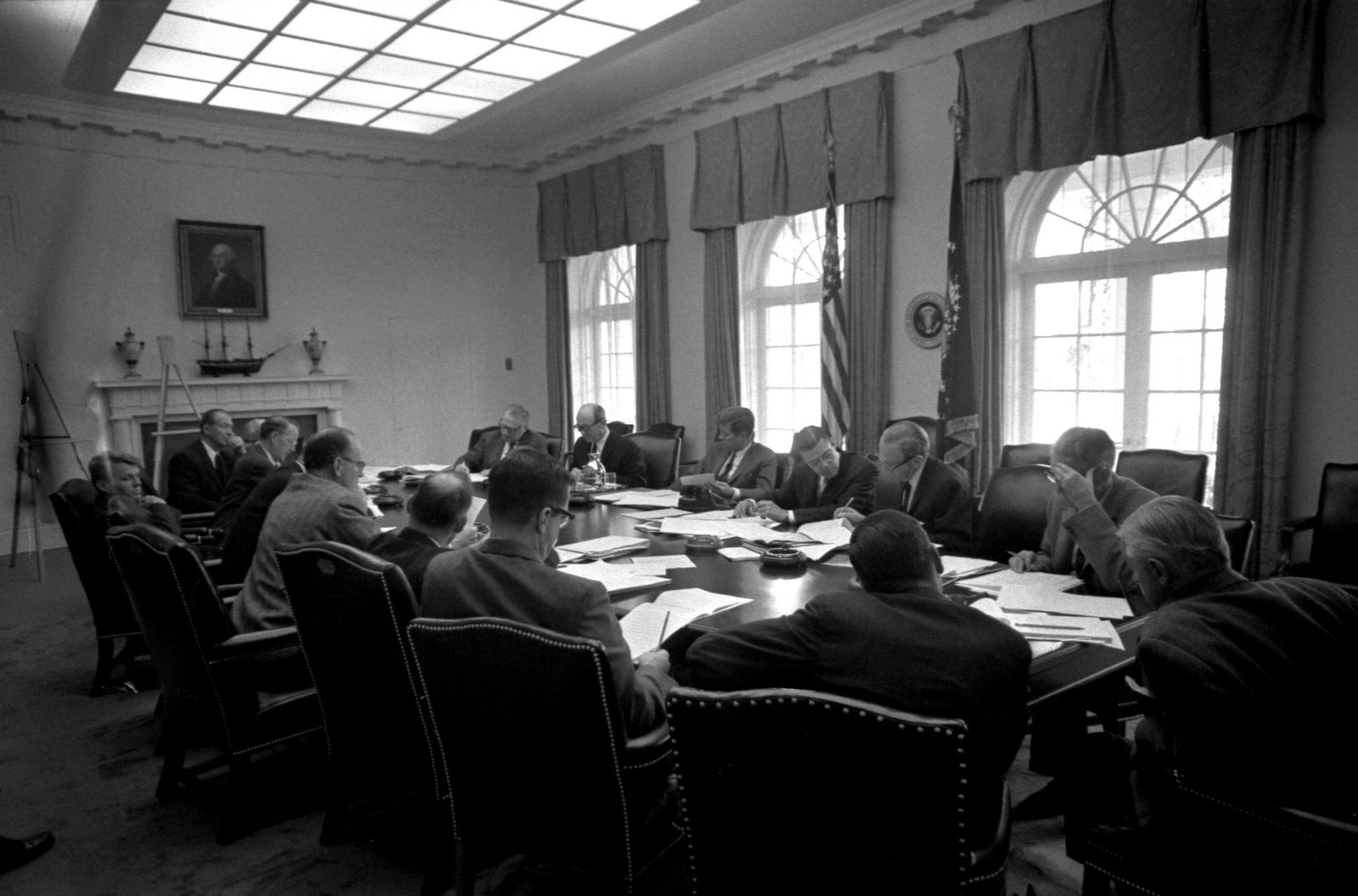
Years after the Cuban Missile Crisis, Castro said he would have allowed the missiles to be used even at the cost of his country being wiped off the map. The author argues, through the Ukraine war, that in the nuclear age leaders do not always behave rationally.
Image: Cecil Stoughton, White House / Wikimedia Commons, Public domain
Almost everyone interested in recent history knows the Cuban Missile Crisis. In short, it is the crisis that began with the US deploying nuclear-tipped missiles in Turkey and Italy and the USSR in Cuba, that brought the two superpowers of the time face to face in October 1962 and left the world under the threat of nuclear war.
Years later the leading figures of the period come together on an occasion, and former US Defence Secretary Robert McNamara asks Fidel Castro:
“If you had allowed the Russians to use the missiles in your country against the US, the US would have counter-attacked and probably wiped Cuba off the map; you knew that. Even so, would you have allowed the Russians to use these missiles?”
“Yes,” says Castro, “I would have allowed it.”
McNamara says he was very surprised, even shocked, by this answer, and that logic evidently does not always work. “Clouds over Cuba” and “The Fog of War”, productions about the period, are worth the time of those interested.

People who have worked in fields such as diplomacy, international relations and negotiation techniques are familiar with this subject. The question of why people, overcome by certain emotions, harm themselves and those around them with irrational decisions is also of interest to psychology and sociology.
Recently, in a similar vein, an interview Putin gave in 2018 resurfaced online. The subject was the use of nuclear weapons. Putin stated that he could use nuclear weapons if necessary and, regarding the possible consequences, that there was no need for a world without Russia.
Of course, this mafia-like attitude and claim of superiority based on brute force, like adolescent boys competing in strength, can still find acceptance in some countries. But in Western civilisation or the modern world, extreme nationalism, bullying, gender-based superiority, brute force and threats not only mean little but are, on the contrary, perceived negatively. That is why developed countries try to assess every kind of unexpected development and its possible consequences in advance, analyse them with realistic and rational scenarios and determine courses of action against possible developments.
Everyone knows how different nuclear weapons are from conventional weapons, their destructive effect and the terrible damage that lasts for years. In analyses made during the Cold War, whoever used nuclear weapons first, that is, threw the first punch, gained a great advantage over their opponent. Today, however, we do not know exactly what level developed states have reached in weapons technology. And imagining what would come after a possible nuclear war is beyond our powers of imagination.
In this context, the news that Putin had ordered his nuclear-capable units to a high state of readiness recently broke on the wires. If Putin gave this order, was his aim to show his determination and intimidate his adversaries, or had he played his last trump card so early because things were not going as he wished? For now we cannot know.

This situation, naturally criticised harshly by many, above all the UN and NATO, actually also signals many changes for the future. Just as many paradigms in international relations changed and many theories lost their validity after the 11 September attacks, frankly, Putin’s operation in Ukraine and his nuclear threat also have the potential to trigger many developments in the near future. How remarkable it is that after the collapse of the USSR, Ukraine ceremoniously handed over the nuclear weapons in its territory to Russia.
In this context, the “Non-Proliferation Treaty”, prepared by many countries to protect the world from nuclear catastrophe and signed by almost all countries, may be reconsidered, especially by many developed states. As is known, under this treaty only five major states (the US, the UK, Russia, China and France) have the right to possess nuclear weapons. In other words, this right is limited to countries that built a nuclear bomb before 1 January 1967.
But in international relations states sign treaties voluntarily. Except in exceptional cases, a treaty does not bind those who have not signed it. For example, Israel, Pakistan and India have not signed this treaty and continue their strategies of possessing nuclear weapons in line with their own security perceptions. North Korea signed it but later withdrew. Iran, although it signed the treaty, has had problems arising from the International Atomic Energy Agency inspections in the additional protocols and has been criticised for not being transparent on this issue and for wanting to produce nuclear weapons.
This treaty also places certain responsibilities on countries that possess nuclear weapons, such as not threatening others, cooperating with other countries in the peaceful use of nuclear power, or not selling these weapons. At this point, after Putin’s threat, what if other countries also choose to acquire nuclear weapons? What if other dictatorial regimes also enter the nuclear arms race and try to gain something from it? In short, could this situation cause a domino effect? In today’s world, thirteen countries are thought to have the enrichment or reprocessing facilities needed to produce suitable material for making nuclear weapons. In other words, if they wished and allocated resources, it would not take these countries very long to acquire nuclear weapons either.
On the other hand, current military doctrines state that the decisive result is achieved through the final ground operation. Predicting the outcome of a possible large-scale ground operation, however, is very difficult.
Many parameters are uncertain for now:
- How far will the scale of civilian casualties, the influence of international public opinion and domestic pressure in Russia be effective?
- Will the US, the UK and the EU slow the process and prefer Putin to lose power?
- Will China support Russia in the background?
- Will the US, which is not at all fond of the EU army project, prefer to remain always needed in order to increase its influence in the region?
- Is the UK in favour of a strong or a weak EU?
- What will the EU’s new energy strategy be from now on?
- Will other dictators see Putin’s possible departure as the beginning of their own end?
- With the arms support provided, how many losses can Ukraine inflict on the Russian army?
- If things go badly for Russia, will Putin attack more ruthlessly?
Frankly, we do not know the answers to all these questions; we can only speculate. We must look at every piece of information that reaches us with suspicion. Since the days of Saddam and Gaddafi we have closely witnessed how wrong those who make comments beyond their depth on TV have been and how they have made fools of themselves. But it seems that the Western world, with sanctions harsh enough to disturb the Russian people too, aims both to break Russia’s power in the international arena and to increase domestic pressure on Putin. For now this seems to be succeeding.
How Russia will explain its losses to its own people is a matter of curiosity. In short, we do not know what logical explanation will be given to the families of the young soldiers who died going to invade another country. But it seems possible that, because of economic and political losses, Russia’s military victory may turn into a “Pyrrhic victory”[i]. Finally, it is worth noting the following: everyone tries to choose, from the options before them, the one most beneficial to them, that is, the most logical one. And in the end they expect a positive result. Unfortunately, human life does not work so simply, and logical decisions do not always bring positive results. But people have no choice other than to make logical decisions. A sensible person does not knowingly and willingly incur harm. Besides, the existence of those who make irrational decisions and harm themselves and others with these decisions is a separate matter. And when these people have a say in the fate of countries, the troubles inevitably become great.
[i] Pyrrhic victory: a victory that becomes meaningless because of the losses suffered to achieve it.
Monthly · free
Compass of the Month
PUGAT’s monthly newsletter.
Read next


What is PUGAT? A non-profit community publishing independent analysis from Europe on security, migration and society in Turkish, German and English.
Go to the homepage
