

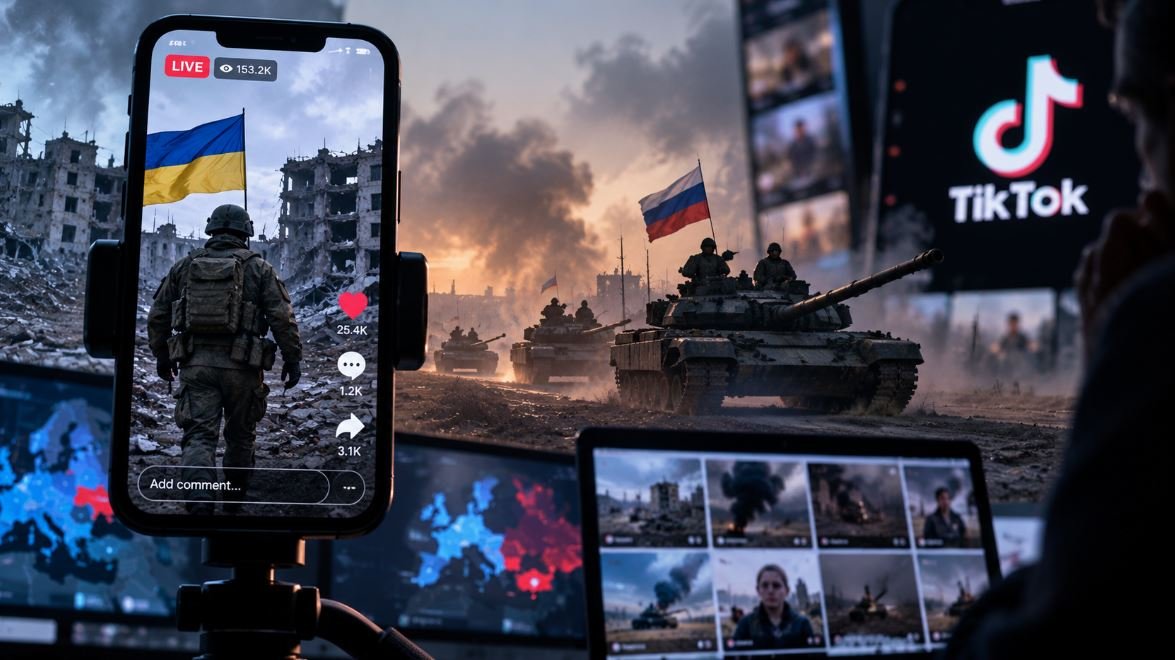
Vietnam was the first television war; Ukraine became the first TikTok war. Social media is fundamentally changing how war is seen and perceived.
The Vietnam War was the first war broadcast on television. The Gulf War, again broadcast on television, would go down in history as the “news war”. With the US invasion of Iraq, the adventure of wars on social media began to make itself felt through YouTube. From 2010 onwards, the “Arab Spring” uprisings and unrest that broke out in the Middle East would spread like an avalanche, organised especially through Facebook and Twitter. With Russia’s invasion of Ukraine, the impact of social media on war has been taken to a new dimension: “the First TikTok War”.
The Power of Social Media
Before looking at TikTok, it is worth touching on the place of the internet and social media in today’s world. According to the 2022 digital report produced by New York-based We Are Social together with Hootsuite, about 4.95 billion people (62.5%) out of the 7.91 billion living on our planet use the internet. While this figure was 1.48 billion according to 2012 data, it had increased 3.1-fold by 2022. The average daily time spent on the internet worldwide is 6 hours 58 minutes.[i]
According to the same report, 58.4% of the world’s population, or 4.62 billion people, use social media. The average daily time spent on social media worldwide is 2 hours 27 minutes, which corresponds to about 35.2% of daily internet use. [ii]
TikTok, Then and Now
Social media platforms compete with each other every day to offer users access to more data with fewer resources and less effort, and the opportunity to share more visual content. In the early days of the internet, blogs or websites were used to access information; with YouTube and Twitter this came to involve more visual content and far less effort. TikTok, the most popular app of recent times, has broken new ground in this field by providing access to information entirely through visual content and very quickly.
TikTok, or Douyin as it is known in China, offers video creation and sharing as well as live streaming and is a social media application. Launched by ByteDance in September 2016, the app became the fastest-growing application as a platform for sharing short music videos for entertainment. The app, which lets users produce short videos in musical, dance, comedy, acting and other genres, had passed the threshold of 1 billion users in 150 countries as of February 2022. After its launch in the Chinese market in 2016, TikTok began opening up to the world market from 2018 and, according to Morning Consult data, reached more than 2 billion mobile downloads worldwide in 2020 and was named the third fastest-growing brand after Zoom and Peacock.
The Invasion of Ukraine and TikTok
TikTok, which emerged as an entertainment app for sharing dance videos, is now leaving its mark on the evolution into war of a crisis the world followed live, and on the process that followed.
But how?
The answer lies in TikTok’s simplicity. This system, built on easily combining an image with a sound effect and publishing it, introduced the concepts of “ordinary citizen journalism and intelligence” into the literature in 2022. And with the ability to reach larger audiences faster, thanks to being much quicker than conventional methods.
In the days when Putin was denying questions about whether he would invade Ukraine, The Washington Post cited videos shared on TikTok as sources for its reports that Russia was about to launch a major operation.
With Russia’s invasion of Ukraine, the images TikTok users shared from the hot zones began to set the agenda. Ordinary Ukrainian citizens with no technical infrastructure were instantly sharing images of queues in supermarkets and footage from shelters on TikTok, taking the pulse of the war, so to speak. Until Russia banned access to many social media companies nationwide, the places bombed in Ukraine, the drama of the Ukrainian people who began living in shelters, the women, children and elderly forced to leave their country, and the Ukrainian citizens working with the army to defend their homeland first reached the world public via TikTok. There are of course many reasons why Ukrainian refugees have been so widely welcomed around the world, but it is also a fact that the images shared on TikTok, and the fact that the world could follow the tragic plight of innocent people in real time, played an important part in this.
For example, footage of a car driving along a street being crushed for no reason by an oncoming Russian tank would be laid before the eyes of the whole world almost a few minutes after the event. In this way, raising Ukraine’s psychological righteousness to the level of superiority was achieved within minutes, and with images shot through a citizen’s lens.
From the start of the war on 24 February to mid-March, views of posts with the #Ukraine hashtag on TikTok exceeded 30.5 billion. This figure was almost double the view counts of content on other social media platforms. TikTok’s ease of use and its algorithm play a very large part in this. The algorithm is configured so that the longer a user spends on a video on TikTok, the more often it shows similar videos, keeping the user on screen.
Although he lags behind Ukraine in the psychological war waged on social media, Vladimir Putin, too, is financing TikTok influencers and, particularly to convince the domestic public of the war’s legitimacy, having them publish posts containing claims that hundreds of Russian children and women were killed in the Donbas region over the past eight years.
The popularity TikTok enjoys among the global public is also prompting governments to take it into account in the steps they take. So much so that last March 30 TikTok influencers, including users with more than 10 million followers such as 18-year-old Ellie Zeiler, were briefed by White House officials in a special Zoom meeting. At the meeting, the importance of the messages young and popular users convey in their posts was emphasised, and the aim of shaping these in line with state policy was envisaged.
Disinformation Posts on TikTok
Besides allowing many real news stories to reach the world public instantly, some posts on TikTok are causing a considerable amount of false information to occupy the agenda and are leading to disinformation. So much so that some of this false information was accepted as true at ministerial level and shared through official channels, while many media outlets also broadcast similar fake footage to their viewers under the heading “breaking news”.
- The footage in a post claiming that a group of Ukrainian soldiers faced Russian soldiers at an air base was shot in 2014 at Belbek Air Base near Sevastopol during Russia’s annexation of Crimea,
- The footage in a post claiming that Russian soldiers were carrying out an airborne landing was footage shot in 2015 by a member of the Russian army, which spread as a video believed to have been shot in Ukraine after it was uploaded to a TikTok account on 24 February,
- The footage said to belong to the plane flown by a Ukrainian fighter pilot, nicknamed the “Ghost of Kyiv”, who was claimed to have shot down six Russian planes in one go in the first days of the invasion, came from a video game called “Digital Combat Simulator (DCS) World”, and such a pilot never actually existed,
- The footage in a post claiming that Russian warplanes were carrying out an air strike on Kharkiv came from an air show held in Russia in 2020: these are just some of the posts that platforms such as Teyit and Doğruluk Payı determined did not reflect the truth.
In conclusion, the contribution of the aid given to Ukraine, including weapons and ammunition, to the fact that Russia, with its clear superiority in technology and firepower, has not yet achieved its military goals in Ukraine is undeniable. At the same time, social media platforms, which have stood out as a tool in the propaganda waged against Russia on a global scale, have emerged as an element of power. When we consider Ukrainian President Zelensky’s effective use of social media from just before the invasion, and his attempts thereby to push Western states into open support in the eyes of their domestic publics, together with the intelligence and propaganda efforts the public has voluntarily carried out on TikTok, we can say that war today can no longer be won by military force alone and that its dimensions have become even more complex. To cut a long story short: an operation in which social media is not taken into account as a planning factor to the extent it deserves has not, mentally, been planned in this century. At least from now on, this is certain.
[i] This figure reaches about 8 hours 2 minutes for Turkey. South Africa ranks first on this list with 10 hours 46 minutes, followed by the Philippines with 10 hours 27 minutes and Brazil with 10 hours 19 minutes. On the list, where Japan ranks last in daily internet use with 4 hours 26 minutes, countries such as Denmark (5 hours 2 minutes), the Netherlands (5 hours 11 minutes), China (5 hours 15 minutes) and Germany (5 hours 22 minutes) are the other countries that spend the least time online.
[ii] Facebook holds the leading position among social media platforms with 2.91 billion active users. YouTube follows with 2.56 billion and WhatsApp with 2 billion. TikTok, for now, ranks sixth, after Instagram and WeChat. However, considering that 71% of users have turned to TikTok only in the last three months, a change in this ranking in the near future would, it appears, come as no surprise.
Monthly · free
Compass of the Month
PUGAT’s monthly newsletter.
Read next



What is PUGAT? A non-profit community publishing independent analysis from Europe on security, migration and society in Turkish, German and English.
Go to the homepage
