

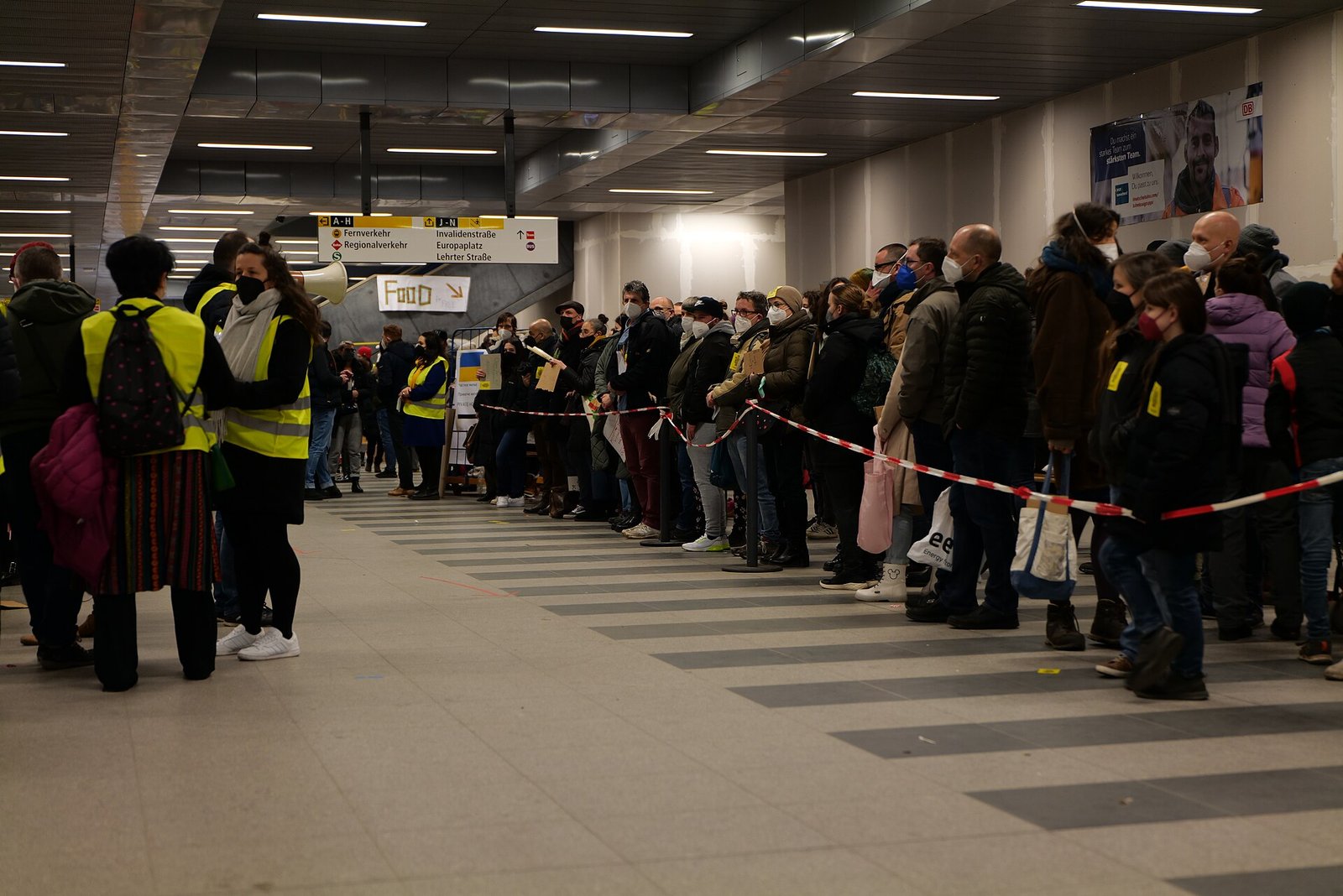
More than a million people fleeing the war in Ukraine have sought refuge in Germany. But the support provided and arbitrary administrative practices have sparked debate over unequal treatment compared with other migrant groups.
In their first years, migrants and refugees are full of gratitude and thankfulness towards the country they have come to. As time passes, in some people these feelings can give way to expectations of more and to a dissatisfaction we might call “turning up one’s nose”. Part of the reason is that not everyone has the same opportunities. The support the state offers varies from region to region, and the broad discretionary powers given to officials are interpreted differently, which creates unease among those who have been through the same experiences and suffered the same hardships as other migrants.

About nine months have passed since Russia launched its attempted invasion of Ukraine. The fighting is not as fierce or intense as in the first period, but people are still fleeing the region and migration continues. Together with some other European countries, above all Poland, Germany has taken in a large share of the refugees from Ukraine. According to official records, more than 1 million people are known to have come to Germany so far. Given Germany’s migration policies, the number of unregistered migrants is unlikely to be high. Probably everyone has applied officially except those known to have been involved in crime in Ukraine or those inclined to crime.
A Win-Win Relationship or a Sign of Humanitarian Sensitivity?
It would not be right to view Germany’s refugee policy from an entirely optimistic perspective. Instead, I think it is no exaggeration to say that it has shaped this policy with an understandably pragmatic approach, alongside a humanitarian reflex and the principles of international law. In Germany, whose population is ageing and whose working-age population is at risk of shrinking in the long term, the IAB, the research institute of the Federal Employment Agency, estimates that net immigration of around 400,000 people a year is needed to maintain the labour supply. Since a large part of this demand is for lower-level jobs, the qualifications of incoming migrants do not matter much.
While we are on the subject, it should also be said that Germany is one of the rare countries where migrants feel “human” again, especially when compared with how they are treated in the countries they have to pass through on their journey. It is also a fact that the vast majority of the German people approach migrants with empathy and goodwill. You can see that the majority has drawn the right lessons from the past. Having stressed that the German government supports migrants and tries to integrate them into social life, even at the cost of confronting its own citizens when necessary, we can begin the part of our article about Ukrainian refugees.
Before that I should point out that, of course, Ukrainians are not the only ones who have experienced and are experiencing the difficulties I will describe. From events I have witnessed myself, I know that there are people who have lived through much harder conditions. I will try to examine some possible situations in the specific case of Ukraine and draw general conclusions from them. In fact the problems I will write about are ones that all migrants experience or are likely to experience. I simply think it is better to tell the story through Ukrainian refugees, since they have recently been the most numerous group in this situation.
The Unchanging Fate of Migrants: Psychological Trauma
Ukrainians who have seen the deadly face of war and been driven from their homeland have been warmly welcomed and given preferential treatment in the countries they have reached, but they will also face difficulties. Drawing on past experience, I think it is useful to note some of the problems they are likely to encounter.
Ukrainian refugees set out on an exhausting journey at a time they did not expect, feeling the chill of death to the marrow of their bones, leaving their homeland and homes behind with whatever belongings they could carry. They are going through a hard period that tests the limits of the human psyche. Many have lost relatives, acquaintances and loved ones. Just as people exposed to such hardships should not be expected to behave normally, they should not be treated as if nothing had happened to them either. I believe it is essential that these people receive professional support to recover from the traumas they have experienced before they are integrated into society.
People who obeyed the rules and fulfilled their civic duties in their lives before the war may break the rules, cause trouble or become involved in crime in the country they come to. This may stem from trauma or from not having been subjected to the necessary checks.
While migrants and asylum seekers coming to Germany undergo different identity, background and security checks depending on the type of application, there are claims that the checks applied to Ukrainian refugees have been inadequate. It is essential to determine whether there are individuals or groups with a problematic criminal past among the migrants. Let me explain with a simple example: a Syrian official known, from the statements of Syrian refugees who came to Germany in recent years, to have committed torture and ill-treatment had also come as a refugee, was identified through witness testimony and was put on trial.
In Germany, the work obligations of refugees and migrants and state support for rent, heating and living costs vary according to their legal status and need; those without sufficient language skills are usually directed first to language and integration courses. However, some people who think they are being clever try to earn extra income through undeclared work. This is not only a crime under the law but also morally wrong. I would also like to point out that tax evasion in Germany is a very severely punished crime. I believe no one has the right to tarnish the society, nation and faith they belong to for the sake of earning a little more money.
Because of the “special treatment”, Ukrainian refugees may face reactions and hostile behaviour from migrants who came earlier. Both sides need to show good sense here. The social problems Ukrainians will face in Germany may not be limited to other migrants. There are millions of Russian citizens and Germans of Russian origin in Germany. Just like the Turks living here, Russians have strong nationalist feelings, and a significant number of them are pro-Putin. Some friction is likely, even if not on a large scale. Attention should also be paid to intelligence gathering, surveillance and the compilation of dossiers on individuals. There were reports that refugees from Turkey had been harassed and followed by some people of Turkish origin settled in Germany, who also compiled dossiers on them.
It is common knowledge that Ukrainian refugees coming to Germany have been treated better than other migrants and enjoy positive discrimination. You may attribute this to the fact that Ukrainians are also European, that they share the same religion or that the country they face is Russia. Of course this double standard cannot be considered right, but we should ask ourselves how we would act in a similar situation. And let us not forget that, even if there is privilege in the welcome and the initial treatment, what comes afterwards is shaped by the migrants’ own behaviour. In a nutshell: people are welcomed for their clothes, honoured for their knowledge and sent off for their character…
The Responsibilities of a Welfare State
Apart from those mentioned, there may also be problems with finding housing and kindergarten places, practising one’s profession, language gaps and certain cultural and religious issues, but we should not overlook that many German citizens also suffer from these situations.
Another important point that should not be forgotten is this: in Germany you can see a welfare state trying with all its might to support those living in the country. The state’s resources are mobilised to provide similar opportunities to everyone living in society. It is enough to recall the aid and support that the state, borrowing when necessary, gave to low-income citizens, migrants and refugees during the pandemic and the gas crisis alone. Given the figures, I think one should be optimistic about a country that registers close to 1 million migrants and refugees a year. Even though there are millions of people who have not yet attained the opportunities they deserve and a minimum standard of living, I hope and expect that, with effort and goodwill, this will be resolved as soon as possible.
You can witness that everyone who works conscientiously and integrates into society is rewarded for their efforts and is able to reach their goals. I suppose this is where the strength of being a great state comes from. Refugees and migrants of course have rights guaranteed by international agreements. We know that the UN and the EU give substantial funds and support to countries hosting migrants. Yet despite the substantial international funding Turkey and Greece receive for programmes supporting migrants and refugees, there is a chasm between the opportunities offered there and the conditions offered by Germany and some other countries. Whatever the reason they came, people must repay the opportunities and environment offered to them with loyalty and dedicated work. This society, which embraces and sincerely helps people of other religions, races and cultures, deserves it.
Monthly · free
Compass of the Month
PUGAT’s monthly newsletter.
Read next
What is PUGAT? A non-profit community publishing independent analysis from Europe on security, migration and society in Turkish, German and English.
Go to the homepage
