

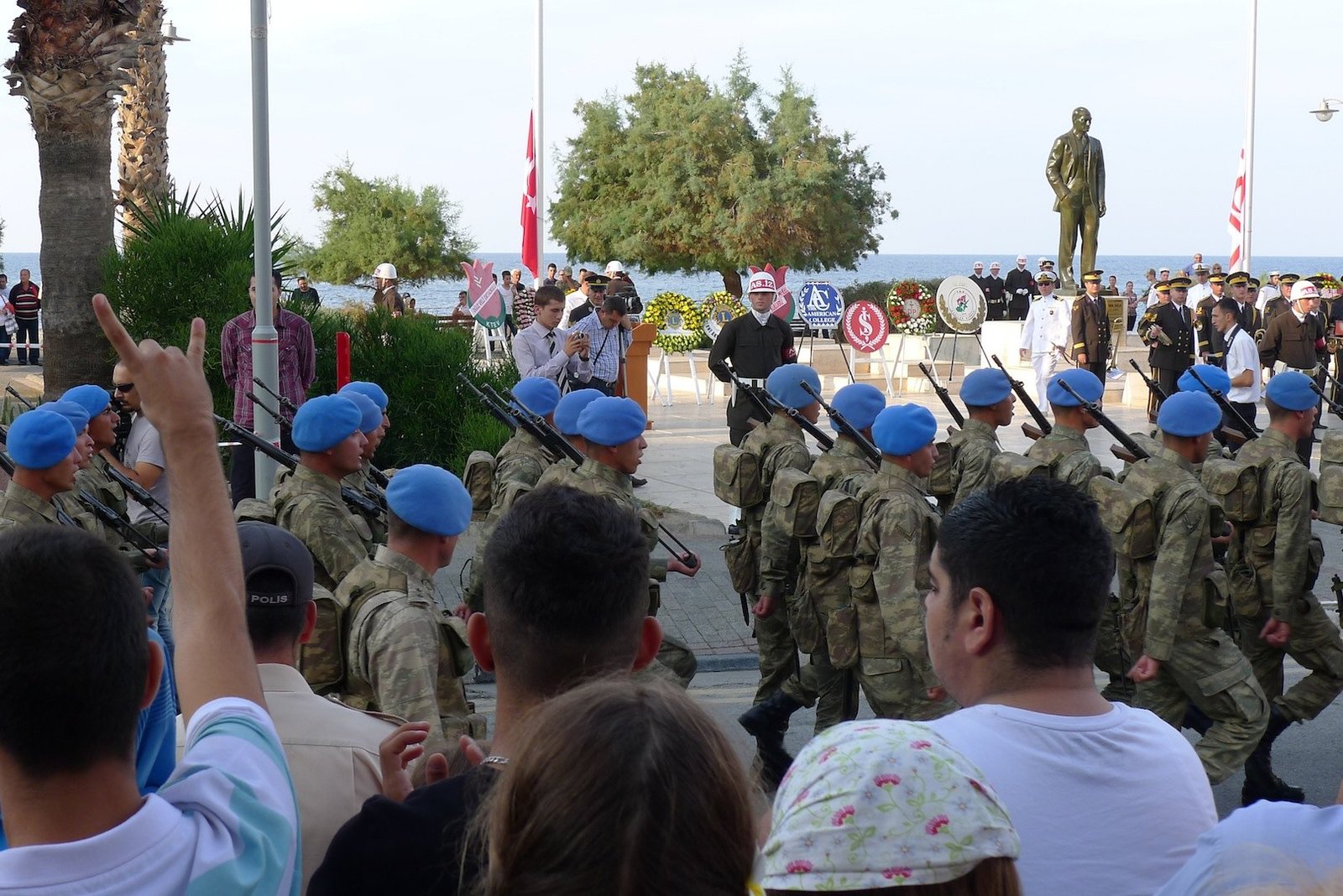
In 2021 the European Parliament called for a ban on the Ülkücü movement in EU countries to be examined. The fourth part of the Ülkücü series looks at the stance in Europe and the US.
Image: Ansgar Bovet / Wikimedia Commons, CC BY 3.0
A Hint of “Ülkücüs Are Terrorists” in the European Parliament’s (EP) Türkiye Report
In its 2019–2020 Türkiye report, adopted at the EP plenary on 19 May 2021 by 480 votes to 64, the European Parliament asked the European Union (EU) to examine a ban on the Ülkücü movement in EU countries. The report stated that the Ülkücü movement, described as “racist and far-right”, “is spreading alarmingly not only in Türkiye but also in EU member states”.
The movement, whose closeness to the MHP was stressed and for which an examination was requested into “adding it to the EU list of terrorist organisations” and banning its organisation within the EU, was said to “pose a threat especially to people of Kurdish, Armenian or Greek origin and to anyone they consider an opponent”.
The Grey Wolf Sign Banned in Austria
In Austria, the symbols law adopted by parliament in December 2018 completed the legislative process and entered into force on 1 March 2019. The symbols law, introduced in 2015 to prevent the propaganda of terrorist organisations such as ISIS and al-Qaeda, was expanded to include the symbols and signs of groups such as the Muslim Brotherhood, HAMAS, the military wing of Lebanon’s Hezbollah, the terrorist organisation PKK and the Croatian nationalist Ustaša.
Under the law, which also bans symbols of the ülkücüs such as the Grey Wolf sign and the crescent, those who violate it can be fined up to 4,000 euros or jailed for one month. Repeat offences carry a fine of 10,000 euros or six weeks in prison.
All Activities of the Grey Wolves Banned in France
In France, although they had not formed an official organisation under the name Grey Wolves, all activities of the ülkücüs were banned by a Council of Ministers decision in 2020 on the grounds that they were an “ultranationalist” and “paramilitary” movement. The decision was based on French law and on the provision banning “armed street demonstrations that provoke hatred, discrimination and violence against a person or group because of their origin or because of their belonging or not belonging to an ethnic group”.
In 2020, in the cities of Vienne and Lyon in France, ülkücüs who attacked Armenians and the Armenian Genocide Memorial then tried to march, with cries of tekbir, into neighbourhoods where Armenians live in large numbers in and around the city, and were met by police intervention. Footage from the events in Lyon, in which ülkücüs spray-painted “RTE”, the initials of Turkish President Erdoğan, and “Loups Gris” (Grey Wolves) on walls, was long debated by the French public.
Political scientist and Turkologist Elise Massicard, stressing that although it is a youth association linked to the MHP it also includes AKP members, describes the Grey Wolves as follows: “When there is dirty work to be done in Europe or intimidation is needed, they come to the fore.”
It is also said that the posts of Grey Wolves member Ahmet Çetin, who called on social media for attacks on the Armenian community, were influential in the ban decision in the country. In a live broadcast on his Instagram account in August 2020, Ahmet Çetin said: “Let the Turkish government give me 2,000 euros a month and a gun, and I will do what is necessary anywhere in France.” After the post, legal action was taken against Ahmet Çetin, who was sentenced to four months’ suspended imprisonment and a fine of 1,000 euros for “incitement to violence or racial hatred”. The Bourg-en-Bresse court also suspended Çetin’s right to stand for election for five years.
A Terrorism Examination of the Grey Wolves in the US
The “ülkücü threat”, long high on the agenda in Europe, has recently been opened for debate in the US too. The 2022 US National Defense Authorization Act, including the motion prepared by Nevada Representative Dina Titus of the House Rules Committee on the Grey Wolves on “examining whether they are a terrorist organisation”, was passed by the House of Representatives.
The report submitted by Dina Titus asks the US State Department to submit to Congress within 180 days “a detailed account of the activities of the Grey Wolves, also known as the Ülkü Ocakları, against the interests of the US, its allies and international partners; an assessment to determine whether they meet the criteria of a foreign terrorist organisation; and, if they are concluded not to be a foreign terrorist organisation, a detailed explanation of which criteria they did not meet”.
What Do Terrorism Investigations and Decisions Against the Ülkücüs Herald?
Although the influence of the Ülkücü movement in the US is not as great as in European countries, we can say that the heightened sensitivity in the US after the 9/11 attacks towards radical religiously motivated terrorist organisations and radical immigrant structures, at a time when the US has been forced to prefer more rigid policies in terms of internal security, has channelled it into also seeing the ülkücüs as a threat.
Moreover, with Türkiye–US relations periodically becoming tense, the US’s new stance towards Türkiye can also be seen openly behind this move. This move can also be seen as a kind of initiative against the AKP following an even more nationalist course in its alliance with the MHP.
Above all, the situation of the ülkücüs, against whom a “terrorist organisation” examination has also been launched in the US, partly because of their activities in Türkiye from a historical perspective and then factors such as endangering public safety owing to the climate of fear they created in Europe, actually gives us important clues about the treatment today’s powerful will face in the near future.
Labelling the Turkish government’s unofficial “paramilitary” forces as “terrorist” in the US and Europe, or legally banning their activities, can also be interpreted as the footsteps of fundamental changes that will occur in the Turkish political spectrum in the near future.
Let us examine the stance taken towards the ülkücüs in the Middle East and Central Asia in a separate article.
Monthly · free
Compass of the Month
PUGAT’s monthly newsletter.
Read next
Grey Wolves in a Region Where They Have Officially Been Deemed “Terrorists” for a Quarter Century (The Ülkücü Movement, Part 5)
The Framework Law (2): Will It Contribute to Social Peace?

The Framework Law (1): Deferral for the Armed, Punishment for the Unarmed Opposition
What is PUGAT? A non-profit community publishing independent analysis from Europe on security, migration and society in Turkish, German and English.
Go to the homepage
