

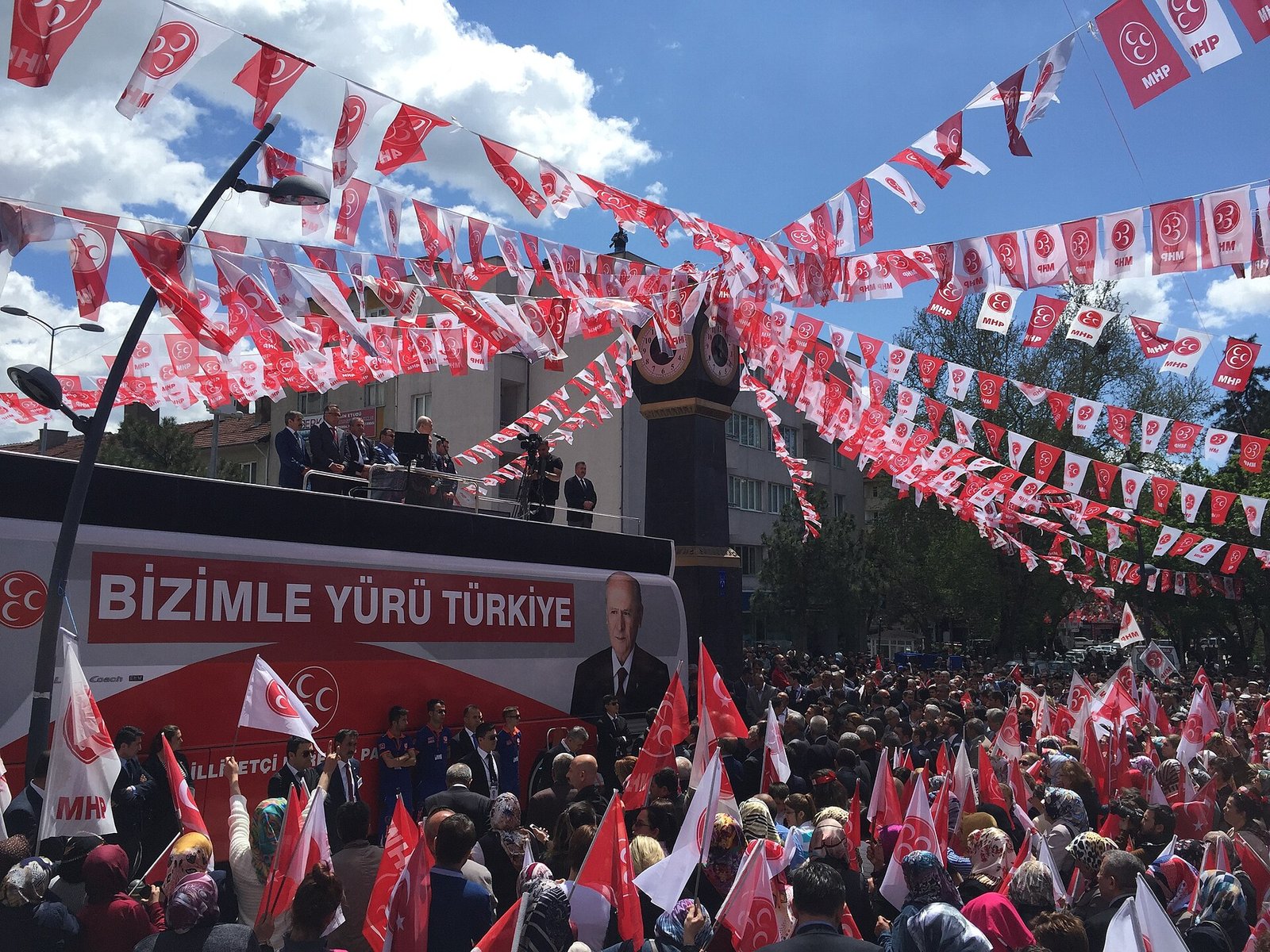
They were banned in Austria and France, the European Parliament raised the idea of a terror listing, and the US Congress called for an inquiry. Why does the world fear the Ülkücüs? The first part of the Ülkücü series.
First their activities were banned in Austria and France, then the idea of “adding them to the European Union (EU) list of terrorist organisations” was brought to the European Parliament (EP), and finally the US House of Representatives passed a bill calling for an “investigation into whether they are a terrorist organisation”…
I am speaking, of course, of the Ülkücüs, also known as the Grey Wolves, who are known in Turkey for their closeness to the government partner, the Nationalist Movement Party (MHP), and whose name has lately been mentioned alongside “terrorist organisation lists” amid growing sensitivity to the far right in Europe and around the world…
In this study, we will try to find answers to questions such as why the world fears the Ülkücüs, and whether it was a political concern or justified fears with solid foundations that triggered these serious steps, by looking at the Ülkücüs’ actions and activities in Turkey, Europe and the US, the Middle East and Central Asia.
Please, go ahead…
The Ülkücüs in Turkey and Dark Events Still Awaiting Light
Although the chronological development of the Ülkücü movement is not the subject of this article, it is said that the Ülkü Ocakları, or Grey Wolves, founded by Alparslan Türkeş in the 1960s, clashed with left-wing organisations in the 1970s and led, or themselves pulled the trigger in, the killing of hundreds of people in many mass events such as the Maraş, Bahçelievler and Taksim massacres.
Although the perpetrators implicated in some of these events were caught, thanks to their influence within the state they were either allowed to escape or were released one way or another as the laws were amended over time to suit them. From these events, we have compiled for you some of those which, through their consequences, dragged the country into turmoil and military rule or left a mark on our recent history and have still not been fully brought to light, “with a focus on the roles the Ülkücüs played”.
How Did the Number One Ülkücü Defendant in the Maraş Massacre Become an MP?
Let us recall the attacks on Alevi citizens in Kahramanmaraş on 19-26 December 1978. In this period, when Alevi-Sunni tension was rising, or “being stoked”, events escalated after Ülkücüs first threw an explosive during a film screening at a cinema and, the next day, carried out a bomb attack on a coffee house, followed by the killing of two left-wing Alevi teachers.
In these events, in which the request of then Governor Tahsin Soylu for troops to be sent to the city was turned down and the massacre was all but allowed to happen, 120 innocent people were killed according to some sources, 150 according to others. More than 200 homes belonging to our Alevi citizens were burned. Nearly 100 workplaces were destroyed.
What happened after this event, which led Turkey to the 12 September coup and helped “the conditions to ripen”? The cases opened in martial law courts lasted until 1991, and a total of 804 people, mostly described as right-wing and far-right, were tried. All three of the massacre’s intervening lawyers were killed after successive attacks. After the trials, 29 defendants were sentenced to death, 7 to life imprisonment and 321 to prison terms of between 1 and 24 years.
Initially, the sentences of the defendants other than those sentenced to death or life imprisonment were reduced by one sixth. With the Anti-Terror Law passed in 1991, the sentences of many of the convicted were suspended and they were later released. Ökkeş Kenger (who later changed his surname to Şendiller), the number one defendant in the case, accused of being the perpetrator of the bombing of the cinema that lit the fuse of the events and one of the leading Ülkücüs of the time, was acquitted. And in the end, Ökkeş Kenger (Ökkeş Şendiller) was elected MP for Kahramanmaraş from the Welfare Party in 1991.
In the report he prepared on the Kahramanmaraş massacre, the then Interior Minister İrfan Özaydınlı, who would later resign, had said that the planners of these events “were found to have come to the city in the guise of 26 itinerant lottery vendors”. Interior Minister Özaydınlı’s report stated that Ülkücüs such as Ünal Osmanağaoğlu, Haluk Kırcı, Mustafa Özmen, Bünyamin Adanalı and Ahmet Ercüment Gedikli, whose names would years later also be linked to the Susurluk scandal, were in Kahramanmaraş during the days of the massacre.
The Bahçelievler Massacre:
Ülkücüs Sentenced to Death Seven Times Each and Released Under a Judicial Package
On 8 October 1978 in Bahçelievler, seven left-wing university students were murdered by the Ülkücüs Haluk Kırcı, Ünal Osmanağaoğlu, Bünyamin Adanalı, Ercüment Gedikli, Mahmut Korkmaz and Kadri Kürşat Poyraz, led by Abdullah Çatlı, five of them in the flat where they were staying and two shot by the side of the Eskişehir road.
With this action by the Ülkücüs, Turkey was brought one step closer to the 12 September coup. The fates of the perpetrators were as follows:
Abdullah Çatlı: Never caught. Died in the Susurluk crash in 1996.
Haluk Kırcı: Sentenced to death seven times. Escaped from police custody on the day of his capture in 1996. Recaptured in 1999. Released on 18 March 2004. Caught in Ukraine in October 2004. Released again on 27 May 2010. Arrested again on 8 February 2011 and released on 4 February 2015.
Ünal Osmanağaoğlu and Bünyamin Adanalı: Caught in 1999 and sentenced to death seven times. Released on 10 July 2012 under the legal reform known as the “3rd Judicial Package”.
Ercüment Gedikli: Caught in 1980. His death sentence was commuted to life imprisonment, and he was released under the 1991 amnesty.
Osman Engin: Caught in Adana on 15 April 2013.
Mahmut Korkmaz and Kadri Kürşat Poyraz: Never caught.
(In the next part we will discuss Uğur Mumcu, Turgut Özal and other actions with an Ülkücü motif in Turkey)
Monthly · free
Compass of the Month
PUGAT’s monthly newsletter.
Read next
What is PUGAT? A non-profit community publishing independent analysis from Europe on security, migration and society in Turkish, German and English.
Go to the homepage
