

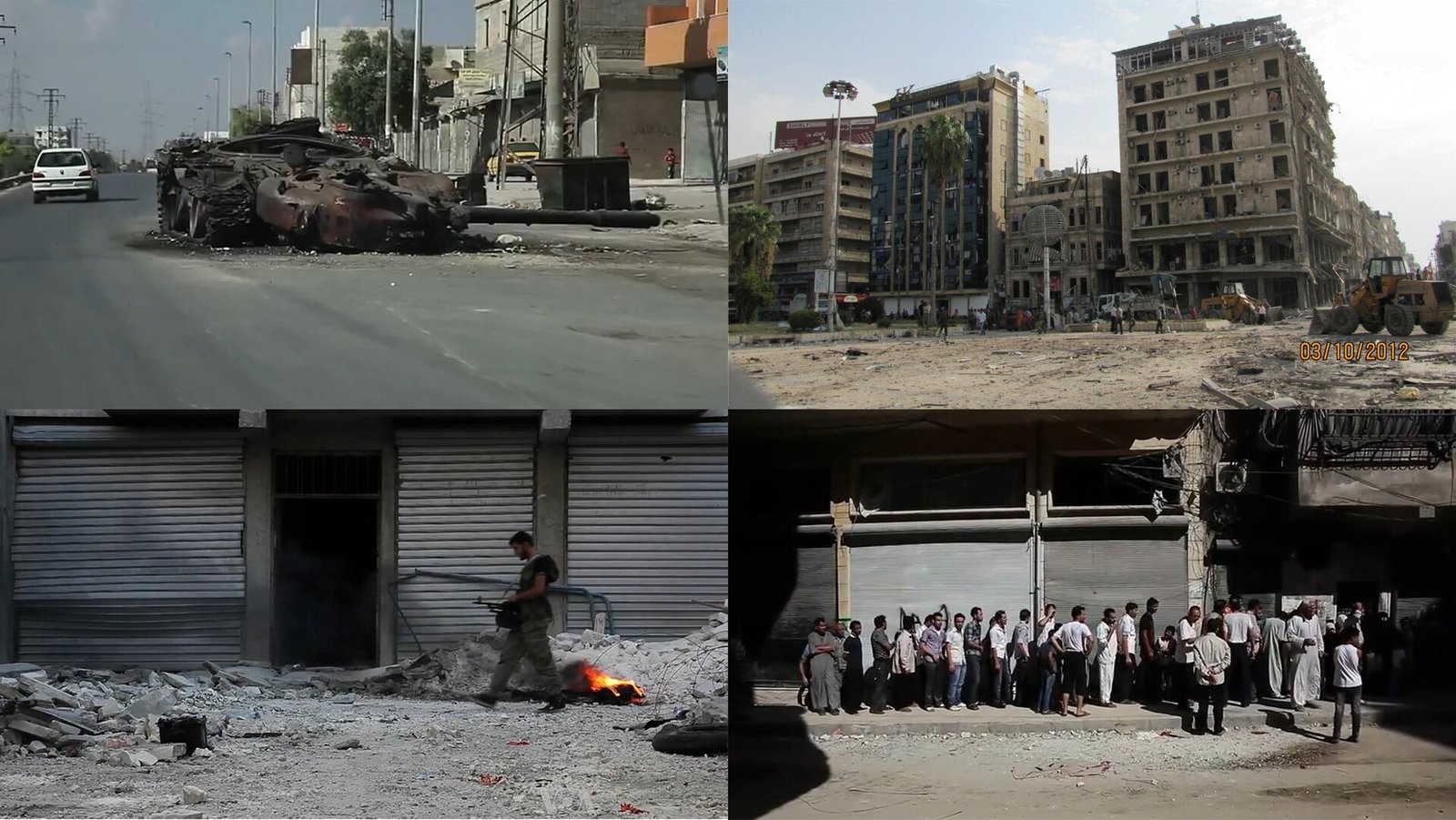
With the Arab Spring reaching Syria, Turkish–Syrian relations broke down. The years 2011–2022 were a period in which Turkey became isolated in the region.
– Turkey’s Syria Policy –
The AKP’s foreign policy towards the Middle East, and Turkish–Syrian relations on that basis, can be considered in two periods: before and after 2011. In its first years in power the AKP presented the West with a conservative, democratic profile that respected human rights and did not reject the EU’s values as framed by the 1993 Copenhagen Criteria. At the same time, however, it foregrounded its Muslim identity and tried to develop a model of relations with Muslim countries built on shared faith. How unsuccessful this model was became clear later, as the Arab countries in question, Syria first among them, broke off relations one after another.

Antipathy Towards Turkey
The Ottoman-heir poses that the AKP struck, mainly for a domestic audience, found a certain resonance in Arab societies too. Arab heads of state, however, were far less taken with them. The AKP regime’s web of contradictory relations on two or more levels, its unprincipled stance built on personal interests and its hollow, bombastic rhetoric deepened the antipathy felt towards Turkey.
The “Arab Spring”, which began in 2010, made itself felt in Syria just as it had in other autocratic Arab regimes. Anti-government demonstrations began on 26 January 2011. On 15 March the protests spread across the country and began to threaten Assad. The clashes between the Assad regime and the Syrian opposition, which with the support of Western countries took the form of an organised coalition, rapidly intensified. Uprisings that had begun with the people’s demands for reform turned into civil resistance because the government chose to suppress them by force.

Turkey’s first statement on the developments in Syria was issued by the Foreign Ministry on 25 March 2011. It said that events were worrying, but that Turkey supported the steps taken and promises made by the Assad government on reform, and that the necessary help would be provided for reform in this process.
Fidan and Davutoğlu in Syria
By sending figures such as Foreign Minister Ahmet Davutoğlu and Hakan Fidan, the AKP regime conveyed to the Syrian leadership the message that Turkey could help Syria in the reform process. While the violence in Syria initially drew condemnation from the West and the US, the AKP regime by contrast pursued a more cautious policy. It is hard not to think that Erdoğan’s financial ties with Syria also played a role in this approach. For in the days when protests were starting in Syria (6 February 2011), Erdoğan was laying the foundation stone of the Asi (Orontes) “Friendship Dam”, a joint project planned with Syria. The same day he went to Aleppo to see “brother Assad” and said that Assad should learn from what had happened in Egypt and Tunisia and speed up reforms.

Erdoğan: “Bashar is my close friend”
In May, in an interview with the American Charlie Rose Show, Erdoğan was saying: “Bashar is my close friend. He has been late in taking the necessary steps, but it is still too early to call on him to step down.” At that time Erdoğan was sending the message that Turkey’s weight in the “Alliance of Civilisations” was growing by the day, that the idea had not been welcomed at first but the US now supported it too, and that Turkey, with its weight in international diplomacy, had become a country that sets the agenda. He even stated that they regarded Syria “not as foreign policy” but as a domestic matter for Turkey.
However, 3,000 Syrians fleeing the June 2011 Jisr al-Shughur operation, launched by the Assad government against the opposition, took refuge in Turkey. After this Erdoğan declared, “What Syria is doing is unacceptable, this is savagery,” and warned Syria against a second Hama massacre. The first response from Syria in this period came from Foreign Minister Walid Muallem. He asked Turkey to help with the return of the Syrians who had fled to Turkey and to reconsider its position. At the same meeting Muallem also said that they took lessons from no one and that, once the reforms were carried out, they would be the ones giving others lessons in democracy.
With the start of mutual criticism, a new period of tension began between the two countries. The fighting on the Syrian side of the border and the ensuing movement of refugees led Turkey to review its military presence on the border.
The “Istanbul for Syria” Meeting
In July Syrian opposition figures met in Istanbul for the “Istanbul for Syria” meeting and elected a 25-member National Salvation Council. While Turkey continued to call on the Assad government to reform, it allowed the opposition to organise in Turkey, even though it had not formally established contact with it.
On 9 August Foreign Minister Ahmet Davutoğlu travelled to Syria to convey the Turkish side’s wishes and demands to the Assad government. Conveying the message that there should be no delay in democratisation and the implementation of reforms, Davutoğlu also indicated that Assad’s time was limited.
The Syrian leadership was not at all pleased with this visit, and relations between the two countries broke down as Turkey began to play a greater role in organising the Syrian opposition and as the Syrian National Council was announced in Istanbul on 15 September 2011. After meeting Obama, Erdoğan announced that he had cut off talks with Syria and that they would begin work on sanctions.
Turkey Hosts the Syrian Opposition
From then on the Turkish side argued that regime and structural change were needed in Syria and called on Assad to step down, warning that otherwise he would be swept away. Turkey sharply raised the dose of its criticism of the Syrian leadership and made harsh accusations. With Davutoğlu’s direct meetings with Syrian opposition figures and the opening of an official office in Istanbul by the Syrian National Council (SNC), relations between Turkey and the Syrian opposition became official.
While Turkey’s support for the Syrian opposition was being discussed, it also emerged that Lieutenant Colonel Hussein Harmoush, the founder of the Free Officers Movement who had taken refuge in Turkey, had been abducted from a camp on the border and handed over to Syria, and it was later reported that he had been killed by the regime. The Turkish Foreign Ministry, however, denied this account in a statement.
Under an agreement with the Arab League to start a political dialogue and end the violence, the Syrian government had promised to withdraw its tanks and troops from the cities, release political prisoners and give journalists freedom. Contrary to these promises, however, it continued the massacres. On 12 November 2011 the Arab League suspended Syria’s membership on the grounds that Syrian security forces had not stopped using violence against opposition demonstrators, and on 27 November it decided on a series of political and economic sanctions against Syria. Turkey showed its support for these decisions in an official statement. After this statement, supporters of the Assad regime in Syria attacked foreign diplomatic missions, including Turkey’s.
A Nine-Point Sanctions Package from Turkey to Syria
After the Arab League’s sanctions decision against Syria, Davutoğlu announced the sanctions to be imposed on Syria at a press conference in Ankara. In the nine-point sanctions package, the item stating that the transfer of weapons and military equipment from third countries to Syria via Turkish territory, airspace and territorial waters would be prevented in line with international law stood out. For in an audio recording leaked to the press on 27 March 2014, at a meeting attended by Foreign Minister Davutoğlu, Ministry Undersecretary Feridun Sinirlioğlu, Deputy Chief of the General Staff General Yaşar Güler and MİT Undersecretary Hakan Fidan to discuss what should be done in the event of an attack on the Tomb of Süleyman Shah, Fidan said: “We have sent nearly 2,000 trucks there.” The AKP regime’s disregard even for the rules it had set itself would once again expose the inconsistency of its diplomacy.
By 2012, following its economic and diplomatic sanctions, Turkey chose increasing international pressure as its main strategy against Syria. While Turkey argued that the UN should take a more active role in the face of the massacres in Syria, which grew in intensity every day, problems arose in its relations with countries supporting the Syrian regime, such as China, Russia and Iran. The failure of the UN Security Council to adopt a resolution against Syria, because of Russian and Chinese vetoes, caused disappointment in Turkey.
At a press conference in Paris, SNC President Burhan Ghalioun said that a military bureau would be set up to supply weapons from foreign countries to the opposition inside the country and that its headquarters would most likely be in Turkey. Russia and Iran then began to claim that Turkey was arming the opposition in Syria.
Iran: A Meeting of Syria’s Enemies
At the Friends of the Syrian People Group meeting held in Istanbul on 1 April 2012, it was declared that the Syrian regime had lost its legitimacy and that the SNC was a legitimate representative and interlocutor of all Syrians. Before this meeting the Turkish Foreign Ministry stated its support for the Syrian opposition. When Iranian Parliament Speaker Ali Larijani described the meeting as a gathering of Syria’s enemies and called Turkey a subcontractor of imperialism, a minor crisis with Iran followed as well.

After the Houla massacre of 25 May 2012, carried out by Assad’s forces, in which 108 people were killed and 300 wounded, the Turkish Foreign Ministry described the operation as “despicable” and announced that the Syrian diplomats still in Turkey were being expelled.
Turkish F-4 Fighter Jet Shot Down by Syria
In this period of mutual diplomatic salvos, the downing of an unarmed Turkish F-4 fighter jet by Syria on 22 June 2012 started a new crisis between the two countries. Syria said it had not realised the aircraft was Turkish and had merely exercised its legitimate sovereign rights against an “unidentified” aircraft violating its airspace. Turkey, while accepting that the plane had briefly entered Syrian airspace, maintained that it was shot down in international airspace. Describing Syria as a rogue state, Erdoğan stated that Turkey’s perception of Syria had changed and that the Assad regime had now become a threat to Turkey. After this incident Turkey revised its rules of engagement and announced that any military element approaching the border from Syria would be regarded as a threat and a target. Turkey requested a NATO meeting under Article 4 (for cases where a member’s security is threatened) and sought international military support.
Is there a connection between this incident, in which two pilots lost their lives, and Fidan’s remark “I will send four men across and have them fire eight missiles” in the audio recording of a Foreign Ministry meeting leaked to the press in March 2014?
Was it an attempt to produce a “casus belli” as part of the AKP regime’s persistent efforts to enter Syria? Perhaps one day these questions too will find their answers.
(To be continued)
Monthly · free
Compass of the Month
Once a month: five points from Europe’s security and migration agenda and the month’s PUGAT articles, in your inbox.
Newsletter sign-up opens soon.
Read next
What is PUGAT? A non-profit community publishing independent analysis from Europe on security, migration and society in Turkish, German and English.
Go to the homepage
