

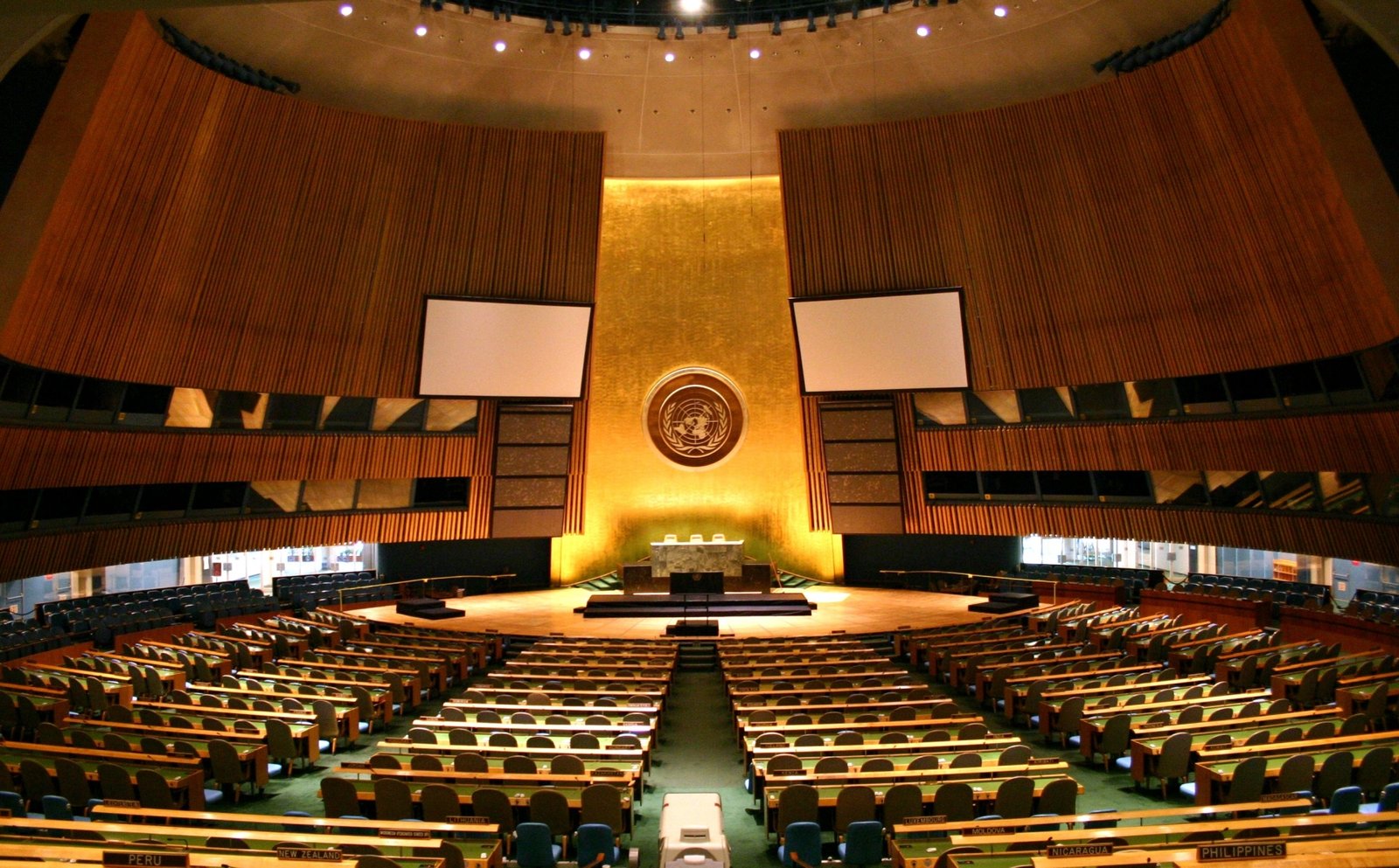
Europe faces its largest conventional war since the Second World War. The article discusses whether UN and NATO intervention against Russia is legally and militarily possible.
“I never thought something like this could really happen. I am a director, a teacher. We studied history, but we never thought this could happen on our soil.” These words belong to the teacher Olena Kurilo, whose bloodied photograph was carried by the world press after Russia’s attack on Ukraine.
Almost no one, in Ukraine or in other countries, expected Putin to launch such a military operation. But on 24 February 2022 the world woke to missile strikes launched by Putin’s Russia across Ukraine, including near the capital Kyiv.

On just the fourth day of the intervention, recorded as the largest conventional war on European soil since the Second World War, Russia decided to put its deterrent forces, that is, its nuclear weapons and hypersonic missiles, on special combat alert.
On the ninth day, after Russia’s attacks on Zaporizhzhia, Europe’s largest nuclear power plant, British Prime Minister Boris Johnson said the attack “could directly threaten the safety of all of Europe”, while Biden also voiced support for Ukrainian President Zelensky. Zelensky further declared: “We must stop the Russian army immediately. If there is an explosion, it is the end of everything, the end of Europe. It means the evacuation of Europe. Only urgent European action can stop the Russian troops. Do not allow Europe to die from a catastrophe at a nuclear power plant.”
On the eleventh day of the attacks, as Russia was on the verge of cutting off Ukraine’s access to the Black Sea, Zelensky said: “Ukraine’s airspace must be closed to make it safe.”
Before these latest developments, Russian Foreign Minister Lavrov had stated: “A Third World War would be a destructive war in which nuclear weapons would be used.”
As grounds for raising nuclear forces to alert, Putin cited the “aggressive statements” of NATO officials, the world’s response and the economic sanctions.
Now, once again, many experts and officials say they do not believe Putin will really use nuclear weapons. But so many things said to be impossible have happened so far!
- That being so, what steps will the United Nations, founded after the Second World War to protect humanity from the destructive effects of wars and contribute to ensuring peace and security in the world, and NATO, whose very necessity was at one time debated, take after Putin’s invasion of Ukraine and especially his latest nuclear threat?
- Leaving aside debates about whether this would be preferable in terms of the global balance and politically, is a direct military intervention by NATO against Russia on Ukraine’s side legally possible, with a decision by the UN or its bodies or without any decision?
- What does Russia’s veto of the draft resolution prepared in the UN Security Council on 24 February 2022 condemning the attack in Ukraine mean?
- Does this unprecedented situation make the UN powerless to take measures and act?
- In this context, what is the significance of the proposal by Ukrainian President Volodymyr Zelensky and the United Kingdom to remove Russia from the UNSC?
To find answers to these questions, we need to look briefly at the legal bases of the competent UN bodies and NATO and at the examples of military intervention so far.
The Legal Grounds for the Military Intervention Options of the UN and NATO
While the UN General Assembly and other bodies adopt recommendatory resolutions, the decisions of the Security Council are binding on states. The UNSC is the UN’s primary organ responsible for maintaining international peace and security. It has provided the legal legitimacy for the decisions on military intervention taken so far.

Under NATO’s Article 5, frequently cited in public recently, in the event of an attack each member state is obliged, individually or in coordination with other states, to support the state attacked in every necessary way, including the use of arms.
The United Nations, founded in 1945 immediately after the Second World War, replaced the League of Nations, which had failed to prevent the Second World War and lost its function, and became the sole competent authority in this field on the international stage.
Through its founding charter, the United Nations has given the UN Security Council the authority to take a series of measures in situations that may threaten global or regional peace. These measures may be military as well as economic, political and so on. The circumstances in which the UN Security Council will use force are set out in Chapter VII of the UN Charter.
In summary, this chapter lays down the principles of intervention under the heading of threats to the peace, breaches of the peace and acts of aggression. The chapter:
- in Article 39 gives the Security Council the authority to determine a situation constituting a threat to the peace and to set out the necessary measures,
- in Article 40, to make recommendations to the parties to the crisis to take certain measures before the use of force,
- in Article 41, to call on member states to apply sanctions in economic, political, diplomatic and other fields other than military measures,
- and in Article 42, should the measures of the previous article prove inadequate, the authority to resolve the crisis by military intervention using joint land, sea and air forces.
As can be seen, the UN Security Council is equipped with the authority to use proportionate force from the outset of events threatening peace. Although military intervention is conceived as the last option, a reaction mechanism has been created in which the dosage is increased step by step.
NATO and Its Legal Grounds
NATO, founded in 1949 and currently with 30 members (Update note, November 2026: With the accession of Finland in 2023 and Sweden in 2024, the number of members rose to 32.) , while putting the prevention of the Soviet threat first, also placed ensuring regional peace and stability on its agenda as another important goal. Unlike the UN, it was founded with military cooperation and the concept of joint operations at its centre.
In its official documents NATO has also defined itself as a political and military alliance. In this definition, the “political cooperation and alliance” part is striking. Alongside military cooperation, NATO regards the protection and development of democratic values as one of its missions. In this way, it has not remained confined to the barracks and has been able to operate across a wider spectrum. Indeed, this point should also be borne in mind when examining the foreign policy choices of countries such as Ukraine and Georgia.
The aims and framework of activity of the organisation were set out in the Washington Treaty signed on 4 April 1949. From its very beginning it saw being in close contact with the UN as an important requirement. In this context, in the first article of the treaty it undertook not to act contrary to the UN in resolving international crises and not to adopt incompatible courses of action.
The backbone and spirit of the treaty are upheld by its most important article, Article 5. In line with the principle of “self-defence” set out in Article 51 of the UN Charter, it regards an armed or cyber attack against one of the NATO member states as an attack against all member states of the organisation. This is known in short as NATO’s “collective defence” feature.
Under this article, in the event of an attack each member state is obliged, individually or in coordination with other states, to support the state attacked in every necessary way, including the use of arms.
In short, with this article, the way the “self-defence” authority granted at the international level by the UN is used has been systematised and, given the high cost of lost time, turned into a protocol that allows rapid action in crisis conditions. On the other hand, it is of course also possible to say that a UN lacking the support of NATO’s military organisation is at a disadvantage in reacting quickly to crises.
In this sense, looking at general practice, it can be said that NATO sees acting in line with decisions taken by the UN Security Council as a priority. In this way it aims to gain broader international support and increase the legitimacy of its operations.
(We will continue with this topic.)
Monthly · free
Compass of the Month
PUGAT’s monthly newsletter.
Read next
What is PUGAT? A non-profit community publishing independent analysis from Europe on security, migration and society in Turkish, German and English.
Go to the homepage
