

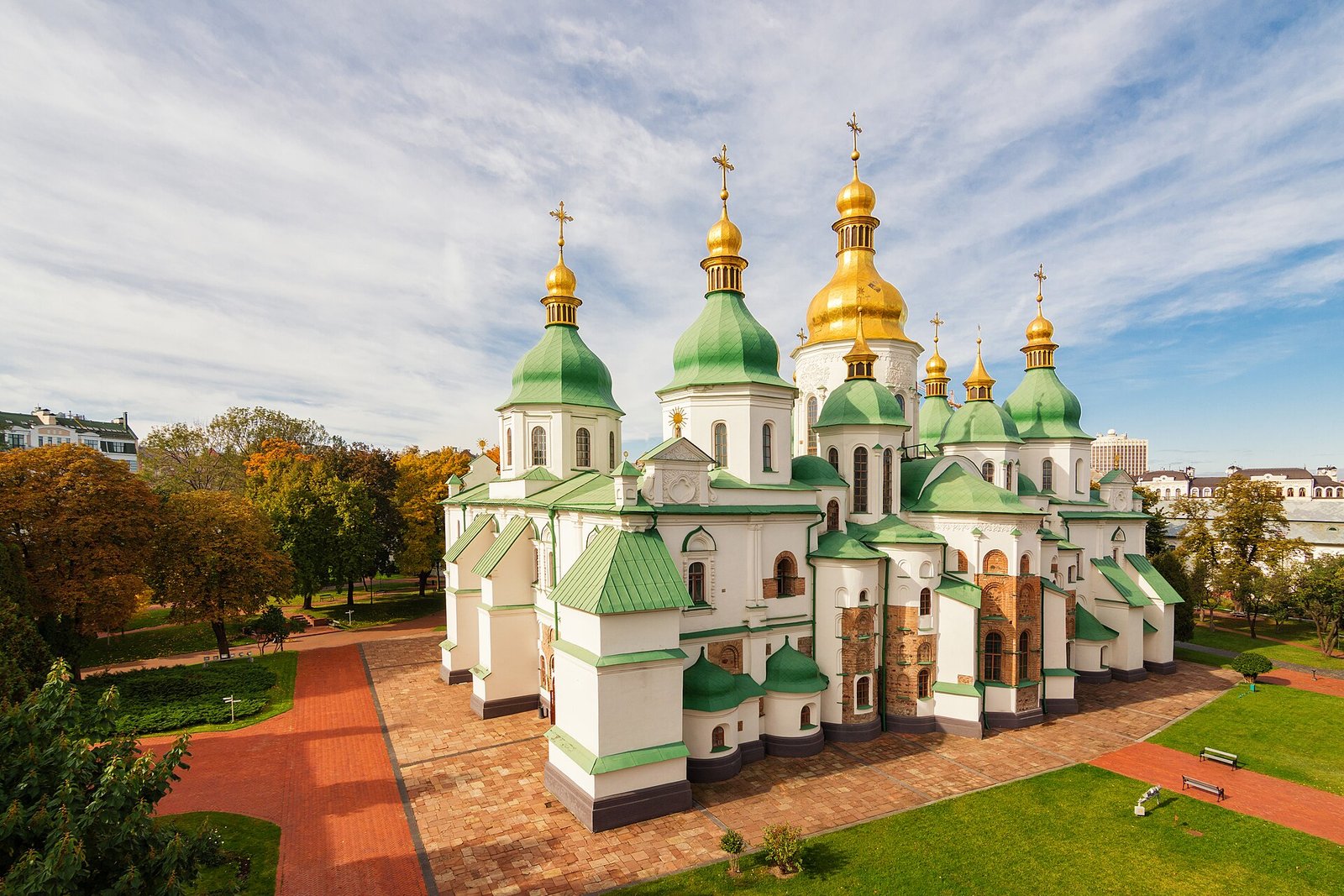
From the Principality of Kyiv to the Cossack Hetmanate, from Ottoman Podolia to the Holodomor: a brief look at Ukrainian history up to 1991.
Kyiv was the capital of Kievan Rus, which ruled between 882 and 1132 and is regarded as the ancestor of Russia, Belarus and Ukraine. After its fragmentation in the 12th and 13th centuries, the states in the region began to see Kyiv as rightfully theirs. The lands divided between Belarus and Moscow are still regarded by the nationalist publics of both countries as their own.

Ukraine, which struggled for independence for centuries, regained its place on the map of Europe between the 16th and 18th centuries as the Zaporozhian Sich, a community of military and administrative structures, as a result of the great uprising the Cossacks launched against Poland under the leadership of Bohdan Khmelnytsky.
The Ottoman Period
As a result of the Ottoman–Polish wars of 1672-1676, the Podolia Eyalet was established under Ottoman sovereignty in the historical region of Podolia, covering south-western and central-western Ukraine.

At the end of the Ottoman–Russian war of 1676-1681, the Treaty of Bakhchisaray was signed in Crimea between the Ottoman Empire and the Crimean Khanate on one side and the Tsardom of Russia on the other. Under the treaty, which was agreed to be valid for 20 years, the Dnieper River, which runs through Ukraine, was set as the border between the Tsardom of Russia and the Ottoman Empire. As a result, Zaporizhzhia came under Ottoman sovereignty. Ottoman rule in the region lasted until the Treaty of Karlowitz in 1699.
The First World War
Ukrainian lands, under the rule of Russia, Poland and then Austria-Hungary, were the scene of fighting between Russia and the Austro-Hungarian Empire during the First World War.
After the Socialist October Revolution of 1917 and the civil war that followed, the Ukrainian Soviet Socialist Republic took its place within the Union of Soviet Socialist Republics (USSR), founded in 1922.
The Holodomor
In Ukrainian, the official language of Ukraine, formerly called Ruthenian, the word plainly means “killing by starvation, killing by hunger, famine”. The Holodomor genocide, or the Ukrainian famine as some sources call it, was a genocide that took place in 1932 in what is now Ukraine and in Russia’s Kuban region. The genocide carried out by Soviet leader Joseph Stalin ended in 1933; according to estimates, between 3.5 and 5 million people, and according to some sources more, died in two years.

The Second World War
During the Second World War, almost all of Ukraine’s territory was occupied by Nazi Germany. Nazi massacres were seen in their most brutal form in Ukraine. Partisan warfare broke out in the country throughout the war. Ukraine was liberated from Nazi occupation in 1944. Five million Ukrainians lost their lives in the war. 700 cities and 28,000 villages in the country were devastated.
In 1945 Zakarpattia, and in 1954 Crimea, became part of the Ukrainian Socialist Republic.
Independence
In 1986 Ukraine suffered the Chernobyl disaster, one of the greatest nuclear disasters in history. In the process of dissolution under the name of “restructuring” that took place in the Soviet Union as the 1990s approached, a nationalist wave rose in Ukraine, as in all the other former Soviet countries.
Ukraine left the Soviet Union on 24 August 1991. Leonid Kravchuk became the country’s first president. In 1994 Leonid Kuchma took the presidential seat.

Ukraine’s Geopolitical Position
The word Ukraine is thought to mean “borderland” in Old Slavonic. Its position has always been problematic, from the past to the present. Let us draw a portrait of the geopolitical situation of Ukraine, which today serves almost as a buffer zone between Russia and NATO, giving space to different views about it.
Because it has long borders facing both Europe and Asia, Ukraine is one of the regional powers obliged to pursue multidimensional policies. While Ukrainian territory is defined by the EU as the “Post-Soviet Space”, it is defined by Russia as the “Near Abroad”.[1]
From the US perspective, geopolitical pluralism must be preserved in the post-Soviet space, that is, any integration in Eurasia under the Russian umbrella must be prevented, and Ukraine must be a central European state.[2]
As a geopolitical pivot, Ukraine has played a supporting role in the transformation of Russia. Without Ukraine it is impossible for Russia to build a Eurasian empire. Only if Russia can establish dominance over Ukraine will it be able to acquire the material resources needed to be a strong and expansionist state over Europe and Asia.[3]
Ukraine is Russia’s weakest point on its western belt, and the very existence of a sovereign Ukraine is, at the geopolitical level, a declaration of war on Russia. The “Ukraine question”, at the centre of Western geopolitics, requires Moscow to take urgent preventive measures, for what is now at stake is a strategic blow to Russia.[4]
In response to the EU and US aim of removing Ukraine from Russia’s sphere of dominance, Russia sees Ukraine’s integration into the Atlantic system as a major threat and tries to prevent Ukraine from acting together with Western countries.[5]
In conclusion, although it is a self-sufficient country, because of its location it is constantly acquiring allies and enemies. It is inevitable that it will be the “starting point of war or peace” between East and West.
In our next article, let us address the process that began with the “Orange Revolution” and continues to the present.
Sources
- Bingöl, O., 2014. Ukrayna Krizinin Ulusal, Bölgesel ve Küresel Bağlamı ve Gelecek Öngörüleri, Karadeniz Araştrmaları, Sayı; 41
- Derman, G.S., Ongarova, Y., 2014. Ukrayna’da Siyasi Kriz, Karadeniz Araştrmaları, Sayı:42
- Brzezınskı, Z., 2005. Büyük Satranç Tahtası, İnkılap Kitabevi, İstanbul
- Dugin, A., 2016, Rus Jeopolitği Avrasyacı Yaklaşım, Küre Yayınları, İstanbul.
- Gafarlı, O., 2014. AB ile Rusya Arasında Ukrayna, htp://www.bilgesam.org/incele/76/-ab-ile-rusya-arasinda-ukrayna/#.VCuZ_fl_vi0, Şubat
Monthly · free
Compass of the Month
PUGAT’s monthly newsletter.
Read next

What is PUGAT? A non-profit community publishing independent analysis from Europe on security, migration and society in Turkish, German and English.
Go to the homepage
