

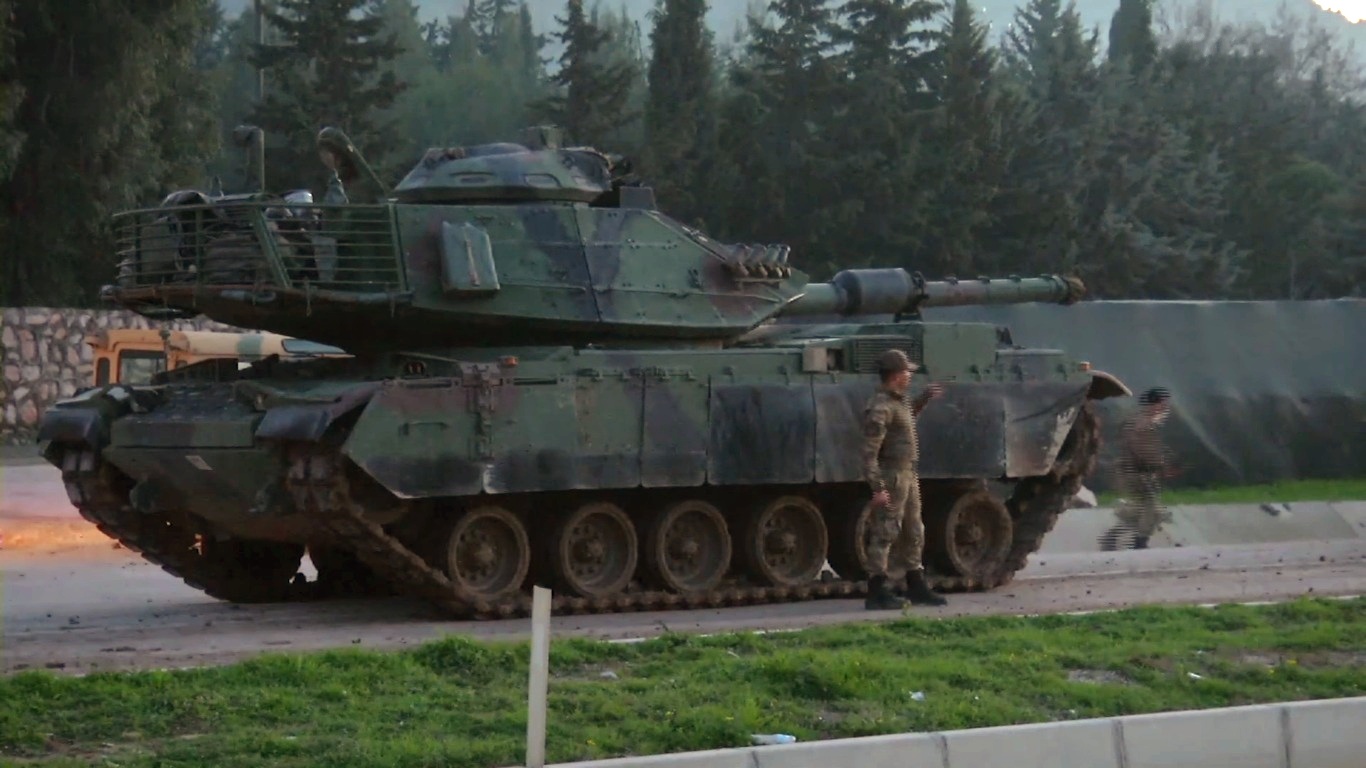
Turkey’s cross-border operations in Syria, from Shah Euphrates to Claw-Sword. The introductory article of the series examines what the operations have in common, above all their timing.
A General Assessment | 1
A cross-border operation, as the name suggests, is a military activity carried out, when border security is seen to be in danger, in a specific area of a neighbouring country whose central authority is weak and which cannot control its borders.

What distinguishes cross-border operations from other types of military operation most of all is their scope and international dimension. Acceptance by international public opinion and conformity with international law are among the basic requirements for the legitimacy of cross-border operations, which require the approval of the Grand National Assembly of Turkey to be carried out.
It is fair to say that Turkey is now conducting in northern Syria operations similar to the ground operations it conducted in northern Iraq in the past. In this study, as we examine each operation, we will try to assess it on the basis of the following data:
- The timing,
- The units taking part,
- The visible and behind-the-scenes reasons and justifications,
- Points that stand out,
- The results and repercussions.
In the following parts we will examine the cross-border operations carried out in Syria one by one. But first we think it will be useful for a proper understanding of the subject to set out point by point the common features that apply to all of them.
Notable General Features of the Cross-Border Operations
1- The most striking aspect of the operations is their timing. They appear to have been carried out at times when the AKP government was in political difficulty, at times when citizens were speaking loudly about the bad state of the economy and, above all, before upcoming elections.
| 22 Şubat 2015 | Şah – Fırat Operasyonu |
| 24 Ağustos 2016 – 29 Mart 2017 | Fırat Kalkanı Harekâtı |
| 08 Ekim 2017 – 27 Şubat 2020 | İdlib Harekâtı |
| 20 Ocak – 24 Mart 2018 | Zeytin Dalı Hatekâtı |
| 08 – 18 Ekim 2019 | Barış Pınarı Harekâtı |
| 27 Şubat – 05 Mart 2020 | Bahar Kalkanı Harekâtı |
| 19 Kasım 2022 | Pençe – Kilit Harekâtı |
| 07 Haziran 2015 | Genel seçimler | AKP iktidardan düştü |
| 01 Kasım 2015 | Genel seçimler | AKP |
| 16 Nisan 2017 | Cumhurbaşkanlığı sistemi ve anayasa değişikliği | AKP |
| 24 Haziran 2018 | Cumhurbaşkanlığı ve genel seçimler | AKP ve Erdoğan |
| 31 Mart 2019 | Yerel seçimler | AKP |
| 18 Haziran 2023 | Genel Seçimler | ??? |
2- Looking at the hostile groups against which the operations were carried out, the PYD and ISIS terrorist organisations stand out. There were also clashes with the Syrian army, albeit rarely. But it should be noted that these clashes arose in response to developing situations. While the primary target of the coalition forces and the US was ISIS, it must be said that the AKP government’s priority target was the PYD. Although at the request of the US a corridor was opened within Turkey’s own borders and passage into the region via Turkey was allowed, at many points operations were mounted on the opposing front only against the PYD. For this reason, Turkey did not feel the need to carry out a direct cross-border operation when ISIS was gaining strength or at the height of its power. Only when ISIS entered its phase of decline and Kurdish groups began to settle in the areas it left behind did the need for an operation arise.
3- It is striking that some of the personnel who served in the operations were personnel slated for dismissal after the events of 15 July 2016 or subject to a “travel ban”. In particular, the shortfall caused by the dismissal of a very large number of pilots from the Air Force Command was addressed by assigning pilots who had been suspended or were subject to travel bans. In a sense, these people were made to bear the possible risk of death by being deployed to critical and dangerous areas.
4- Although almost all the operations appeared to be successful, it is hard to say that Turkey actually gained anything. From where we stand now it is even clearer that although Turkey was the country that suffered military and material losses in Syria, the ones who made gains were the US, Russia and the Syrian central government. While the US and Russia shared the region’s oil and sold weapons, the Syrian central government regained strength and consolidated its central authority, comfortable in leaving to the TSK the fight it should have waged itself. Over this period Turkey lost soldiers, had to take in millions of refugees and still has to keep troops and outposts in place to control the region.
5- The National Intelligence Organisation (MİT) played a very active role in Syria. When trying to understand MİT’s role in the region, relying on newspaper phrases such as “MİT detected, TSK struck” or “MİT pinpoint operation in Syria” prevents one from seeing the overall picture. We should also not forget that MİT Undersecretary Hakan Fidan, in the tapes that came to light, said that he could force Turkey into an operation in Syria, saying “If necessary, I’ll send four men to Syria and have eight missiles fired”, that by then MİT had supplied the opposition with two thousand truckloads of materiel and weapons, and that through the MİT trucks even many armed groups in Syria were supported against Assad.
6- Syria became one of the countries most affected by the internal unrest that began in 2011 under the influence of the Arab Spring. In a country with many different ethnic groups and ideological structures, it faced a much greater threat of fragmentation than the other countries affected by the Arab Spring. ISIS too exploited this chaos and loss of authority at every opportunity. The power vacuum brought clashes and uprisings against the government in many areas. When some of these clashes spilled across the border and also harmed Turkey, the response depending on circumstances was sometimes long-range artillery fire and sometimes a cross-border operation.
7- The actions of the YPG and PYD, known as the Syrian branch of the PKK, and ISIS attacks and bombings are the memorable events of the 2011–2015 period. Although Turkey carried out no cross-border operation during this period apart from Operation Shah Euphrates in February 2015, it destroyed designated targets with air operations and artillery fire.
8- In fact, in the period up to 2015 there was no situation that required Erdoğan and the AKP to be political enemies of either the PKK or ISIS. Some circles in Turkey did not even accept ISIS as a terrorist organisation until a certain point. It is no longer a ‘secret’ that the AKP government sent truckloads of aid and weapons. From the PKK’s point of view the situation was no different. That attacks and actions were met with silence until July 2015, when the peace process ended, is established by Erdoğan’s own statements. Until Operation Euphrates Shield, both the PKK and ISIS carried out many bloody attacks in Turkey. ISIS, which kidnapped and took hostage the staff of the Mosul Consulate General, also carried out many bloody attacks such as those in Ulukışla, Suruç, at Ankara station, in Sultanahmet and at the airport, and the burning of our soldiers. The PKK, for its part, carried out many attacks such as those in Siirt, Dağlıca, Iğdır and Şırnak.
We can now examine in turn the cross-border operations carried out on Syrian territory.
(To be continued)
Monthly · free
Compass of the Month
Once a month: five points from Europe’s security and migration agenda and the month’s PUGAT articles, in your inbox.
Newsletter sign-up opens soon.
Read next

What is PUGAT? A non-profit community publishing independent analysis from Europe on security, migration and society in Turkish, German and English.
Go to the homepage
