

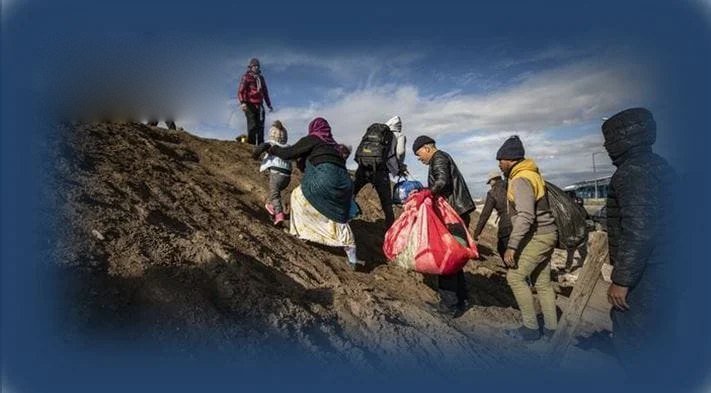
Afghans are one of the world's largest groups of asylum seekers. The article uses figures to assess the causes and meaning of the Afghan migration reaching the Turkish border via Iran.
For many years the Afghan people have suffered hardship because of the civil war in Afghanistan, serious human rights violations, mass killings carried out by groups such as the Taliban, worsening economic conditions and drought. Because of these conditions, Afghans are one of the largest groups of asylum seekers worldwide.
According to figures published at the end of 2019, some 2.6 million Afghans were internally displaced, while some 2.7 million Afghans were registered as refugees. Under the mandate of the United Nations High Commissioner for Refugees they are described as the world’s longest-displaced and dispossessed population.
In Turkey, Afghans form the second-largest group of refugees and asylum seekers. According to Turkey’s Directorate General of Migration Management, the number of Afghan refugees began to rise from 2018, and by 2019 it had doubled compared with the previous year. In recent days, videos have been shared on social media showing migrants alleged to be Afghan nationals entering the country in large groups at various points on our eastern borders.
That the arriving groups are made up of young men, with no women, children or elderly people, is another striking point. Considering how hard it is to reach Turkey after walking thousands of kilometres, the predominance of young men may make sense, but there is talk of 1,000-1,500 refugees (most of them Afghan) entering central Van alone every day; the figures are truly alarming.
According to information I received from several former colleagues, the borders have, so to speak, become a sieve; they spoke of complete disorder in the border units and the gendarmerie, a serious rise in the number of personnel caught up in bribery because of the money circulating in the smuggling market, and even people known to organise smuggling moving freely in the headquarters.
All this concrete information brings to mind certain dirty policies the AKP applied after the Syrian war. People who think that the Palace, whose vote share is melting away fast, will steal the election with a fait accompli in order to make its rule permanent, and that it may take every risk for this, including bloodshed, are watching the developments in Afghanistan and the wave of migration closely.
So how might the AKP regime use the Afghan migrants?
The refugee card is one Erdoğan likes and has obtained results with against Europe. Here is how:
The refugee problem is the most important item on the agenda of European countries. In recent years Afghan citizens’ asylum applications have generally not been accepted, but this process may change for those coming from a Taliban-dominated Afghanistan. Aware of this, a large Afghan population, including Afghan citizens already living in Iran and Pakistan, is setting out towards Europe.
Europe is certainly also watching closely the images of Afghans crossing into Turkey in droves. Tayyip Erdoğan, who knows the West’s migrant phobia, can both obtain financial support from EU funds thanks to the Afghan migrants and threaten Europe through them. He tried this method with the Syrian refugees and succeeded.
Besides the refugee card, the second matter is the Afghans’ potential as a human resource for new paramilitary armed groups. The AKP government, which opened the borders to millions of refugees and tens of thousands of foreign fighters as the Syrian war began, then used the paramilitary groups it recruited from them in Syria, Libya and Azerbaijan. It may now be planning something similar for Afghanistan.
The only thing that might worry the Palace, which will deploy the Turkish soldier to a risky region like Afghanistan to mend relations with the US and wring concessions from the West, is the reaction of domestic public opinion. In this context, among the reports coming in is that 3,000 militiamen from Syrian paramilitary groups will be sent to Afghanistan under the guise of private security in support of the Turkish soldiers.
Meanwhile, the Afghan Marshal Rashid Dostum still lives in Turkey and has a close relationship with Tayyip Erdoğan. In their one-on-one meeting with Erdoğan on 24 April 2021, the role Rashid Dostum will play in Turkey’s new position was surely discussed. It is possible that Afghan commanders loyal to Rashid Dostum have contact with some, if not all, of the Afghan migrants in Turkey, and that these people could be used for petty gains in any chaotic situation in the country.
Afghanistan is not easy to grasp from a distance; the region has a complex process and equation and delicate balances. I think Afghanistan looks set, before long, to move from being a secondary item on Turkey’s agenda to one of its top items.
Monthly · free
Compass of the Month
PUGAT’s monthly newsletter.
Read next

What is PUGAT? A non-profit community publishing independent analysis from Europe on security, migration and society in Turkish, German and English.
Go to the homepage
