

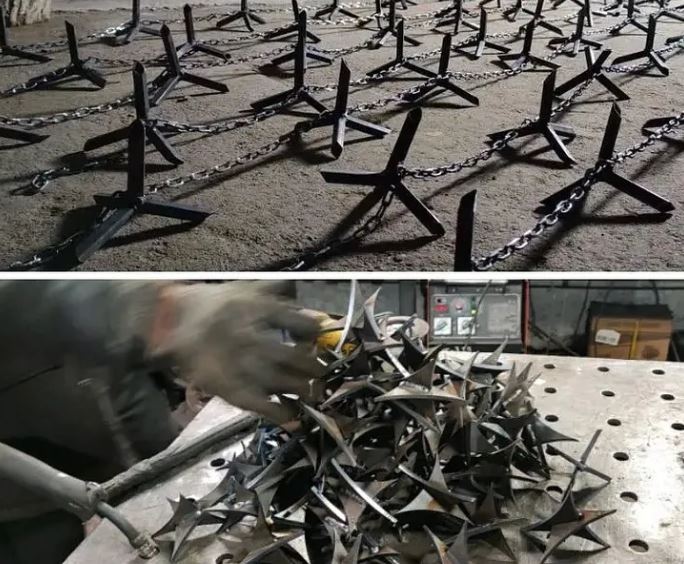
Lacking the strength to counter-attack, Ukraine is resorting to tactics as old as antiquity, from caltrops dropped by drones to soldiers hit while in the toilet. The war has turned into a war of attrition once again.
Some military experts call the strategy Ukraine has pursued since the start of the war “denial warfare”.
It means an army without the strength to counter-attack resorting to tactics that can slow, wear down and exhaust the aggressor. This strategy, however, does not help to stop the enemy’s advance or to achieve outright victory.
Although the West promised support at the start of the war, as the war dragged on it grew wary of public opinion at home and of Russia abroad. Because of this one-step-forward, two-steps-back support, the war dragged on and Ukraine grew weaker.
To spare its young population, Ukraine at first chose to send soldiers over 27 to the front. Early in the war, some of the soldiers fighting at the front were close to 50. Because of persistent Russian offensives and Western indecision, Ukraine finally realised that it had to throw everything it had at the front. (Update: In April 2024 the mobilisation age was lowered to 25.)
Russia, so to speak, made a fool of itself in the early phase of the war. Later on, a large number of its navy’s ships were hit and put out of action. On the battlefield it lost thousands of soldiers and even generals. Vehicles stranded on the roads, breakdowns in logistics and supply lines and outdated weapons laid bare the inertia and clumsiness inherited from the Soviet army.
According to recent analyses, Russia, thanks to its autocratic regime, switched to a war economy at once. The number of tanks and artillery pieces it produces now exceeds even the combined output of the main European countries. By calling up prison inmates, Russia made hundreds of thousands of soldiers ready for the front in a short time. In fact, the idea of having convicts join the ranks in exchange for a pardon came from the mercenary company Wagner. Wagner’s commander Prigozhin, who turned thousands of criminals into war machines in this way, died in suspicious circumstances after falling out with Putin, but the Russian Ministry of Defence continues to apply his idea successfully.
Meanwhile, the Russians dug in on every piece of land they seized as if they never meant to leave, and built fortifications. The aim is to slow down a Ukrainian counter-offensive. In any counter-offensive, the Ukrainian army can expect trench battles like those of the First World War. Not to mention the thousands of mines laid along the axis of attack.
Left alone and desperate, Ukraine became expert in “fieldcraft”, a term often used in American military terminology. To survive and keep fighting, it adapted whatever it could lay its hands on to the war and came up with new, simple tactics.
For example, Ukraine, whose air force lags far behind Russia’s, turned to drones, which were becoming ever more important in air attacks. Unable to catch Russian soldiers on the battlefield, the Ukrainian army began to hit them at their most vulnerable moment, “in the toilet”, and once again shocked the Russian war machine with its success. Russian soldiers who leave their trenches to relieve themselves become targets of drone attacks when they least expect it.
Another example of fieldcraft is caltrops dropped by drones. These spiked pieces of iron, used to slow the Russian advance, have been known since antiquity and were also used against vehicles in the Second World War. The Ukrainian army began dropping them on target areas from drones. Used in the past to stop elephants, camels and cavalry, caltrops are classed in military strategy as “anti-access/area denial” weapons. Because one spike always points upwards however they land on terrain and roads, they are a serious obstacle to wheeled vehicles.
With uncrewed boats it calls sea drones, the Ukrainian army has so far put close to 30 Russian ships out of action. Very cheap compared with a missile, sea drones even helped Ukraine open a corridor for its vital grain exports. With the small Mamai sea drones, produced after the Sea Baby and Magura and used in “kamikaze”-style attacks, even Russian ports were hit, sending the Russians the message that “the war can come to your home too”.
It is accepted that all is fair in war. It would be harsh to call absurd the actions of soldiers who do whatever the tactic requires. Until, that is, you see a soldier shooting arrows. Recently a Chechen fighter was seen shooting arrows at Ukrainian soldiers. Soldiers using bows and arrows had also been spotted several times with night-vision devices. It is unclear whether firing VOG-17-type grenades at a target with a bow and arrow counts as “fieldcraft”, but such high-explosive grenades are normally fired from their own grenade launchers.
Some experts also call the Ukrainian army’s tactics “drone warfare”. The Russia–Ukraine war, with its new tactics, is “unfortunately” helping to update the art of war and military literature.
Sources
- washingtonpost.com washingtonpost.com
- washingtonpost.com washingtonpost.com
- essanews.com essanews.com
- warontherocks.com warontherocks.com
- forbes.com forbes.com
- businessinsider.com businessinsider.com
- pravda.com.ua pravda.com.ua
- hisutton.com hisutton.com
- medium.com medium.com
- forbes.com forbes.com
- armyrecognition.com armyrecognition.com
Monthly · free
Compass of the Month
Once a month: five points from Europe’s security and migration agenda and the month’s PUGAT articles, in your inbox.
Newsletter sign-up opens soon.
Read next


What is PUGAT? A non-profit community publishing independent analysis from Europe on security, migration and society in Turkish, German and English.
Go to the homepage
