

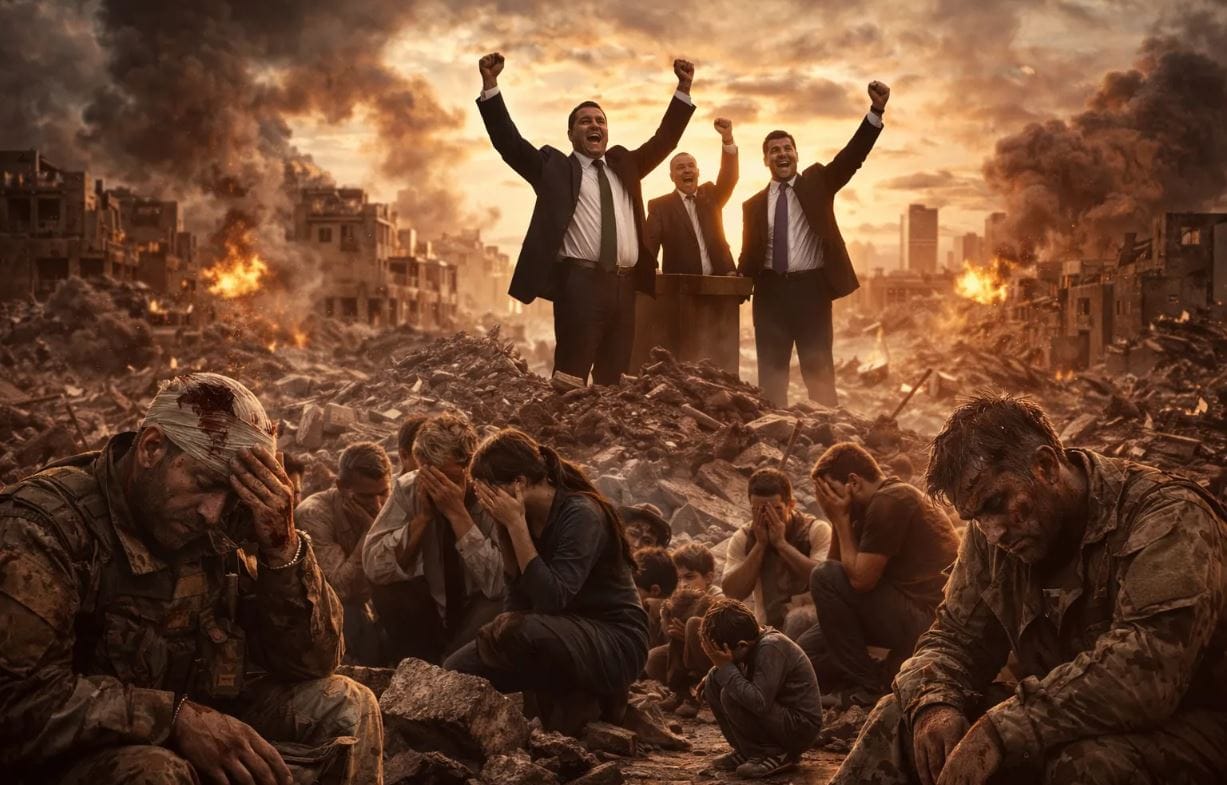
In modern wars even the stronger side cannot win a decisive victory. The US and Israeli war against Iran has also stalled in a state of neither war nor peace without reaching its goals; every side will declare itself the winner, and the peoples will be the losers.
In history, the loser of a war has never wanted to admit defeat. Heads of state and commanders see it as humiliating, and they are often expected to see it that way. Yet in the last two centuries, as rulers have come to bear greater responsibility towards their peoples, one might have expected wars to become less frequent. The picture, however, has not improved as hoped. On the contrary, taking advancing technology and growing populations into account, the number of people harmed by wars has exceeded the losses of past centuries.
Harsh-sounding concepts such as war, conflict, operation and attack have unfortunately become increasingly normalised in recent years. Long-running wars and conflicts continue in many parts of the world. New ones are added from time to time, while some come to an end. Considering, moreover, that many states stand ready for conflict at any moment, it would be no exaggeration to say that humanity lives on tenterhooks. While past wars were mostly confined to particular regions, today even the smallest tension can have global effects.
The Russia–Ukraine and Israel–Hamas conflicts of recent years clearly reveal the nature of modern wars. However powerful a state may be, it has become almost impossible to achieve a decisive victory unless the other side formally accepts defeat. This shows that wars have moved further away from being a solution. Indeed, recent wars have proved that, even where there are large differences in power on paper, it is extremely hard to bring a state completely to its knees as long as resistance continues.
The most recent example is what has happened in Iran. The United States and Israel had completed many of the preparations needed against Iran, above all military and economic, for a war they had been preparing for years. At the very start of the war they showed the whole world how effectively they used intelligence and local support. On the first day of the war they even killed many of the most important figures of the Iranian leadership, above all the Supreme Leader Ali Khamenei. Although they also seized full control of Iranian airspace, the war did not end. The ceasefire announced on 8 April 2026 through Pakistani mediation was violated repeatedly, and the Islamabad Memorandum signed in June collapsed in July. As of October 2026, the United States has not struck Iranian territory since early September but continues its blockade of Iranian ports and its sanctions, while negotiations are deadlocked. At this point, beyond setting back Iran’s nuclear capacity and greatly weakening its military, the United States has not fully achieved its objectives. As far as can be understood from US President Donald Trump’s statements, there were other goals as well, including regime change in Iran and the sharing of its natural resources.
The Iranian regime, even though it is unwanted by most of its own people, has proved that it cannot be brought down by war in this way. The fact that, after Ali Khamenei’s death, his son Mojtaba Khamenei became Supreme Leader also shows this. For the regime, in building its leadership cadres, had turned itself into the state with the notion that “Iran = the regime”. At this point, the US and Israeli attacks appear to have made the regime more legitimate and untouchable.
When this article was first written, the war was expected to end in late April, without a ground offensive. Months later, a state of neither war nor peace persists. However the war eventually ends, it is not hard to predict that the countries and leaders involved will declare themselves the winners. In the end, yet another war will have been left behind that served no purpose and produced nothing but the deaths of innocent people and economic hardship. Looking at the parties to the war, the leaders of the United States and Israel as well as those of Iran are going through difficult times in their countries’ public opinion.
According to one prominent view, the reason wars are started is that leaders seek to stir up nationalist sentiment in order to halt, completely or temporarily, the reactions likely to be directed at them. This tactic has been seen to work for years in Turkey and similar countries. Cross-border incursions and large-scale operations that suddenly appear when governments’ actions or leaders’ activities begin to be questioned are among the clearest signs of this.
At this point, it is a great paradox that leaders who are expected to protect their country and, wherever possible, to avert potential attacks by diplomatic means should endanger their countries, their soldiers and their citizens for the sake of their own interests. Indeed, the words of Abraham Lincoln, who was accused of being too kind to his enemies, strikingly capture the difference between war and diplomacy: “Do I not destroy my enemies when I make them my friends?”
Monthly · free
Compass of the Month
Once a month: five points from Europe’s security and migration agenda and the month’s PUGAT articles, in your inbox.
Newsletter sign-up opens soon.
Read next


What is PUGAT? A non-profit community publishing independent analysis from Europe on security, migration and society in Turkish, German and English.
Go to the homepage
