


Russia’s networks of influence in Turkey and the Flynn–Alptekin connection that emerged during the Trump campaign. The third article in the “Focus on Russia” series looks at the Turkish side of influence operations.
Russia organising in Turkey’s schools, universities, media organisations and official institutions!
We can say that efforts to spread Russian ideology in Turkey have been intensive since the Cold War years. Since the 1970s we can observe that Russian ideology, the idea of communism, has to some extent been instilled in pupils at school and that pro-Russian figures in the press have been supported financially. We see that not only Russia but also China is quite influential in Turkey in this respect. Through funded journalists the desired perception is created, and by playing an active role in politicians’ corruption and bribery relationships, the desired policies are pursued. During the regime change in Turkey after 15 July, we saw clearly how Russian sympathisers profiled civil servants. We had the opportunity to see plainly that many of the people who profiled others and had innocent people dismissed from the civil service were in fact admirers of Russia, that people who call themselves ulusalcı (secular-nationalists) are supporters of Russia and China, and that they even see NATO as a hostile structure. (Yavuz Bülent Bakiler’s article “They Became Communist Nests with the Promise of Training Teachers” offers very interesting information for those interested in the subject.)
The help and support given to Trump’s election campaign by the Perinçek group and the Turkish government
Former US National Security Adviser Michael Flynn, as part of a plea agreement with the special counsel in the investigation against him, admitted that he had made false statements to the Federal Bureau of Investigation (FBI) about his contacts with the Russian government.
In his testimony under the agreement, Flynn also confirmed for the first time the allegations that, during the period when the election campaign was under way on behalf of President Donald Trump, he had established direct relations with the Turkish government and carried out consultancy work in line with the government’s instructions and guidance.
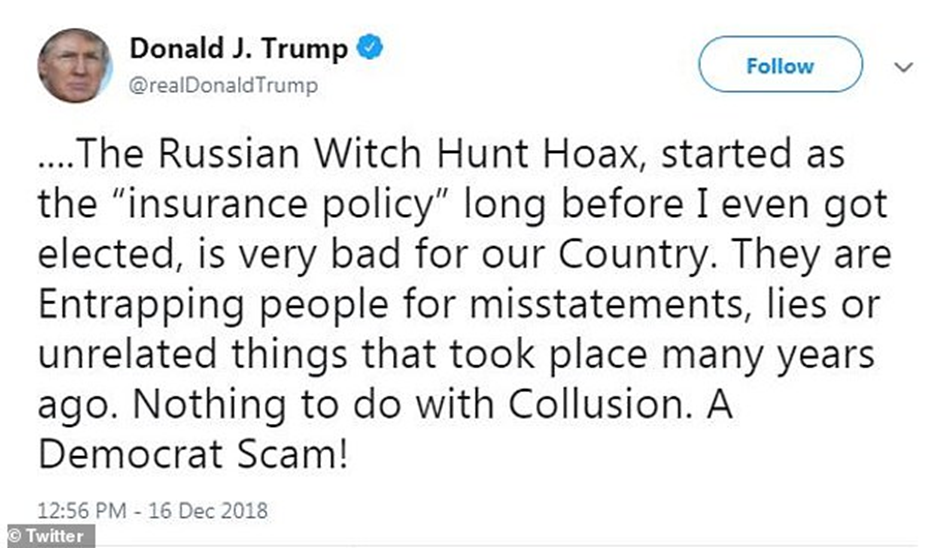
Under his agreement, Flynn was not charged for failing to make, in good time, the notification he was legally required to make to the Department of Justice about his relations with Turkey. However, charges were brought against Flynn’s former business partner Bijan Rafiekian and against Ekim Alptekin, chairman of the Turkey-US Business Council, who paid for the consultancy services on Turkey’s behalf. (Update: Flynn was pardoned by Trump in November 2020.)
Let us open a parenthesis here and talk about Ekim Alptekin, by no means an ordinary figure. The public first knew the name Kamil Ekim Alptekin as “the man who ordered künefe by jet”. The “story” of Alptekin, one of the “fast-rising” Turkish businessmen in the US, appeared in 2014 in Milliyet newspaper’s series “Turks Who Discovered the New World”. In the series, Alptekin, whose name was said to be counted among the most successful Turkish entrepreneurs in America although he had lived there for only a year, said: “I lived in the Netherlands for 20 years. I stayed in America for only 1 to 1.5 years. But in that time I felt more American than I ever felt European in Europe.”
According to press reports, his father Mustafa Sevinç Alptekin was part of the circle of the Workers’ Party led by Doğu Perinçek. Ekim Alptekin’s name came to public prominence when he and his Dutch partner bought Eclipse Aviation, an American aircraft company worth 1.5 billion dollars that was in financial difficulty, for 40 million dollars.
Unfortunately he cannot currently travel to the US because of various investigations against him. This is a subject that deserves separate treatment. But Russia’s activities in the 2016 elections are still being investigated in the US. In this context, recently (November 2022) Republican political operative Jesse Benton was found guilty in federal court of funnelling 25,000 dollars from a Russian businessman into Donald Trump’s 2016 presidential campaign.
(Additional information: Federal laws set out how and from whom candidates for president, senator and representative who raise their own funds may collect donations. The laws also limit how much a single person may give. They also ensure that the press and citizens know who has contributed to any candidate. A presidential candidate must set up a campaign organisation called a political committee and register it with the Federal Election Commission. Once registered, political committees may raise donations but must report all donations received to the commission. The commission in turn makes this information available to the public. Making or receiving donations on behalf of foreign states is also prohibited. Yet the repeated attempts by states and large companies wishing to influence a future president and their policies to get around these bans are also a reality.)
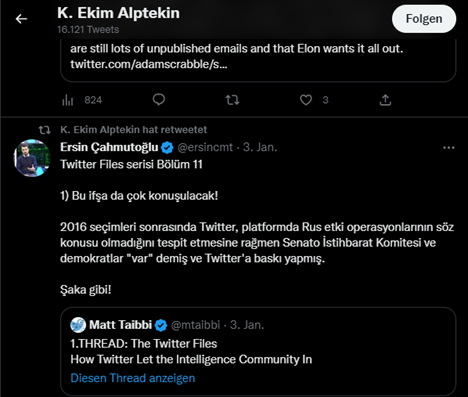
Judging by the message Alptekin retweeted on Twitter on 3 January, this investigation is still ongoing, and not only he but many others are in trouble.
Conclusion
In the context of allegations of Russian interference in the 2016 US presidential election, Russia and Turkey working towards the same goal is quite remarkable. Trump’s victory was, after all, served up with great joy by the pro-government media.
Do you also think Russia is influential over other countries in foreign policy? Selling a NATO member like Turkey the S-400 missile system it can never use, earning billions of dollars from the sale and directly contributing to Turkey’s removal from a strategic project such as the F-35. For now, this is indeed seen as a great success for Russia. Another very striking point is that many news reports and interviews on this subject, for example on the donations and support Ekim Alptekin and his team allegedly gave to Trump’s election campaign in 2016 and similar matters, have been deleted from the internet. This can be understood as an effort by the parties concerned to erase some traces, or as a tactical softening of the ground by the US to deepen the investigation further. Because the people in question are under full surveillance in the current climate, and so every contact they make and every statement they give is followed by Western intelligence services and American prosecutors.
Sources
Monthly · free
Compass of the Month
Once a month: five points from Europe’s security and migration agenda and the month’s PUGAT articles, in your inbox.
Newsletter sign-up opens soon.
Read next


What is PUGAT? A non-profit community publishing independent analysis from Europe on security, migration and society in Turkish, German and English.
Go to the homepage
