

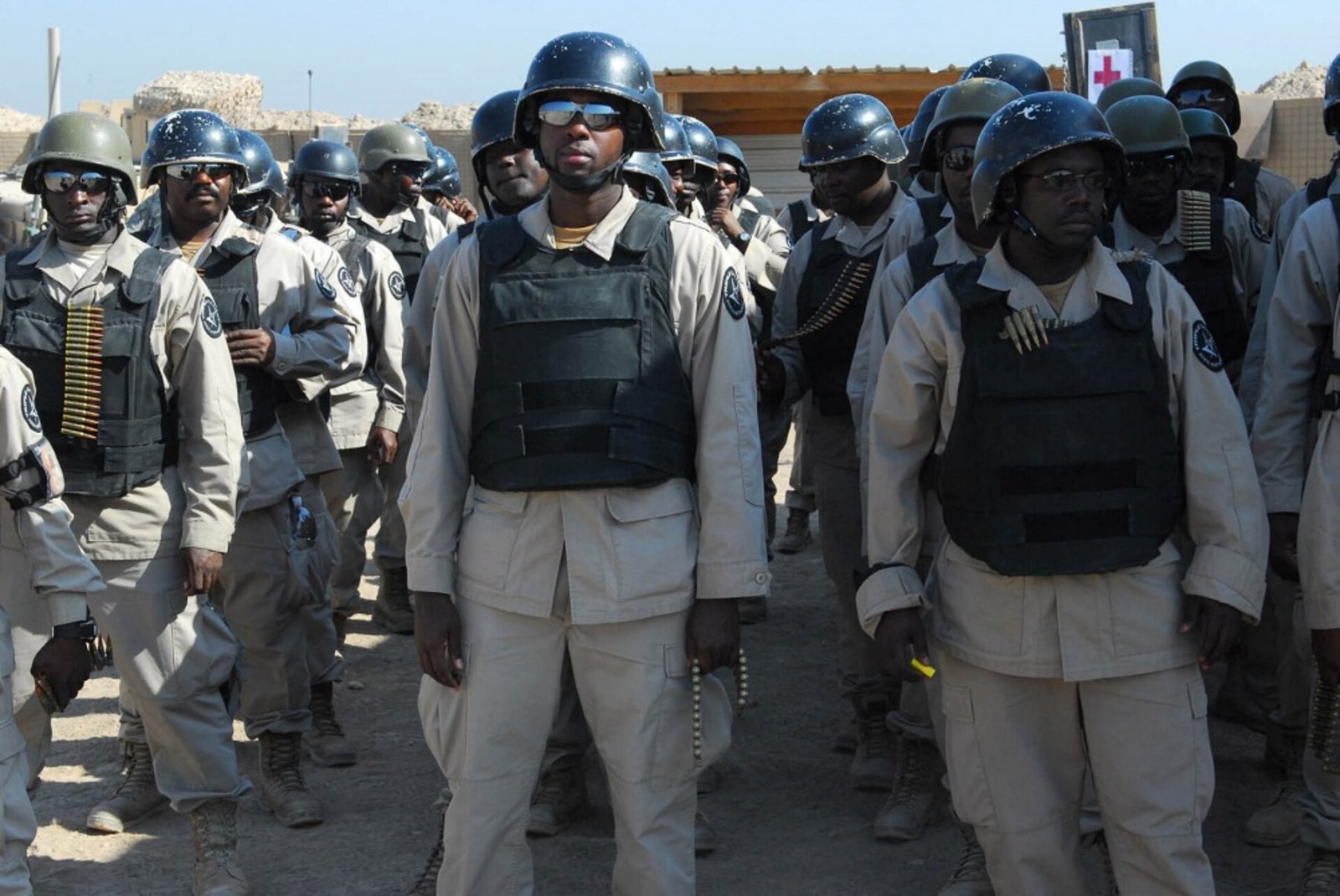
From Blackwater to Wagner, private military companies are now part of every conflict. What are these “private armies” that let states wage war without taking responsibility, and why are they dangerous?
What exactly is the “private army” that we come across so often today, and that, if you look closely, turns up under every stone?
It is known by the short form PMC. It stands for “Private Military Company”. In other words, a “private military company” or “private security company”.
The US need to keep critical regions such as the Middle East under constant control, and the political and legal obstacles it faces in deploying and directing its national army, led to the emergence of private armies.
According to journalist and writer Fehim Taştekin, the Americans and the British above all use these private war companies in situations where their own soldiers could be prosecuted or where things could turn into a cost within their own political decision-making mechanisms. In a sense, they do this as a mechanism for distancing the crime from themselves.
David Isenberg of the Peace Research Institute Oslo uses the term “shadow force” for this ingenious alternative armed force, onto which countries can shift responsibility for everything that happens in the theatre of operations, with which they can evade international law and keep their soldiers away from risky areas.
The Brookings Institution goes even further and describes private armies outright as governments’ proxies.
According to American experts, private armies look set to replace national armies in the future. Because to mobilise a country’s army and deploy it to a far corner of the world, persuading the government is not enough. The approval of that country’s legislature, its public and even its military leadership is needed. On top of that, the power of the media, financial resources and domestic dynamics must be taken into account. And it is impossible to ignore the place in the equation of the international agreements the country is bound by, organisations it belongs to such as NATO, and its neighbours.
Statistics say that a private army soldier costs the state ten times as much as a national army soldier. This price difference offers global powers two options. Either they pay a private army or they use another state’s army. We already know that the second alternative is used from time to time. So where are private armies used, and why do they exist? Our first answer to this, unfortunately, is “the policy of secrecy”. Even America, the inventor of the business, has no clear answer to the question of exactly what private military companies are used for.
Foremost among the best-known private armies is the American “Blackwater”, now called “Academi”. The company, which left its mark on the occupations of Afghanistan and Iraq, receives 90 per cent of its contracts from the US government. Blackwater, the hands and feet of US operations overseas, was not held institutionally responsible for civilian deaths in Afghanistan and Iraq; four of its employees were convicted in the US over the 2007 Nisour Square massacre (they were pardoned in 2020). Yet it still could not escape investigations over allegations that several employees had smuggled weapons.
If even an American company, whose every step is or should be monitored because it is both a military formation and a commercial enterprise, has a bad record, imagine the rest.
Apart from Blackwater, there are dozens of private military companies in the world. The leaders in this field are US and British firms. Each has different areas of operation and capabilities. Some have made their name training countries’ law enforcement agencies, others specialise in fighting crime. There is only one thing they have in common: Crime.
From arms smuggling in Afghanistan to the killing of innocent people in Baghdad, from sex trafficking in Bosnia to the suspicious death of a prisoner in transit in Australia, from opening fire on civilians to drugs… Unfortunately, the names of many private military companies are associated with illegal activities. Because of the backlash, even the US has recently had to put the brakes on its cooperation with private armies. It has terminated contracts with those that became criminalised and begun to use some only to secure supply and transport. Guarding oil and mining sites is one of the alternative uses that keeps private armies at least somewhat out of the line of criticism.
The most important observation about private armies comes from the American political scientist Deborah Avant. She explains the problem through the absence of three features of democracy: “Transparency, legal oversight and public consent”. What this means is that private armies lack the three pillars of democracy.
In his report “Private Military Contractors and U.S. Grand Strategy”, David Isenberg believes that it is precisely for this reason that the US makes heavy use of private armies. They remain outside legal oversight. They are shielded from public criticism and pressure. They have state backing, ample financial power and, of course, the ability to control the media. To put it bluntly, no one knows what they are doing, and they do not have to answer to anyone.
Another aspect of private armies open to abuse is that they can be hired by democratic and authoritarian regimes alike. The “He who pays the piper calls the tune” approach is a risk that security experts point to with regard to private armies.
According to a study in the US, the corporatisation of military force is another factor that makes private armies problematic. For a private army whose only aim is to make money, it does not matter on behalf of which country it goes to war.
Nor does it matter whether using weapons and killing people is legitimate. If pleasing the boss has become the goal, human rights violations can also be ignored.
If the boss is an authoritarian regime, just imagine the “mission-type” orders the private army receives.
Monthly · free
Compass of the Month
PUGAT’s monthly newsletter.
Read next


What is PUGAT? A non-profit community publishing independent analysis from Europe on security, migration and society in Turkish, German and English.
Go to the homepage
