

The Turkish Penal Code does not define espionage and does not question the spy’s motivation. This gap can expose civil servants who reveal crimes and journalists who report on them to espionage charges.
Our penal code does not question which motivations apply to a person accused of espionage. Not even the concept of espionage is defined.[*] In this situation, the task of defining the concept has been left to a legal doctrine afflicted by ideological fragmentation and to case law. Those who dispense the law, too, determine whatever definition they like, or the question of “the spy’s motivation”, which the Turkish Penal Code and the Code of Criminal Procedure do not even touch on, according to their personal views and experiences. As a result, another state official who exposes a crime committed by public officials in the course of their duties, or a journalist who reports on that crime, can easily face accusations of espionage and receive heavy prison sentences.
Espionage
Although crimes of this nature are regulated in 14 articles in the seventh section of the Turkish Penal Code entitled Crimes Against State Secrets and Espionage (Art. 326 to Art. 339), when the public speaks of “espionage”, it mostly means Articles 327 to 330. Indeed, public prosecutors also mainly base their charges on these articles. We can summarise these articles in a simple table as follows:
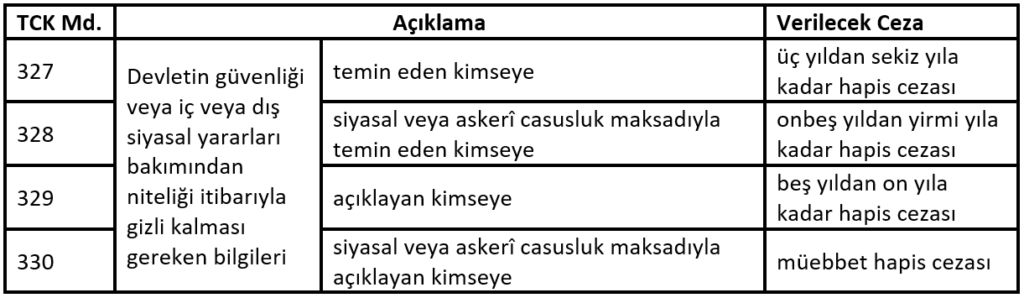
Here we face a dual situation. Obtaining “information that, by its nature, must remain secret in terms of the security or the domestic or foreign political interests of the state” and disclosing it are regulated as separate crimes. Moreover, obtaining and disclosing this information “for the purpose of political or military espionage” is dealt with in other articles. I will not enter into a legal discussion on the subject. Many studies can be found with a simple internet search.
In such research one will come across many names who have faced espionage accusations. But very few people will be found against whom a judgment was rendered under Articles 328 and 330, which correspond to the espionage charge in the Turkish Penal Code. For some reason, public prosecutors in our country are rather generous when accusing people. But when the matter reaches the stage of the court’s judgment, because sufficient concrete evidence cannot be obtained regarding the obtaining and disclosure of secret information “for the purpose of political and military espionage”, the judgment is rendered under Articles 327, 329 or other articles of the Turkish Penal Code.
It is impossible to understand why both investigating and trial prosecutors insist on the “espionage” charge without evidence and without basis. Frankly, one struggles to find any motivation other than ill intent, ideological conditioning or political expectation.
Now to the question of “state secrets”.
State Secrets
In fact, the main reason for the debates conducted through the “espionage” charge is that the concept of state secrets has not been given a precise definition. Moreover, we still have no legal regulation that would resolve the debates and uncertainties surrounding the concept of state secrets.
The State Secrets Bill was prepared in 2008. It has been awaiting enactment ever since. Of course, the entry into force of such a law is not functional for those among legislators inclined to commit crimes and who use the concept of “state secrets” as a screen for the crimes they commit. For example, let us recall the way the AKP government has intervened in developments in Syria since 2011. We see that almost every stage was concealed from parliamentary scrutiny and that a chain of crimes was committed using the armour of “state secrets”. In this situation, it is, to use a phrase lawyers like, self-evident that the enactment of the state secrets bill will not be wanted by those who commit crimes by using the influence provided by public office.
But this much must also be said: since there are no clear legal definitions of the concepts of state secrets and espionage, the courts have broad discretion. We saw during the “MİT Trucks” trial, conducted by the 16th Criminal Chamber of the Court of Cassation as the court of first instance, that this broad discretion was used not to establish justice but arbitrarily and in a partisan way to secure political advantage.
The 16th Criminal Chamber of the Court of Cassation could not decide whether the transport of material in the trucks stopped in Adana, alleged to belong to MİT, and the material inside the trucks, constituted state secrets. Or rather, it did not want to decide. Without seeing any need to investigate, it accepted as true the statement in letters written by MİT to the prosecution and the court that “MİT personnel were performing a duty within the scope of state secrets”. Yet at that time (and even at the time this article was published), who has the authority to determine what is a state secret remained a mystery.
Whether an official document contains “information that, by its nature, must remain secret in terms of the security or the domestic or foreign political interests of the state” may be understood from the stamps indicating its level of classification. But to insist, without presenting any official document to the competent authorities, that an activity carried out by public officials falls within the scope of state secrets is tantamount to insisting on the truth of an assumption. And for the security officials who took part in inspecting this activity to face espionage accusations and even be punished is a complete lawlessness, a complete violation of rights.
These points must also be taken into account when trying to understand the arrest on espionage charges of former soldier Metin Gürcan, one of the founders of the DEVA Party. We must adopt a cautious approach not only towards Metin Gürcan and the prosecutors and gendarmes convicted in the MİT Trucks case, but also towards Osman Kavala, Can Dündar and everyone accused of espionage, alleged to have obtained or disclosed information and documents of the nature of state secrets, and put on trial.
Quite apart from the “presumption of innocence”, one of the basic rules of universal law, fairness requires that everyone and every group who has suffered as a result of the law being interpreted wrongly or in bad faith should think ten times before speaking once when levelling accusations such as “spy, traitor, terrorist” against people under criminal investigation.
Secret or State Secret? Which Is Honour?
- The truths that emerged with the MİT Trucks incident are state secrets. The trial ended; that what was done was unlawful was demonstrated by all sorts of evidence. Much was written, drawn and said in the media. Knowing full well that there was no secret at all, a trial was held on the basis of the concept of “state secrets”. None of us, including members of parliament, know what decisions were taken behind closed doors about Türkiye’s Syria policy, or what kind of adventure we were dragged into on the other side of our border. Why? State secrets.
- The truths of 15 July are state secrets. Those who need to speak to shed light on that “hot” night, many aspects of which are still disputed and which contains question marks contradicting the official narrative, make no statements either in the courts or in parliamentary commissions. Why? State secrets.
- A major serving at the Army Aviation School goes to the MİT compound in Yenimahalle and makes a report. But we can never learn the details of this major’s statements. Why? State secrets.
- MİT Undersecretary Hakan Fidan walks freely into and out of the General Staff headquarters a few hours before the events began. No one knows who was spoken to and about what. Why? State secrets.
- According to some claims, high-level contacts were also made with Special Forces Commander Lieutenant General Zekai Aksakallı just before the events. Do we know what was discussed in these contacts? No. Why? State secrets.
- Do we know what lies behind the scenes of the truths that came out with the 17/25 December operations? No. Do we know where the millions of dollars that the Erdoğan family allegedly smuggled out before they could be seized, based on the seized money and leaked phone recordings, were sent? No. Why? State secrets.
- No statement satisfying the public is made about the allegations concerning the fortunes of the family ruling the country in foreign banks, above all in Britain and Qatar. Why? State secrets.
- We do not know whether the President has a university diploma or not. Why? State secrets.
- Susurluk? State secrets.
- The 1990s, the unsolved murders? State secrets.
There is certainly a very serious error and a wrong definition here. Otherwise we would not dismiss so many “secretive” and illegal events as “state secrets”. Those playing the “look at the acrobat” game know what they are doing and what they are hiding from view. That much is certain. But is the informed public aware of what it is missing? A country’s future is being mortgaged by hiding behind the curtain of “state secrets”. The understanding that “a secret is a matter of honour” has gone into the bin ever since it turned into the understanding that “a state secret is a matter of honour”. Every “secret” invented by the mafia-style mindset of government points to the existence of a potential and grave crime that mortgages the future of the country and of generations.
The concept of “state secrets”, not clarified by legal regulation, is being used as the sword and red line of politics and law. Prosecutors cannot accuse people using this concept, which has not been clearly defined and whose elements have not been set out. Judges cannot pass criminal judgments on people on the assumption that this concept, which has no legal basis, has been violated. Politicians cannot snap at this person and that by hiding behind this concept to cover up the crimes they commit. The media cannot use this concept as a weapon to stick the label of spy, traitor or terrorist on anyone it likes.
[*] Is it the task of the penal code to define espionage? In other words, must every crime be defined? Of course, this needs to be discussed separately. But the law has defined the crime where it wished and not defined it where it did not.
Monthly · free
Compass of the Month
PUGAT’s monthly newsletter.
Read next



What is PUGAT? A non-profit community publishing independent analysis from Europe on security, migration and society in Turkish, German and English.
Go to the homepage
