

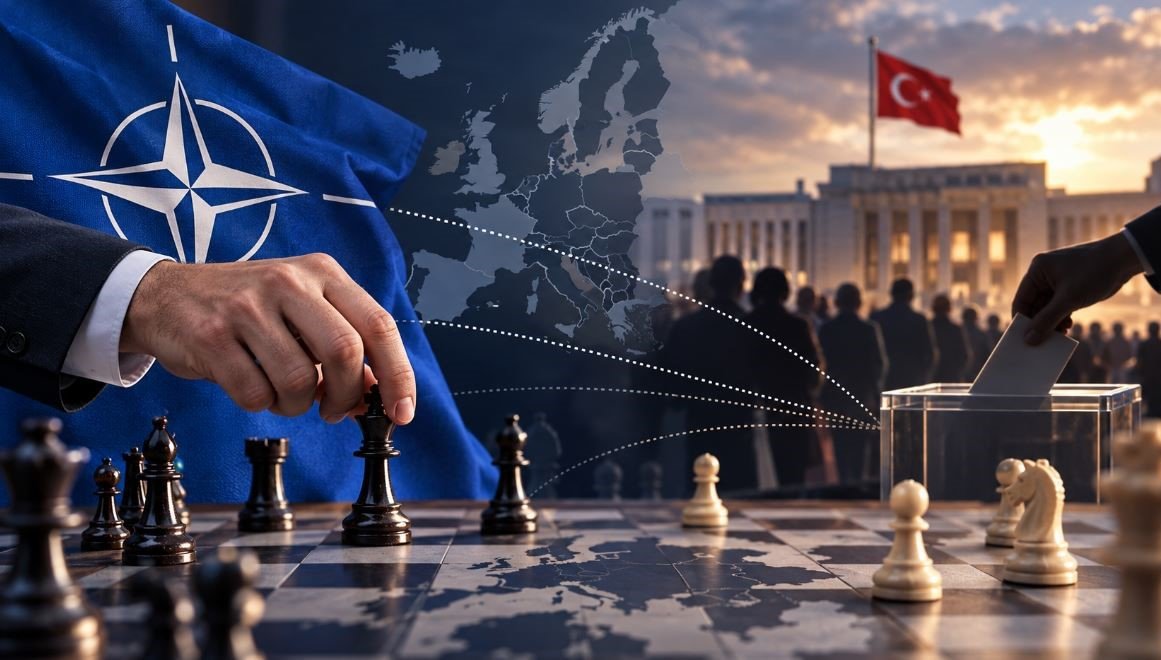
Russia’s invasion of Ukraine brought Sweden and Finland, after decades of neutrality, to NATO’s door. The author reads Ankara’s objection through the lens of domestic politics and electoral calculations.
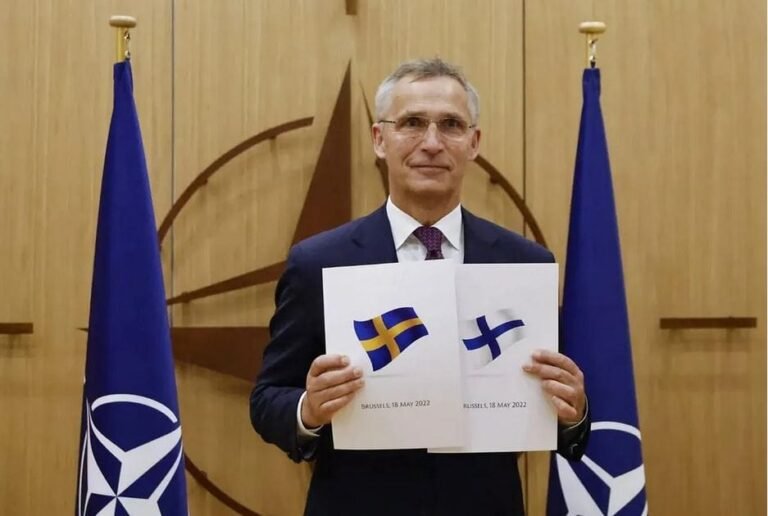
As the perception of security changed worldwide after Russia’s attempted invasion of Ukraine, countries practically entered a new arms race. Sweden and Finland, which had been “models” of neutrality for decades, drew the whole world’s attention by applying to join NATO.

The Breaking Point: The Attempted Invasion
The start of Russia’s attempted invasion of Ukraine on 24 February 2022 pushed Finland, which shares a border of about 1,300 kilometres with Russia, to take precautions against a possible Russian invasion.
Since 2014, when Russia annexed Crimea, only 25 per cent of the Finnish public had supported NATO membership, arguing that Finland should remain neutral. After the Ukraine war this was completely reversed: the latest poll showed that 76 per cent of the public supported NATO membership.
Sweden’s situation is not the same as Finland’s, because Sweden has no border with Russia. Even so, in the face of a possible Russian threat, the Swedes aim to end their “200-year policy of neutrality”, come under the NATO umbrella and secure their country.
After these moves by Sweden and Finland, the two countries received strong support, particularly from the United States, the United Kingdom and Germany. Unlike these countries, Turkey, itself a NATO member, reacted to Sweden’s and Finland’s bids to join NATO almost more strongly than Russia did. As its justification, Turkey claimed that these countries “support terrorist organisations”, above all the PYD.
Turkey, a member of NATO since 1952, had followed a policy of supporting the alliance’s open-door policy. In the post-Cold War period it also supported the accession of former Soviet-bloc countries to the alliance in 1999 and 2004.
Is Turkey Right?
Turkey regards the YPG as a terrorist organisation, but the YPG is the main partner of the US-led coalition fighting ISIS in northern Syria. During this time many countries, above all the United States, supplied the YPG with weapons. With this support the YPG fought ISIS in Kobani and other cities.
Russia’s view of the YPG is no different from that of the United States. The YPG opened one of its first offices outside Syria in Moscow, together with Russian officials. In a speech, Russian President Vladimir Putin said that they saw no need to arm the Syrian Kurds but would continue to work with the Kurds.
Apart from Turkey and Qatar, no country recognises the YPG as a terrorist organisation. The PKK, on the other hand, is designated a “terrorist organisation” by about 40 countries, including the United States and the member states of the European Union. Among the countries with which Turkey has close relations, those that do not regard the PKK as a terrorist organisation are, above all, Russia, followed by the United Arab Emirates, Saudi Arabia, China and Israel.
In March, President Erdoğan received Israeli President Isaac Herzog at the presidential palace with the highest level of protocol, and in the period that followed he paid fraternal visits to the United Arab Emirates and Saudi Arabia!
What Is the Aim?
In these meetings, the recognition of the PKK as a terrorist organisation by the United Arab Emirates and Saudi Arabia was not on the agenda.
By contrast, Sweden and Finland, whose NATO membership Turkey opposes, do recognise the PKK as a terrorist organisation.
During Erdoğan’s visit to the United Arab Emirates in February, agreements were signed in 13 areas. These agreements covered even archives, meteorology and climate change, yet no issue relating to the “PYD” was put on the agenda.
When King Abdullah bin Abdulaziz of Saudi Arabia, a country that does not regard the PKK as a terrorist organisation, died in 2015, national mourning was declared in Turkey and flags were flown at half-mast, yet no national mourning was declared after PKK attacks in which dozens of people lost their lives.
After all of this, we can safely say that President Erdoğan has different plans regarding Finland’s and Sweden’s NATO membership processes. If support for the PYD were really the sensitive point, as Erdoğan claims, he would not have steered Turkey into Russia’s orbit for about five years at the cost of breaking it away from the European Union and NATO.
As can be seen, Erdoğan has no sensitivity whatsoever regarding the country’s interests. As before, Erdoğan continues to abuse the country’s strategic and political advantages for his own political and material interests.
What Will the Outcome Be?
Technically, Finland and Sweden cannot become NATO members without Turkey’s approval. However, it is not possible for Turkey to maintain this stance against the United States, which wants Finland and Sweden to join NATO.
For example, in October 2019, over Turkey’s operation in Syria, then US President Trump wrote to Erdoğan in a letter: “Don’t be a tough guy. Don’t be a fool! I will call you later.” Both in that operation and in the one that followed, token operations were carried out that would not anger the United States and were aimed at swaying public opinion.
Finnish and Swedish delegations came to Turkey in recent days. After these and subsequent talks, Finland and Sweden as well as the United States may make a few concessions that do not run counter to their own interests but allow Erdoğan to trumpet victory in domestic politics.
The real aim of Erdoğan, “NATO’s spoilt child” to some and “Putin’s Trojan horse in NATO” to others, is to drag out the negotiation process as long as possible and turn the so-called gains obtained from it into election material for the presidential election. In conclusion, Finland and Sweden, which Erdoğan says he will not allow to join NATO for the sake of so-called national sentiment and interests, may not join NATO, but if so, it will certainly not be because of Turkey’s objection. (Update note, November 2026: The Turkish parliament approved Finland’s membership in March 2023 and Sweden’s in January 2024. The approval for Sweden came at the same time as US approval of the sale of F-16s to Turkey. Finland became a NATO member on 4 April 2023 and Sweden on 7 March 2024.)
Monthly · free
Compass of the Month
PUGAT’s monthly newsletter.
Read next


What is PUGAT? A non-profit community publishing independent analysis from Europe on security, migration and society in Turkish, German and English.
Go to the homepage
