

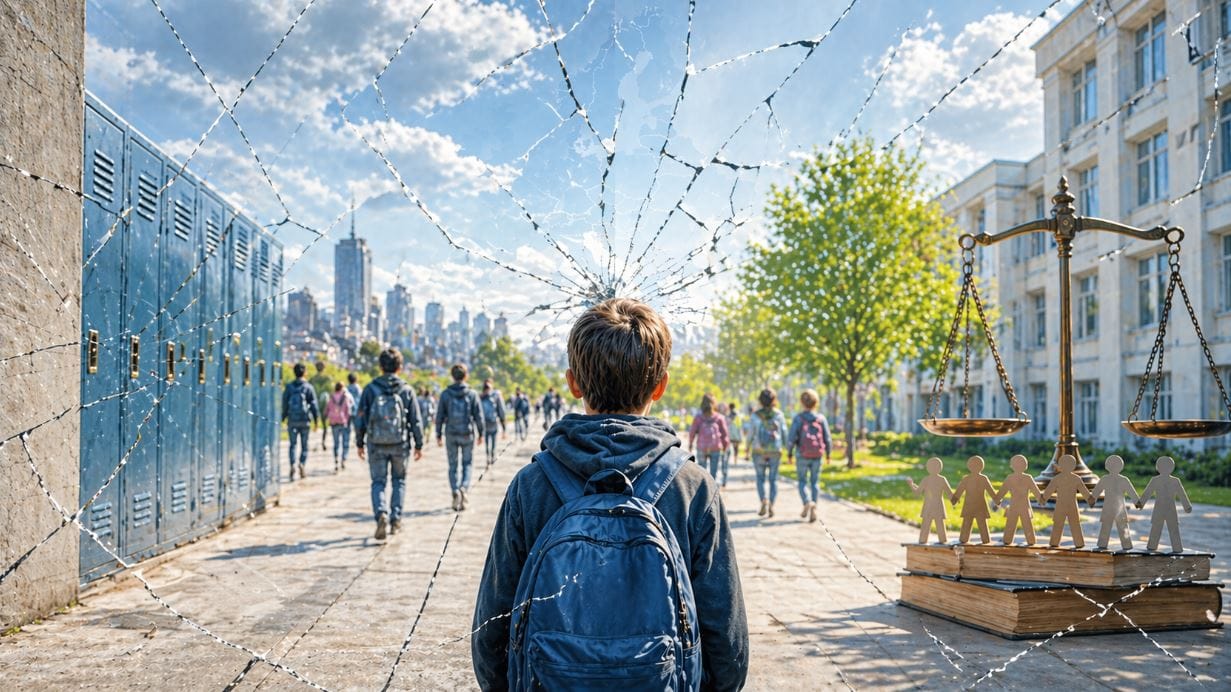
After the school attack in Kahramanmaraş, people spoke of “Americanisation”. Yet similar tragedies have happened in Europe too, from Finland to Austria; the common mechanism is often a licensed gun at home.
Okul şiddeti tablosunda Avrupa ve Türkiye nerede duruyor?
April 2024, Vantaa, Finland. At Viertola School in one of Helsinki’s suburbs, a 12-year-old opened fire on three classmates of the same age. The gun was a relative’s licensed weapon, and the child had no trouble at all getting hold of it.
Two years later, in April 2026, in Kahramanmaraş, some 4,000 km from Vantaa, a 14-year-old took the licensed guns of his father, a police chief inspector, and went to his school. Including those who later died in hospital, 10 people were killed in the attack.
The same mechanism is at work in both cases: the gun is at home, within the child’s reach.
Because similar incidents are so often reported in the US, the comment widely voiced on social media after Kahramanmaraş, “This is entirely the result of Americanisation”, is understandable, but it is surely an incomplete view.
Similar cases in Europe make it unnecessary to cross the Atlantic for comparison.
Germany
Let us start with Germany. In its answer to a parliamentary question for 2024 (Bundestag document No. 21/904), the German Federal Ministry of the Interior reported a total of 94,318 offences related to schools. Of these, 7,243 were violent offences and 743 were knife attacks. That means an average of about 20 violent incidents and two knife incidents a day. The rise between 2022 and 2024 is also striking. As might be expected, the data immediately became a source of political tension: the far-right AfD used it as a platform to reduce the issue to a migration problem.
Yet school violence must be read not only through the identity of the perpetrator but through the social and institutional ground that makes it possible.
This picture shows that in Germany, too, politics operates not with structural solutions in mind but with a reflex to produce visible and quick responses.
For example, a knife ban has been in force at Hamburg’s main railway station since December 2024. Yet in May 2025 another knife attack took place within the zone covered by the ban. The ban was not enough to stop knives. The lesson Turkey should draw from this is actually quite clear: political circumstances always make it harder to ask the right question. And failing to ask the right question does not solve the problem; it merely turns the cost into a deferred bill.
Sweden, Austria, Finland
When other examples are added to Germany, the European picture becomes clearer. In February 2025, at Campus Risbergska, an adult education centre in Örebro, Sweden, a 35-year-old attacker killed 10 people with weapons he carried in a guitar case. The attacker later died as well. According to witnesses, in buildings where classrooms open onto corridors, “there was blood everywhere”. The Swedish Prime Minister called it the worst mass shooting in the country’s history.
Following this grave incident, the Swedish government both tightened gun legislation and required all educational institutions to draw up plans to prevent unauthorised persons from entering. The Swedish police particularly stressed one point: after the incident, false narratives spread rapidly on social media, and tracking them became part of the investigation. In other words, how the incident was told became as much a subject of the investigation as the incident itself. The content produced by C31K after Kahramanmaraş shows how familiar this dynamic is in Turkey too.
In June 2025, at a secondary school in Graz, Austria, a 21-year-old former pupil entered his old school with a pistol and a shotgun he legally owned and killed 10 people. The Austrian government decided to raise the minimum age for a gun licence, tighten psychological tests and extend the waiting period. In both cases the executive gave a quick and visible response.
As we can see, immediately after every attack, states look for a quick response. Slow, structural prevention work stays in the background.
Let us return to Finland. The Vantaa attack in April 2024 is both tragic and an indirect mirror. The 12-year-old attacker used a relative’s licensed gun. One child was killed and two were seriously injured. The initial account of the motive centred on bullying. After the incident, Finland put bullying, children’s mental health and access to guns on the agenda. But beneath its ability to hold that debate lay an infrastructure that had already been working for years: the multidisciplinary “Ankkuri” model, made up of police, social workers, psychologists, educators and local government. The model was put to the test again in Vantaa.
According to experts, the Ankkuri model was effective in preventing chaos after the incident and in managing the post-traumatic process. However, the incident showed that a single model alone may not be enough to stop every tragedy, and that the infrastructure must be constantly updated, especially where social bonds weaken and individual isolation increases. As part of this model, Finland discussed lowering the age of criminal responsibility below 15 and further tightening checks on access to guns.
Where Does Turkey Stand?
To determine Turkey’s place in this picture, we need to look at a few differences and a few similarities. The difference first appears in the figures. In Germany we are talking about more than 7,000 school-related violent offences in a single year. In Turkey, by contrast, incidents following one another in a short space of time (a knife attack on a teacher in Istanbul, the shooting of a school principal in Anamur, the incidents in Siverek and Kahramanmaraş) point to a cumulative picture.
The figures to be added as background are, of course, striking:
According to the Umut Foundation’s 2025 Armed Violence Map report, 2,225 people lost their lives last year alone in 3,422 incidents of armed violence reported in the press. According to estimates previously shared by the foundation, there are around 4 million licensed and 36 million unlicensed guns in Turkey. In other words, for every licensed gun there is assumed to be a far larger pool of unlicensed ones. It is impossible to read Kahramanmaraş without these background figures.
The problem is not just five guns in a police chief inspector’s home, but a wider picture in which guns have become normal and this normality has opened a path for children to reach them.
Moreover, a motion for a parliamentary inquiry into this picture, submitted to the Grand National Assembly in January 2026, was rejected with the votes of the AKP and MHP. The motion called for “a multidimensional examination of the extent of individual armament, its links with violent tendencies and the adequacy of oversight mechanisms”. The Kahramanmaraş attack took place only three months after the motion was rejected.
There is a second similarity between Germany and Turkey: in both countries political debate tends to proceed through symbols rather than the real question. In Germany the symbol is the migrant child. In Turkey it is the digital environment and video games. Yet neither can the problem in Germany be attributed solely to the presence of migrants, nor the problem in Turkey solely to hours spent in front of screens. In both, the root of the matter lies in issues such as social exclusion, domestic violence, peer bullying, easy access to guns and the absence or inadequacy of institutional mechanisms that connect and assess the warning signs.
Visible Measures, Invisible Questions
We can say plainly that visible security measures may satisfy the public, but they are not enough to prevent violence.
So what should Turkey learn from Europe in the face of this picture?
Or, to put it in the context discussed above: does Turkey have a functional equivalent of the Ankkuri model?
On the surface it seems so: guidance and research centres, school counsellors, social service units within district directorates of national education… But when we consider that each of these structures answers to a different ministry, a different budget and a different chain of procedures, we can say that what forms the core of the “Ankkuri” model (a multidisciplinary threat assessment team working under one roof with real-time coordination) has no equivalent in Turkey.
There are guidance services, but according to available data, 500 pupils per school counsellor make it almost impossible to notice behavioural warning signs, form a chain and take action.
This is as much a question of priorities as of budget. If there is no standard threat assessment chain between the head teacher, the school counsellor, the class teacher, the family and, where necessary, the police, each is left with fragments of information and none of them can be linked into a chain. Kahramanmaraş paid the heaviest price for this gap.
Towards a Common Conclusion
The purpose of placing Kahramanmaraş alongside Germany, and Örebro alongside Graz, is not to reassure ourselves by saying “it happens there too, so it is not isolated”. On the contrary, the comparison reveals a far more disturbing truth. Even the countries with the world’s strongest welfare state mechanisms are struggling to solve this problem, because politics always chases short-term solutions that make a good photograph and shies away from long-term, in-depth investment.
The lesson Turkey should draw from this picture is clear: taking action after Kahramanmaraş by putting metal doors on schools, imposing restrictions on social media or applying age limits to screens only creates the appearance of a simple response. The real response is less charismatic and less headline-grabbing, but more long-term: tying the chain of access to guns to legal standards, building the staffing and procedural infrastructure to make the school guidance system work, creating institutional mechanisms through which teachers can link threat signals into a chain, and introducing a standard of media responsibility that takes the risk of “copycat attacks” into account.
Germany was not slow to realise this, but unfortunately the gap between knowing and doing does not close at once. Turkey cannot afford to widen this gap further, because the Siverek and Kahramanmaraş attacks took place just 28 hours apart.
The era of isolated cases is over. We now have to face this pattern. Looking from the corridors of Germany, Sweden and Austria, one can see where this pattern is heading. And at this point, it becomes even clearer how superficial our own debate has remained.
Sources
- German Bundestag, printed paper 21/904 dserver.bundestag.de
- Finnish Institute for Health and Welfare (THL) – Ankkuri thl.fi
- Swedish Police (Polisen) polisen.se
Monthly · free
Compass of the Month
Once a month: five points from Europe’s security and migration agenda and the month’s PUGAT articles, in your inbox.
Newsletter sign-up opens soon.
Read next

What is PUGAT? A non-profit community publishing independent analysis from Europe on security, migration and society in Turkish, German and English.
Go to the homepage
