


All the operations in Syria rested on the goal of toppling Assad; at the time of writing, however, the government was seeking reconciliation with Assad. According to the author, the operations came at a heavy price and their results are questionable.
Cross-Border Operations in Syria | 8
The AKP government and Erdoğan, who built every move in Syria since the start of the civil war around the overthrow of Assad, have now reached the stage of making peace and talking again with Assad. The operations carried out, the groups supported and the political and military policies, whether direct or indirect, are in fact the products of the strategy of removing Assad from power.
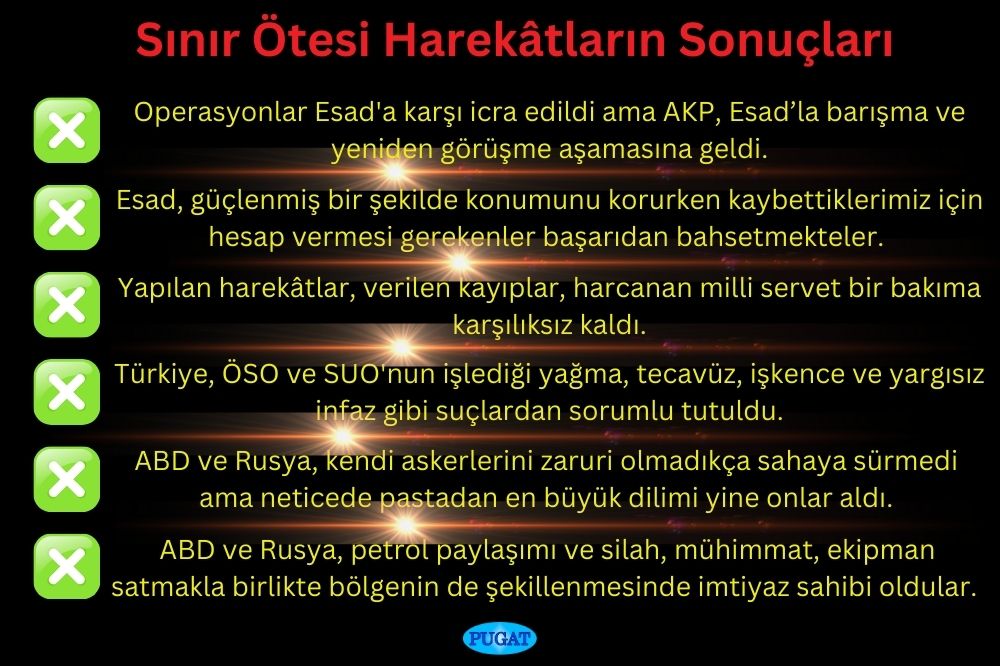
In the end, while Assad has held on to his position, even stronger than before, those responsible who should be held to account for every soldier we have lost and for our national interests are talking about success. Erdoğan and his administration, who punished with emergency decrees (KHKs) the senior officers, academics, bureaucrats and diplomats who were wary of the operations in Syria, did not want to drown our soldiers in the Syrian quagmire and wanted relations to be resolved through dialogue and political steps, should ultimately be seen as chiefly responsible for the losses.
While the AKP government and its supporters accused everyone who objected during or after almost all of the cross-border operations of “treason” and “not being national”, many citizens were also investigated and prosecuted for expressing their views and opinions. An administration with no tolerance for criticism and dissent put society under pressure through politics conducted over the blood and weapons of soldiers.
Turkey’s presence in the region has always been regarded by the Syrian regime as a “violation of national security”, and there have been many confrontations with the Syrian army. Over time the Assad regime has begun to regain control over its territory. It will be inevitable for Turkey to leave the areas where it has troops in the near future. The AKP administration, which wants to open a new chapter with Assad in particular, will acquiesce to the demand that it leave Syrian territory. Given the partnership between the Syrian government and the YPG in recent years, we can foresee that the YPG will have a say in the region and grow even stronger. In that case the operations carried out, the losses suffered and the national wealth spent will, in a sense, have been in vain. (Update: the Assad regime was overthrown on 8 December 2024, and a new administration with close ties to Turkey took power in Syria.)
Operations Whose Profit-and-Loss Balance Went Awry
Turkey was subjected to many accusations and smears because of the actions of members of the FSA and the SNA, which it chose as partners and which are its allies in the region. Turkey, which also took on the task of training and equipping many of them, was held responsible for crimes such as looting, rape, torture and extrajudicial executions committed by militants in these groups. Facing allegations of human rights violations, the use of prohibited weapons and war crimes, especially during Operation Peace Spring, Turkey drew many reactions from around the world and was also subjected to sanctions.
The US and Russia this time used Syrian territory as the ring for their long-running struggle for power and interests. Not sending their own soldiers into the field unless absolutely necessary because of their experiences in Afghanistan and Iraq, these countries ended up as the stakeholders taking the biggest slices of the cake. The US and Russia, which can never agree administratively or ideologically, formed a civilised partnership when it came to sharing oil and territory. Moreover, by selling weapons, ammunition, equipment and technological support to the local forces they backed on the ground, these countries gained a say and privileges in shaping the region.
It will be useful for seeing the overall picture to look at the operations we have examined in chronological order in light of the details mentioned above. History will deliver the final verdict on whether the operations were successful, in a region where we stood in the front line paying the price and fighting, while the gains were reaped by the other countries involved rather than by our people and our country. But it is also possible to make a profit-and-loss assessment on the basis of the available data, and I think readers can easily do so.
(End of the series)
(Continued in the series: Turkey–Syria Criminal Links)
Monthly · free
Compass of the Month
Once a month: five points from Europe’s security and migration agenda and the month’s PUGAT articles, in your inbox.
Newsletter sign-up opens soon.
Read next


What is PUGAT? A non-profit community publishing independent analysis from Europe on security, migration and society in Turkish, German and English.
Go to the homepage
