

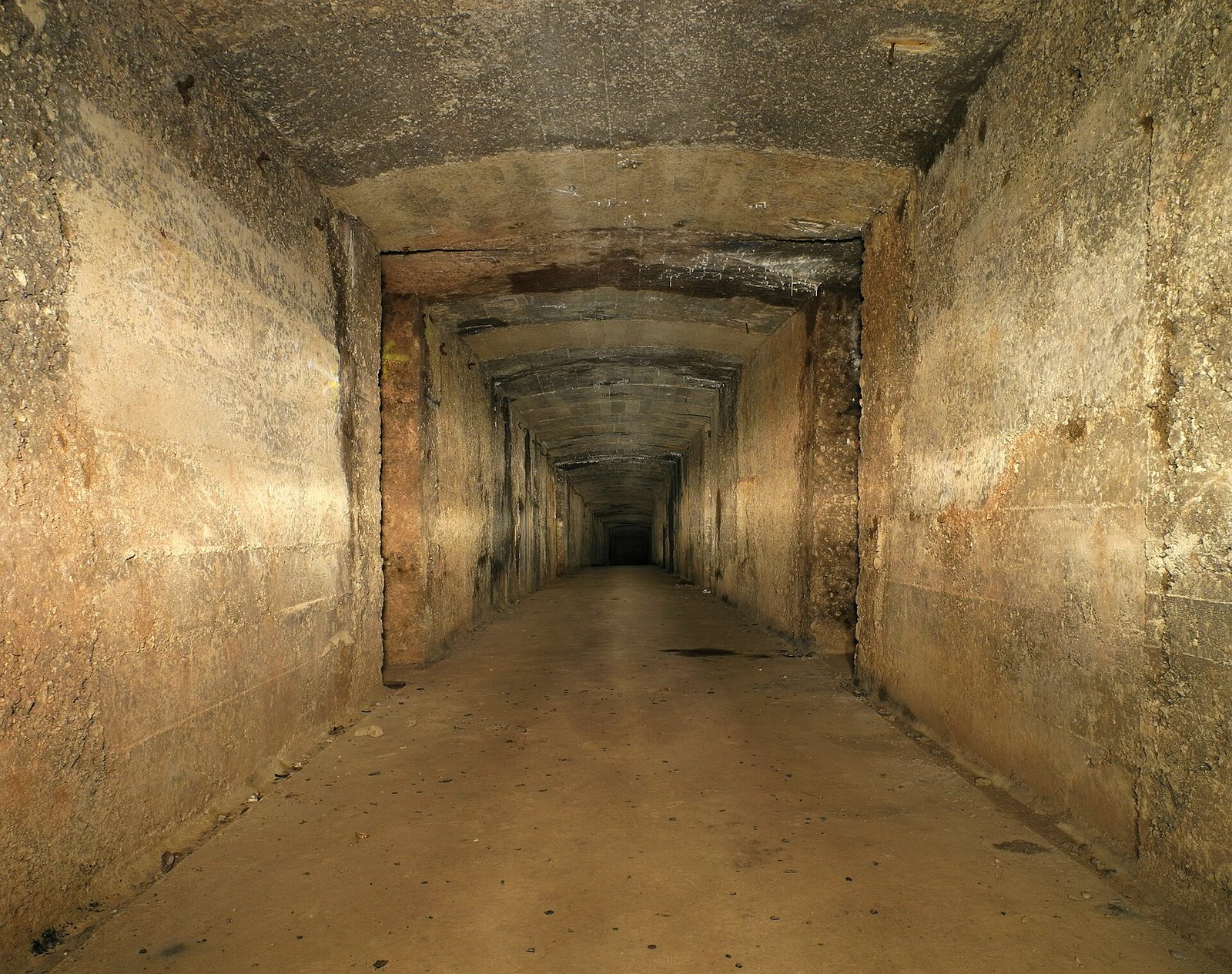
The fate of the war in Gaza will be decided underground. The history and construction of tunnels hundreds of kilometres long, and the challenges they will pose to the Israeli army.
In urban combat, the battlefield is divided into four main parts:
- The sky above the cities,
- Buildings reaching into the sky, offering observation points and opportunities to attack and hide,
- Wide and narrow streets lined with buildings, almost like a labyrinth, and
- The underground tunnels that will pose the greatest challenge to the Israeli army (IDF) when it begins to occupy the Gaza Strip in the coming days.
In this article we will look at the tunnels mentioned in the fourth item and at the Izz ad-Din al-Qassam Brigades, linked to Hamas, which control them. Military experts agree that the war in Gaza will be fought in underground tunnels up to 500 km long, which bombs and drones cannot reach and against which advanced satellites are helpless.
The History of the Tunnels
The first tunnels between Egypt and Gaza began to be built after the border arrangement of 1982. Israel’s first recorded discovery of a tunnel came in 1983. At that time, the tunnels were used to supply weapons to Palestinian fighters.
When Israel blockaded the Gaza Strip, it closed the border crossings that met Gaza’s needs. After a while it opened the Kerem Shalom (Abu Salem) crossing, through which it allowed goods such as food and building materials to pass. But the supplies received through this crossing did not cover even half of Gaza’s daily needs. Israel imposed strict quotas. The siege of Gaza began in 2006, when the Islamic Resistance Movement, better known as Hamas, won the parliamentary elections against Fatah. When Hamas fought Fatah in 2007 and drove it out of Gaza, Israel tightened the blockade further.
When Egypt also closed the Rafah crossing at that time, famine began in Gaza. During the famine, nearly a million people crossed into Egypt to shop through the crossing when it was occasionally opened, which whetted the Egyptian side’s appetite and led it to change its policies.
With the open-door policy Egypt introduced in 2008, the number of tunnels between Egypt and Gaza exploded. After that, the number of tunnels kept growing. According to the latest data, 60 per cent of Gaza’s 1.5 billion dollars of imports came through the tunnels. The rest came through the Israeli-controlled Kerem Shalom crossing. Only people were allowed through the Rafah crossing.
Building the Tunnels
People who have been to Gaza report that on the Egyptian side of the Kerem Shalom crossing, 5 km west of the crossing, tents set up to hide tunnel entrances could easily be seen.
Although the Egyptian side officially denied the tunnels existed, it turned a blind eye to them for reasons such as the activity they brought to the region’s economy, the kinship between the communities on both sides and political interests.
On the Egyptian side, tunnels usually start inside houses or gardens. The first step in construction is digging a chimney-like shaft. This shaft is about 1.5 metres in diameter and 5 metres deep, and its sides are reinforced with cement plaster. The shaft is then dug down to a depth of 20 metres. In tunnels used for military purposes, the depth can reach 40 metres. At this point construction of the horizontal part of the tunnel begins. This is the hardest part of the work. Tunnel diggers advance according to maps and coordinates, otherwise there is a high chance of running into another tunnel.
The quality, width and concealment of tunnels vary according to their purpose. Some tunnels are wide enough for motor vehicles, while others are only large enough for one person to pass.
Inside Gaza, the tunnels used by Hamas militants are of the highest level of concealment and quality. After taking over the administration, Hamas introduced taxes and certain rules for the use of the tunnels. It is estimated that taxes on these tunnels made up a fifth of Hamas’s revenue. Tunnel building is also a serious business sector. According to unofficial figures, at least 6,000 people are employed in it.

Tunnels from a Military Perspective
The use of tunnels in war is nothing new. Several volumes could be written about tunnel warfare from history to the present day. In recent history, for example, during the First World War the British inflicted serious losses on the Germans with tunnelling companies made up of miners. When the US found itself helpless against huge underground complexes in the Vietnam War, it set up units called “Tunnel Rats”, made up of small-built soldiers armed only with a pistol and a torch. But these units did not deliver the expected benefit. The soldiers who went into the tunnels worked at great risk from booby traps, narrow passages and darkness, and the tunnel networks largely kept functioning throughout the war.
Turning to the Gaza tunnels, it is highly likely that Israeli ground forces entering the tunnel complex, up to 500 km long, will share the fate of the US Army’s “Tunnel Rats”.
It is possible to stay inside Gaza’s military tunnels for long periods. Hamas’s leadership hides there. There are command and control centres. The tunnels are equipped with electricity, lighting and rail lines. Dr. Daphné Richemond-Barak, an expert on underground warfare at Reichman University in Israel, says Hamas has perfected tunnel construction and underground warfare methods in recent years.
The tunnels, which the Israeli army calls the “Metro”, were a main target in the operations of 2008, 2014 and 2021. In 2021 a total of 100 km of tunnel network is said to have been damaged. Even if these tunnels have not been rebuilt or altered, this means that probably hundreds of kilometres of complex and deep tunnel infrastructure are still in use in Gaza.
Indeed, the discovery of a tunnel exit near Kfar Aza, where dozens of civilians were killed in the terrorist attack carried out by Hamas on 7 October, shocked the Israeli side. If confirmed, this would mean the tunnel was built even beneath the underground concrete barrier, equipped with advanced tunnel-detection sensors, which Israel completed in 2021. (Update: later investigations showed that no cross-border tunnel was used in the 7 October attack; the attackers breached the barrier above ground.)
Hamas’s Military Wing: The Al-Qassam Brigades
Hamas’s military structure consists of two main organisations:
- The first is the internal security organisation that maintains security and order inside Gaza,
- The second is the Izz ad-Din al-Qassam Brigades, responsible for planning and carrying out attacks on Israel and defending the Gaza Strip from within.
If the Israel Defence Forces enter the Gaza Strip, the internal security organisation comes under the command of the Izz ad-Din al-Qassam Brigades. In addition, some of the armed elements operating within different parties, numbering around 6,000, come under the command of the Qassam Brigades.
The Izz ad-Din al-Qassam Brigades consist of 6 regional brigades deployed in the Gaza Strip, each with an average of 1,000 militants. Each brigade has at least 3 battalions, and each battalion 2 or 3 companies. Each company includes fighters, anti-tank teams, saboteurs and medics. They operate with a complete cell structure. Nobody from outside Gaza is admitted to the core cadre. In the parallel hierarchy, even platoon commanders do not know one another. They wear balaclavas during operations.
Apart from the Izz ad-Din al-Qassam Brigades, the number of militants serving in the internal security organisation is around 13,000. The total number of members of the Hamas-controlled Izz ad-Din al-Qassam Brigades and internal security forces therefore reaches 19,000. Together with other armed groups, the total reaches 25,000. The brigades are deployed from north to south.
Is the Israeli Army Hesitant to Launch a Ground Operation in Gaza?
After the terrorist act and the savagery carried out by Hamas on 7 October, it is impossible for Israel to achieve a political result with the air operations it announced to world opinion as self-defence, in which civilians are also targeted. In military terms, by the principle that “there is no victory where the infantry has not set foot”, a ground operation is highly likely.
As for the question in the heading… Yes, Israel is hesitant, because its 2014 operation was a failure. The real surprise of that war was not where and how Hamas made and launched thousands of rockets, but that it had good fighters. Al-Qassam militants know how to use cities well. They are equipped with very effective equipment, including modern anti-tank missiles and long-range sniper rifles. The armed terrorists whose faces were seen on screens during the 7 October massacre should not be confused with al-Qassam militants. Those groups were elements attached to the al-Qassam Brigades for the terrorist attack.
Hamas’s second advantage is the vagueness of Israel’s goal. The Israeli army has no motivation, in a logic of conquest, to flatten Gaza and plant a flag. Moreover, the potential of Gaza, kept under pressure for years with periodic operations, was seen in the terrorist attack.
With the 7 October massacre, Hamas opened Pandora’s box. Seen from a military point of view, the situation is a complete deadlock. Both sides have very little room for manoeuvre. It was known that Hamas was acquiring increasingly sophisticated capabilities, but after this latest attack its tactical capacity turned out to exceed estimates.
Hamas managed to overcome the walls on land and the famous Iron Dome air defence system in the air. Now it is waiting for the Israeli army underground, where it withdrew after its latest attack. On the other hand, how will the Israeli army impose its will on Hamas? It is possible to enter Gaza and carry out a ground operation. Even if they have the equipment and experience to cope somehow, this operation is very difficult. And it may become increasingly deadly for Israeli forces. It seems that another war is at the door, in which Hamas militants and the Israeli army will face each other underground and bullets will rain mostly on the civilians above ground. I hope there is a force representing reason among the world’s powerful states that will prevent this war.
Monthly · free
Compass of the Month
Once a month: five points from Europe’s security and migration agenda and the month’s PUGAT articles, in your inbox.
Newsletter sign-up opens soon.
Read next

What is PUGAT? A non-profit community publishing independent analysis from Europe on security, migration and society in Turkish, German and English.
Go to the homepage
