


In June 2021, KDP Peshmerga and the PKK clashed, while the Turkish Armed Forces pushed 30 km deep with the Claw-Tiger operations. The hottest period in Northern Iraq in recent years.
In the hot contact between KDP Peshmerga and the PKK terrorist organisation on 5 June 2021 in the Metina area of Duhok’s Amedi district, 5 Peshmerga lost their lives. The Peshmerga forces held the PKK responsible for the clash and the deaths. Then, on 27 July 2021, the PKK announced that it had lost contact with 3 of its members and blamed the KDP. The region is going through its hottest period in recent years.
Under the Claw-Tiger operations, the Turkish Armed Forces pushed about 30 km deep across the border. Turkey, which has set up permanent base areas at critical points, aims to gain area dominance in the region the terrorist organisation calls the Medya Defence Zones. The PKK’s moving south and wish to widen its area of operations, as its mobility was restricted, brought it face to face with the KDP. For some time the PKK has constantly been making life difficult for the Peshmerga in Erbil and Duhok, which the KDP controls.
To prevent local people from giving information to Turkish intelligence units, whether through the KDP or directly, the PKK makes its own approval a condition for local residents who want to go to and from their fields or villages. Naturally, this inflames the tension between it and the Peshmerga.
The Sinjar Agreement That Snapped the Ties…
ISIS’s attacks on Kurdish settlements after it seized many areas in Iraq and Syria had united the PKK and the Peshmerga in the same ranks. As a result of its war against ISIS, the PKK settled further into places such as Sinjar and Kirkuk. When the Peshmerga withdrew from Sinjar on 17 October 2017, the PKK strengthened its presence there by coming to terms with the Hashd al-Shaabi. The Hashd al-Shaabi are Shiite paramilitary, semi-official armed units formed following the fatwa of Ayatollah Sistani, Iraq’s leading Shiite cleric, calling for national mobilisation against ISIS. Although the Hashd al-Shaabi is made up of different groups, it is indisputable that it is under Iran’s influence.
Turkey naturally does not want the PKK to grow stronger in Shengal. The presence of the Hashd al-Shaabi, meanwhile, is unwelcome for both Turkey and the US given their current Syria policies.
As will be recalled, on 9 October 2020, under UN supervision, the “Sinjar Agreement” was signed between the Iraqi Federal Government in Baghdad and the KRG in Erbil to secure Sinjar and rebuild the region. The agreement provides for ending the presence of the Hashd al-Shaabi units and of the PKK and groups linked to it around Sinjar. I would like to note that although a year has passed, no moves have yet been made to implement the terms of the agreement.
Why Is Sinjar Important?..
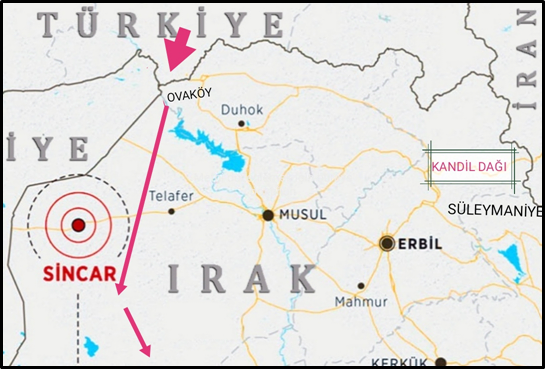
Mount Sinjar, as can be seen on the map, lies in a strategic area between Syria and Iraq and is a very important region and route for both the PKK and Iran. Mount Sinjar is also very well suited to sheltering and defence. It is also the most suitable route for the connection between Iran and Syria.
The PKK argues that while the Peshmerga withdrew and left Sinjar to ISIS, it fought to protect the Yazidis and paid a price. That is why it claims a say in the administration.
Iran wants to keep this place under its control in order to keep its connection with Syria strong.
The US wants the Hashd al-Shaabi to leave the region to prevent Sinjar becoming a safe military harbour for Iran’s intervention in Syria, while trying to whittle down the PKK and set up a more local Kurdish structure. In this way it wants to make the Kurds it turned into actors in Syria an acceptable element in Syria’s future too. It also sees the PKK as an obstacle between the Syrian Kurds and the KRG.
Turkey, for its part, wants the Iraqi central government to take control, out of concern that the PKK could make Mount Sinjar a second Qandil.
The Claw-Eagle Operations…
Looking at the timing of the Claw-Eagle operations, it can be said that a consensus that includes the US wants to sever the ties between the PYD and the PKK. We can assess that this move by the US, which will please Turkey in the short term, is aimed in the long term at uniting the Syrian and Iraqi Kurds.
In this context, Defence Minister Hulusi Akar’s visit to Baghdad on 19 January 2021 was important. During Akar’s visit to Baghdad, the Sinjar operation and the Ovaköy Border Gate were among the main topics discussed. Turkey conveyed that it would carry out an operation in Iraq if the PKK was not removed from Sinjar. The Ovaköy Border Gate is planned as a second border gate between Turkey and Iraq besides the Habur Border Gate, in order to squeeze Erbil, which is economically dependent on Turkey. The new border gate planned at Ovaköy will connect directly to Baghdad via a motorway passing east of Mount Shengal. The Erbil administration is of course aware that a new border gate 20 km from the Habur Border Gate is part of plans aimed less at need than at sidelining it.
The KDP, which does not want to relive the helplessness it experienced when it set Turkey and Iraq against itself with the independent Kurdistan referendum in 2017, is acting together with Turkey against the PKK, in line with its own political goals. On the other hand, since the PKK’s weakening would mean the KDP growing stronger not only in Iraq but also in Syria, this makes it necessary for Turkey to work with the Baghdad government.
Finally, we can say that the Claw-Tiger Operations are a series of operations cooked up in the US kitchen to bring the PKK to its knees in Syria. At the current stage, although the Claw-Tiger Operations appear tactically successful, the PKK’s settling in Rojava from 2013 onwards, beginning with the peace process, and its gaining legitimacy by fighting ISIS were a strategic mistake of the AKP government.
What do they say? Strategic mistakes cannot be made good by tactical successes!
Monthly · free
Compass of the Month
PUGAT’s monthly newsletter.
Read next


What is PUGAT? A non-profit community publishing independent analysis from Europe on security, migration and society in Turkish, German and English.
Go to the homepage
