

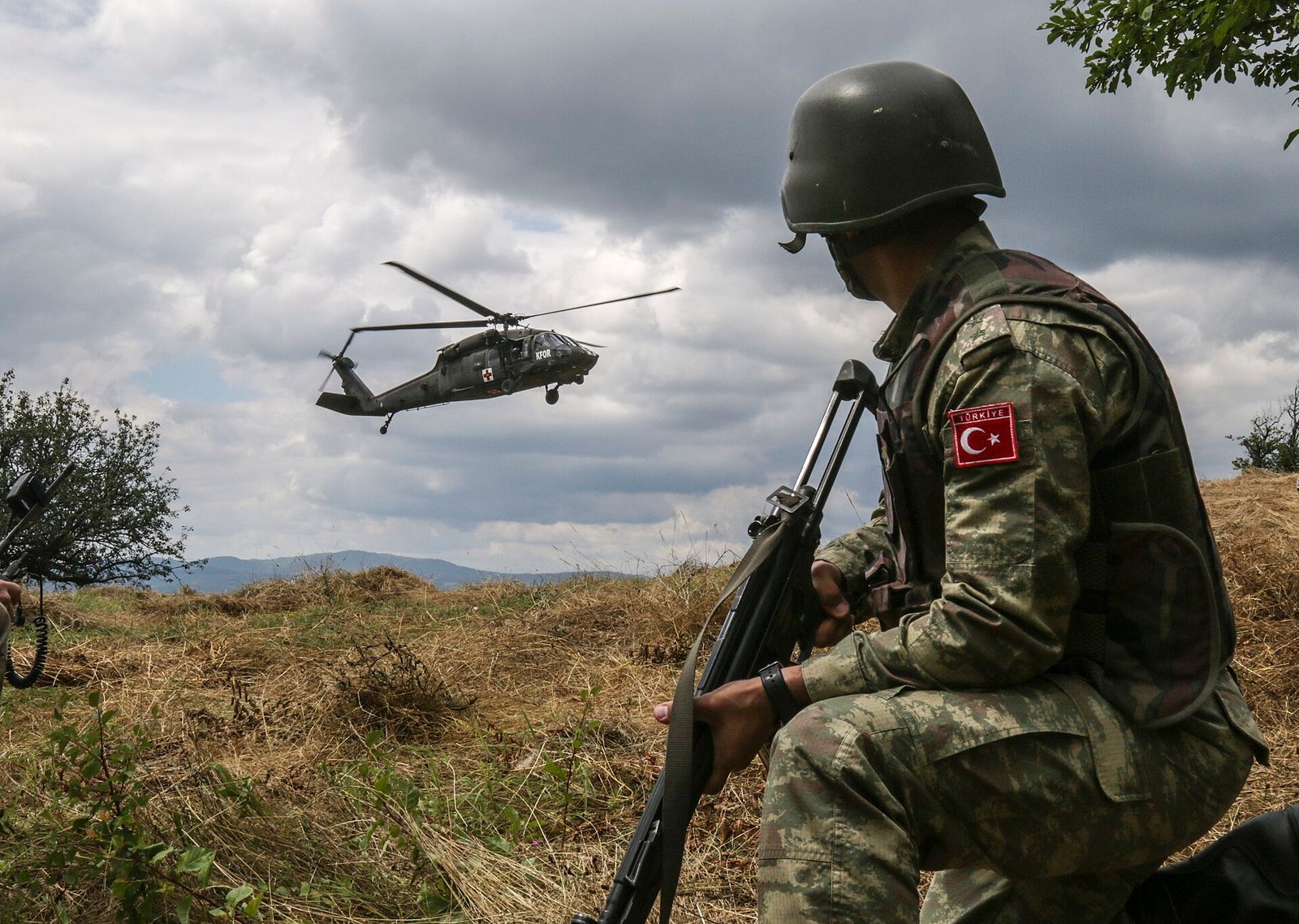
Fifty-six specialist sergeants serving in Libya were dismissed for filing a collective complaint of mobbing with CİMER. Through the battalion commander’s words, the author questions the notions of hierarchy and honour in the army.
In recent days, a hashtag was launched on Twitter about 56 specialist sergeants serving in the Libya Task Group Command of the Turkish Armed Forces. The specialist sergeants, who claimed that their commanders subjected them to psychological and physical mobbing, were dismissed from the profession on the grounds that they had filed a collective complaint with CİMER (the Presidential Communication Centre). Reading the details of this incident, which drew little attention amid a busy agenda, I was struck by the sentences the battalion commander used in a speech addressed to the specialist sergeants. Without going into technical details, I wanted to write down my thoughts on these words.
Battalion Commander: “You do not deserve the money you get. This TSK has eaten generals; you are nothing. You can complain about me wherever you like, I worked in the Legal Branch for 9 years. Throwing you out of the profession takes me 5 minutes. There are thousands of people outside who want to be in your place.”
The young specialist sergeants, who took the commander’s warning speech, in which he described the new era with reference to the post-15 July purges, as an empty threat, may not have thought that things would come to this, but I also think that the punishment given to them holds a lesson for all specialist sergeants.
In the atmosphere that formed after 15 July, a considerable number of personnel in the TSK, especially many specialist sergeants, welcomed the armed forces being used as a tool of politics. In the Gendarmerie General Command, after the organisation was attached to the Interior Ministry, it was voiced that soldiering would now end and peaceful working conditions would emerge within a looser chain of command. Specialist sergeants, whose personal rights had been neglected for years, committed themselves more quickly to the political will out of an emotional reflex.
With the intensive recruitment after 15 July, the TSK took on 70,000 and the Gendarmerie General Command 90,000 new specialist sergeants, bringing the total, together with the existing ones, to over 200,000. Yet many of the problems concerning personal rights that specialist sergeants had raised for years were either partly solved or not solved at all.
As for the personnel’s level of training… I am someone who personally gave specialist NCO training at the Foça Commando School for 4 years. While teaching soldiering to the specialist NCO trainees, we would first explain the laws they were subject to, the legal rules they had to obey, the rights they had, and that soldiering cannot be done for money alone. Each trainee would take in whatever he could in 3 months according to his capacity and then be sent to his unit. As in Atatürk’s saying “The real school is the unit”, in the first years in the unit the team commander and the company commander would work on the young specialist sergeant like a teacher and produce a good soldier. Although the system was not flawless, it had reached a good point. After 15 July, however, tens of thousands of specialist sergeants were recruited before the necessary infrastructure was in place. In a TSK already suffering a shortage of officers and NCOs, it was not possible for these young people to be trained by their first superiors in the unit; indeed, under thousands of NCOs and officers of the same calibre who had just started their duties, a different, undisciplined generation grew up, contrary to the spirit of soldiering. The more senior officers, meanwhile, remained indifferent, or perhaps were intimidated, in the face of a new personnel model they were not used to, one that brought in politicians at every opportunity.
Imagine a specialist sergeant coming up and being able to say: “Commander, why do you keep calling me to the barracks? Are you a FETÖ member too?” And the district governor being able to prevent this person from being punished. I could give hundreds of far more serious examples. In such an environment, who will train whom, who will be a superior to whom?
Here I want to open a parenthesis and continue by recounting a conversation I had with one of the reserve officer cadets training at the Foça Commando School… One day when I was on duty, I was walking around the regiment building at night. A young reserve officer candidate was smoking on the stairs and heatedly recounting on the phone an argument he had had during the day with one of the trainees. I overheard without meaning to. When he saw me coming up the stairs, he stood up. I asked his name; “Ozan,” he said. “Come on, Ozan, since you can’t sleep, let me buy you a tea.” Over tea I said: “I happened to overhear your phone call. It’s an interesting point of view, but I advise you not to get into arguments like this when you go from here to your unit.” Ozan had argued with a specialist sergeant trainee who admired the AKP and had told him something to the effect of: “Use your head! You are the lowest-ranking personnel in the TSK. The environment in which you can best defend your rights legally and be least exposed to personal mobbing is a real democracy of Western standards. In fact, if we achieved such a democracy you would not even want to be a specialist sergeant, but the mindset you worship has no such intention, and in a country where that mindset grows stronger, the air you breathe will be even more stifling.”
Yes, Ozan had made exactly the right diagnosis. The only power that will protect those at the bottom of the hierarchy is the law. But which law?
There is no doubt that the battalion commander in this latest incident with the specialist sergeants knows the regulations, but when he says “You can complain about me wherever you like, I worked in the Legal Branch for 9 years” he is not pointing to the insufficient legal knowledge of his subordinates. If that were so, he would not have used the expression “This army has eaten generals” before that sentence. From these words of the battalion commander I take the meaning: whoever, depending on the conjuncture, has the political will behind him never has his back put to the ground, and you “serfs” cannot bring me down even if you are right.
Monthly · free
Compass of the Month
PUGAT’s monthly newsletter.
Read next


What is PUGAT? A non-profit community publishing independent analysis from Europe on security, migration and society in Turkish, German and English.
Go to the homepage
