

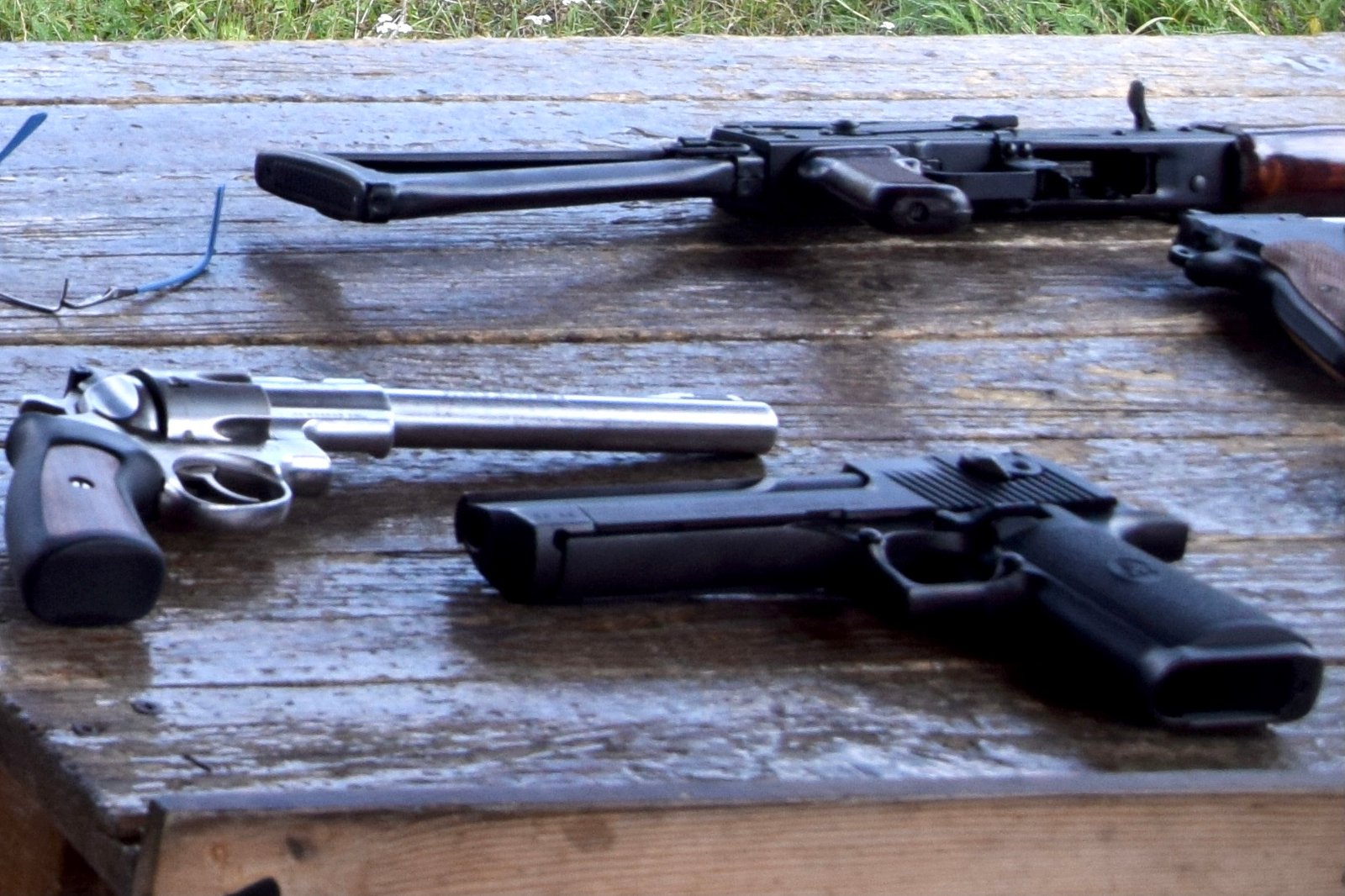
Since 2016, rhetoric that eases the acquisition of licensed firearms has eroded the principle that the monopoly on violence belongs to the state. Individual armament is turning into a security problem in Turkey.
On 17 July 2016, on a live TRT broadcast, Chief Presidential Adviser Şeref Malkoç announced that the way would be opened for buying licensed firearms. As justification for his unfortunate statement, reported in the national and local press as “Everyone will be given a gun”, Malkoç cited citizens’ ability to exercise their right to self-defence against coups and claimed that the guns used in crimes such as homicide were unlicensed.
It is incomprehensible that a state whose purpose should be to keep people alive openly supports an armament that causes thousands of deaths and injuries every year. For the highest officials of a state that claims to hold the monopoly on violence to say “Arm yourselves and use your right to self-defence” is a terrible mistake. How this rhetoric resonated with citizens is well known; it is equally clear how it damaged the acceptance, built up over many years together with civilisation, that the monopoly on violence belongs to the state. Where we have ended up is the perception, created among citizens, that “I must defend my rights myself”.

Interior Minister Süleyman Soylu, who almost boasted of never having read a single security article, denied a statement by the Umut Foundation on the number of unlicensed guns. According to this statement there were more than 20 million guns in Turkey and ninety per cent of them were unlicensed. Yet Small Arms Survey, an organisation known internationally for its research on firearms, also shares data showing that unlicensed guns make up a very large share of the total. The minister, who said “There is no such thing as a number of unlicensed guns”, compared Turkey’s rates with the licensed-gun rates of countries such as Finland and Sweden and, through a rhetorical sleight of hand, ended up saying “We are much better off than Europe”. As if the country where women and children are murdered every day, or where it has become normal for someone to snap and kill whoever is in front of them, were Finland or Sweden and not Turkey.
In debates on individual armament, the high rates of licensed guns per capita in countries such as Finland, Sweden and Switzerland are often stressed in order to divert attention. Yet it is a well-known fact that most guns in Finland are used for hunting, which is very widely practised there as a sport and a necessity. Another well-known fact is that in Switzerland those who have done their military service are allowed to keep the weapons they used in service after it ends, and that this is reflected in the statistics.
On the other hand, we all know that the European average being higher than Turkey’s does not change the fact that there are many times more unlicensed guns in Turkey than in Europe. Indeed, Turkey was also shown among the countries with the fewest deaths in coronavirus statistics, and the data never matched reality.
Moreover, unregistered guns are a problem not only in our country but throughout the world. Such guns are obtained without any legitimate legal reason and are generally used to commit crimes. For example, we can look at a heart-breaking incident in İzmir that shows how easy it is to obtain unlicensed guns in Turkey. According to the killer’s own statement, Funda Güçlü and her father Yahya Köşek and mother Meryem Köşek were murdered simply because they fed street dogs. According to Sinem Güçlü, a grieving member of the family, the killer’s gun was also unlicensed. Unfortunately, similar news can be found every day.
Denial of the Current Situation and Persistence in Encouraging Armament
If you read the reports Turkey submitted to international organisations until recent years, the Umut Foundation was the only NGO mentioned by name; the government’s choice of a policy of denial now can only mean that the current government is declaring its own helplessness. For Turkey’s reputation (!) regarding unlicensed guns appears to have crossed its borders. That German and European law enforcement have to deal with the problem of Turkish-made blank-firing pistols being converted into functional firearms has even appeared in reports.
The result of the persistent efforts to arm the nation is clear: more crime, more deaths. Although at the time of writing the state had for 3 years avoided publishing the statistics on deaths and causes of death it used to publish every year, judicial statistics and social media reveal the gravity of the situation, at least in part.
Some Data in the Light of Judicial Statistics
Statistics on deaths and causes of death, which began to be compiled electronically via the Death Notification System in 2013, have not been published by TÜİK for 3 years. Critics suggested the delay was meant to conceal the number of deaths caused by the coronavirus, though this cannot be established as fact; the delay also made it harder to assess the fatal consequences of armed violence.
Moreover, the judicial statistics published every year do not, contrary to the purpose of their publication, allow meaningful comparison or conclusions for crime prevention. Nevertheless, according to the data on the Distribution of the Number of Offences by Offence Type in Files Opened in Criminal Courts under Special Laws, in the justice statistics published by the General Directorate of Criminal Records and Statistics, we see that the number of offences allegedly committed under Law No. 6136 on Firearms, Knives and Other Tools kept rising, except in 2020: (2016: 48,019; 2017: 50,556; 2018: 58,369; 2019: 60,764; 2020: 35,581; 2021: 67,069 / Justice Statistics, 2016–2021) <Chart-1>

According to the data on the Distribution of the Number of Decisions on Defendants’ Offences by Offence and Decision Type in Files Concluded in Criminal Courts under Special Laws, the number of decisions given under Law No. 6136 on Firearms, Knives and Other Tools also kept rising, except in 2020: (2016: 74,484; 2017: 78,252; 2018: 96,990; 2019: 108,244; 2020: 80,949; 2021: 125,120 / Justice Statistics, 2016–2021) <Chart-2>

In addition, the number of decisions issued during the year by Chief Public Prosecutor’s Offices at the investigation stage concerning suspects of offences in breach of special laws was 493,711, and looking at the distribution by type of offence, offences in breach of Law No. 6136 on Firearms, Knives and Other Tools ranked first with 84,519 (Justice Statistics, 2021).
The Problem of Unregistered Guns and Mafia-Like Structures
Unregistered guns mean support for the growth of uncontrolled mafia-like structures. None of us can imagine an unarmed bandit, tough guy or mafia boss. Because the mafia-like structures now defined as organised crime groups practically feed on guns. From the arms trade, a problem in itself, to every other type of crime we can list under organised crime, from threats to homicide, the gun is the main element.
As you know, there is a famous saying: “The universe abhors a vacuum.” We can say, for example, that individuals or structures that evolved over time from bandits to tough guys and from tough guys to mafia bosses flourished in their societies as if filling certain sociological, legal, moral and economic gaps. We cannot see organised crime groups newly grown fat in Turkey, such as the migration/human-trafficking mafia, the justice (!) mafia and the debt-collection mafia, as independent of the major shortcomings of the legislature, executive and judiciary and of the government’s mistakes. Because what keeps mafia-like structures going is, first of all, authority and then the very society they emerge from.
Old and New Problems in the Question of Individual Armament
We can already say that, in parallel with technological developments, we will face entirely new problems in individual armament in addition to the existing ones. To give a simple example, it is terrifying that even an invention meant to make our lives easier, such as 3D printers, can be used to manufacture weapons by criminal organisations or out of individual curiosity and the like.
Another problem is that even legally traded guns, whose place and maker of manufacture are known up to a point, are diverted into illicit circulation.
The example of the former Yugoslavia shows how big a problem weapons used without control in former conflict zones can cause later on. It has been found that people who armed themselves amid the war and unrest that followed the break-up of Yugoslavia, but who thought they no longer needed these weapons, got rid of them. These weapons are still found in crimes committed in European countries such as Germany.
Combating Individual Armament
It is impossible to cope with the problem of armament through national measures alone. Faced with a problem that must be fought with collective reason at national and international level, states that encourage individual armament must be opposed in the strongest terms on international platforms.
Given the incredible speed of technological developments, extra measures must also be taken to combat unregistered guns. Otherwise a response that fails to keep pace with the scale of the problem could lead to chaos, especially in times of social strain.
Those who govern Turkey should not try to cover up their incompetence in fighting illegal armament with a policy of denial; they should immediately stop encouraging armament, establish justice and try to free their citizens from the “Shouldn’t we defend ourselves too?” mindset.
One of the main duties of the organisation we call the state is to keep people alive through all its institutions and actions.
Keep the people alive so that the state may live!
Monthly · free
Compass of the Month
PUGAT’s monthly newsletter.
Read next


What is PUGAT? A non-profit community publishing independent analysis from Europe on security, migration and society in Turkish, German and English.
Go to the homepage
