

Founded in 1982 with Iranian support, Hezbollah has become an armed force stronger than the Lebanese army. With its rocket and anti-tank arsenal, guerrilla experience and tunnels, how long can it hold out against Israel?
A Brief History of Hezbollah
Hezbollah was founded in Lebanon in 1982 during Israel’s invasion of the country, but its roots go back to an organisation called the Amal Movement. The Amal Movement had been founded in the 1970s by Imam Musa al-Sadr to defend the rights of the Shia community. Amal was the first major structure of Shia resistance. However, under the influence of the Israeli invasion and the Iranian Islamic Revolution, a more radical group emerged from within Amal. Founded with Iran’s support, this group took the name Hezbollah and embraced armed resistance against Israel.
Hezbollah’s limited role in the fighting of the Lebanese civil war (1975–1990), apart from its clashes with Amal in the war’s final years, is an important reason why it was able to shift the balance within the country in its favour. From its founding until the Syrian civil war, Hezbollah positioned itself solely as a resistance movement against Israel. But by entering the war in Syria on Assad’s side, it abandoned this line. While this drew a reaction from Lebanon’s Sunni population, Hezbollah gained significant military experience. It also won the full trust of the Assad regime.
Views of Hezbollah among Lebanon’s population also vary. The Sunni population (25–30%) is critical of Hezbollah; its role in the Syrian civil war in particular, and its refusal to lay down its weapons in breach of the Taif Agreement signed in 1989, have been major subjects of controversy.
The Christian population (30–35%), meanwhile, is divided. Some Christian groups cooperate with Hezbollah, while others perceive the organisation’s influence in Lebanon as a threat.
As for the relationship between the Lebanese army and Hezbollah, the Lebanese army is the state’s national defence force and is independent of Hezbollah. In practice, however, especially in southern Lebanon, indirect cooperation between the two forces can be observed. The Lebanese army generally avoids intervening against Hezbollah and turns a blind eye to its struggle against Israel. Because Hezbollah is militarily stronger than the Lebanese army, a not insignificant part of the population has accepted Hezbollah, especially in matters of security and defence.
Hezbollah’s Military Capacity
Hezbollah’s ground force is estimated at between 20,000 and 30,000. This force concentrates on guerrilla warfare and has a flexible and mobile structure. Its well-trained fighters gained experience particularly in southern Lebanon and in the fighting in Syria. The ground force is organised in small cells or mobile units. It also has more sophisticated military units such as missile units, tank and anti-tank units and special forces. The ground force is further supported by underground tunnels, mines and hidden bases.
Many military experts agree that rocket and missile attacks are at the centre of Hezbollah’s main defence and deterrence strategy. Israel also cites this missile threat as its reason for entering Lebanon.
Let us take a brief look at what Hezbollah’s rocket and missile inventory contains.
- Anti-tank guided missiles, also known as ATGMs. With these missiles Hezbollah managed in the 2006 war to hit Merkava tanks, which Israel had equipped with its most advanced systems.
- The 9M113 Konkurs can penetrate around 600 millimetres of armour and has a maximum effective range of about 4 kilometres. Intelligence reports indicated that thousands of ATGMs and Konkurs missiles fell into Hezbollah’s hands after the Syrian civil war.
- In addition to these missiles, Hezbollah is known to have plenty of Western-origin anti-tank guided munitions such as Milan and TOW, as well as the Toophan missile, an Iranian copy of the US-made BGM-71 TOW.
- Hezbollah has another effective anti-tank weapon, and the story of how it was acquired is interesting. During the 2006 war with Israel, Hezbollah members captured an intact fourth-generation Spike MR guided missile. Israeli soldiers had forgotten to take the missile with them as they withdrew. Hezbollah wasted no time in sending the missile to Iran, which copied it and named it Almas. After launch, the missile first climbs and then dives rapidly onto the turret, the tank’s weakest point. Its range is four kilometres, but there are also versions with ranges of 8 and 16 km. How many of these missiles Hezbollah has is unknown. After this development, Israel upgraded the turret armour of its tanks with advanced technology.
- US intelligence reports have also revealed that Hezbollah has another anti-tank weapon used in the war in Ukraine. The weapon that can overcome the advanced defence systems of Israeli tanks is the RPG-30, developed by Russian engineers. This system consists of two projectiles. When the user fires, the system first launches a decoy so that the target tank’s active protection system concentrates entirely on it. The main projectile is fired immediately afterwards. While the system is dealing with the decoy, the second projectile gains a window of 20 to 40 milliseconds. If the second projectile reaches the target within this time, the protection system can do nothing. These missiles, which are also produced by Iran, are believed to be in Hezbollah’s hands as well.
- Another way to stop tanks is to fight tank against tank. How many tanks Hezbollah has inside Lebanon is unknown. It is known that while fighting in Syria some of its militants received tank training there and that it formed tank battalions. Open sources also reported that Hezbollah had 75 tanks in Syria. Given the mountainous terrain of southern Lebanon, Hezbollah may use its tanks against Israeli tanks.
Hezbollah is also known to have a wide variety of Iranian-made ballistic missiles capable of carrying warheads of up to 500 kg. Although having tens of thousands of rockets and missiles with very different characteristics is an important advantage, under normal conditions it is very difficult to penetrate Israel’s layered air defence system, made up of air defence weapons such as Iron Dome, David’s Sling and Patriot, with these rockets. Hezbollah aims to overcome this defence by firing missiles at a level the system cannot withstand. How far this is possible is, of course, debatable. Israel’s air and intelligence power is at a level that can respond instantly to such a barrage.
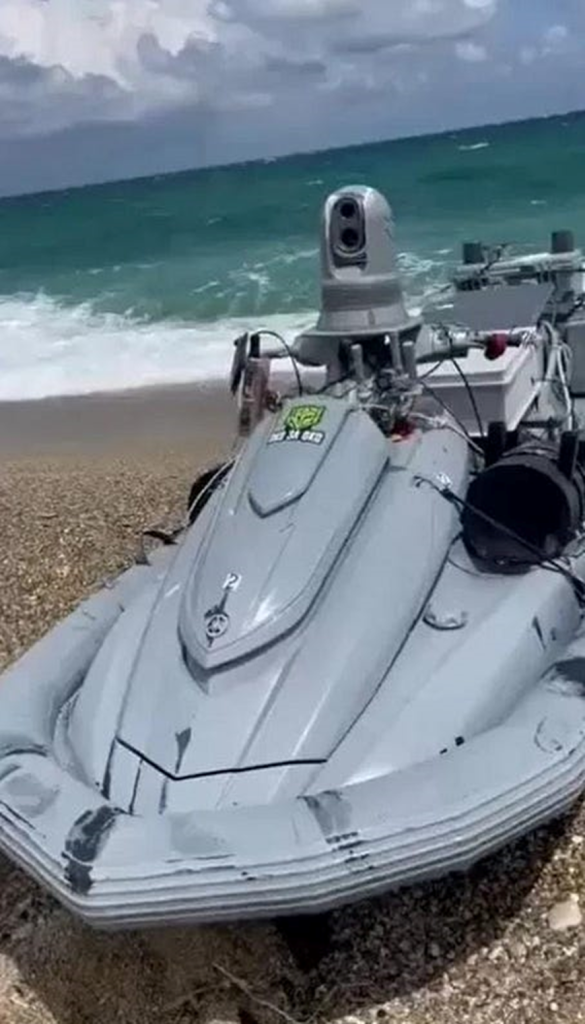
Hezbollah also has a naval unit it calls the Mediterranean Command. Although modest, the Mediterranean Command managed to hit a fully fledged Israeli warship in the 2006 Lebanon war. The ship was put out of action by the damage. A Chinese-made C-701 or C-802 missile is believed to have been used in this incident. Iran bought these missiles from China and then began producing its own copies. The range, 120 km in the first version, was increased to 200 km in the second. A video released in 2019 shows Hezbollah in possession of at least six C-802 missiles. Beyond these, it is known to have naval craft such as unmanned explosive-laden jet skis.
Hezbollah has an abundance of Ababil-series suicide drones.
The Course of the Hezbollah–Israel War
In a possible war between Hezbollah and Israel, Hezbollah will build its defence on its geographical advantage in Lebanon, its underground tunnels and guerrilla tactics, and will target Israeli cities with its missiles whenever it gets the chance. Israel, for its part, wants to bring Hezbollah to its knees with its powerful air force, advanced intelligence and technology-supported armoured ground units. Of course, the geographical advantage here lies with Hezbollah.
In the first stage the Israeli Air Force began bombing in particular the Bekaa Valley, Hezbollah’s logistics hub, arms depot and gateway to Iran, as well as secret military sites identified by its intelligence units. One way of preventing the coordinated missile attacks mentioned above is not to leave the airspace empty. This was an expected development. After inflicting as much damage as possible, Israeli ground forces supported by armoured units are expected to enter southern Lebanon.
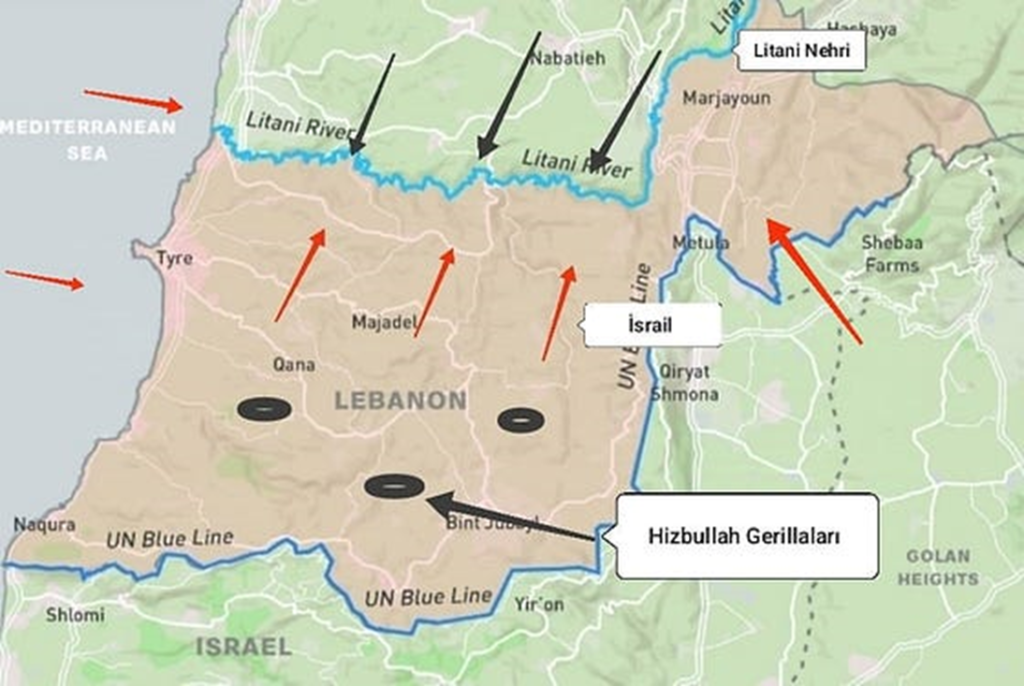
The war’s centre of gravity is expected to be the Litani River. The Litani forms an important natural barrier in southern Lebanon, and this area is known as one where Hezbollah’s military activity is concentrated. In past operations Israel aimed to clear the area south of the Litani of Hezbollah. A possible operation could begin with large-scale ground attacks on this area. The river line is strategically important because it contains many positions Hezbollah uses for missile and rocket fire.
Conclusion
Although the war that has begun between Hezbollah and Israel favours Israel in terms of military capacity, geographical advantages and defensive warfare will give Hezbollah advantages. While Israel does not hesitate to target even civilian areas with lawless methods of warfare and devastating firepower, how Hezbollah will resist such force is a big question mark. With defensive warfare based on guerrilla tactics, they may be able to hold out for a while longer in Lebanon’s mountainous terrain. But what will decide the end of this bloody conflict is not only military superiority or strategic advantages, but also the attitude of international public opinion and where the regional balances shift. Update (October 2026): After this article was written, Hezbollah leader Hassan Nasrallah was killed on 27 September 2024, Israel launched a ground offensive in southern Lebanon in October 2024, and a ceasefire was declared in November 2024. The fall of the Assad regime in December 2024 cut the organisation’s overland supply routes from Iran. In the war that resumed in March 2026, Israel entered southern Lebanon again, and as of October 2026 it occupies a large area along the border. The Lebanese state openly aims to disarm Hezbollah; the organisation is weakened but not defeated.
Sources
- Aurélie Daher, “The Transformation of Hizbullah” (Middle East Journal, 2011)
- Anthony H. Cordesman, “The Military Performance of Hizbullah in the 2006 War”
- Augustus R. Norton, “Hizbullah’s Political Strategy”
- CSS ETH Zürich css.ethz.ch
- Al Jazeera – How October 7 changed Lebanon and Hezbollah’s political reality (9 October 2026) aljazeera.com
Monthly · free
Compass of the Month
Once a month: five points from Europe’s security and migration agenda and the month’s PUGAT articles, in your inbox.
Newsletter sign-up opens soon.
Read next


What is PUGAT? A non-profit community publishing independent analysis from Europe on security, migration and society in Turkish, German and English.
Go to the homepage
