


The arrest of former soldier and security expert Metin Gürcan on espionage charges raised the question of who is chosen as a target in polarised politics, and why.
First of all, this article is not meant to clear or accuse anyone.
In recent days we witnessed the arrest of Metin Gürcan, a former soldier, then an academic and now a founding member of the DEVA Party, on charges of military and political espionage.
Metin Gürcan is a soldier who served for many years in the Turkish Armed Forces (TSK) within the Special Forces Command and retired at his own request. Having completed a master’s degree in the US and a doctorate at Bilkent University, Gürcan wrote on foreign policy and security for many media outlets.
Metin Gürcan, who criticised retired Major General Cihat Yaycı, one of the shadowy figures of 15 July, with the words “Who on earth have we entrusted this vast army to?” and lashed out “He is talking nonsense”, was among the names that stood out for comments that undercut every step taken by the government.
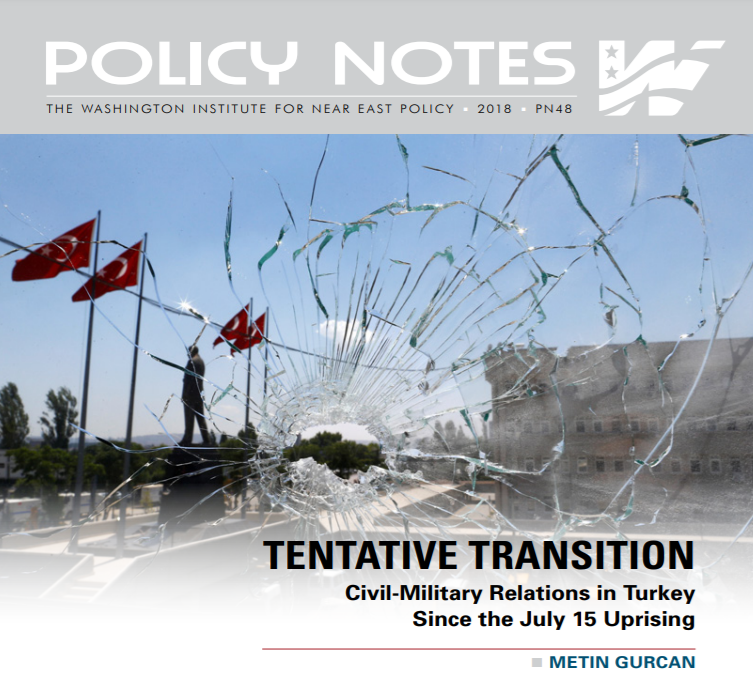
His report for “The Washington Institute” on civil-military relations in Türkiye after 15 July (TENTATIVE TRANSITION Civil-Military Relations in Turkey Since the July 15 Uprising) is even more striking. Openly criticising the state the TSK had been reduced to, Gürcan divided the officers remaining in the army into three categories in terms of dedication to the profession, professionalism and expectations for the future:
According to Gürcan, the “Freeloaders” are officers who stay in the army for maximum benefit. Their relationship with the armed forces is entirely parasitic. In other words, they have no intention of giving more than they take. All of them aim to be promoted to colonel, the final rank. Then: “I’m out”. This group, whose goal is to collect whatever grade, step and salary there is, retire, tell military memories and dote on grandchildren, never feels heartfelt loyalty to the TSK.
The “Breadwinners” are officers who approach their profession pragmatically. This group, which changes direction with every wind, includes officers who managed to survive both the Sledgehammer-Ergenekon process and the purges after 15 July. These officers, winners of every era, do work, but never think strategically or in the long term. They follow the saying “Whoever comes is my agha, whoever goes is my pasha” and can adapt instantly to the conjuncture. According to Gürcan, most of the generals promoted after 15 July have this political elasticity and belong to this breadwinner group.
The last group is the “Reformist wing”. This group tends to see the army as if it were still in the Cold War era. In their view, something is always going wrong and must be intervened in. Made up mostly of young officers at the rank of major and lieutenant colonel, this group is split into two opposing poles: “Traditionalists” and “Innovators”.
The “Traditionalists” are statist, Kemalist, nationalist and secular, and always try to keep the army on this line or pull it towards it. The Innovators, on the other hand, always act with a “Something must be done” mentality. Unfortunately, this group sometimes cannot even stand by its own line. Some of them may drift towards the line of the “Breadwinners”, others towards that of the “Freeloaders”.
This report by retired Captain Metin Gürcan is, in a sense, a document that voices what could not be said after 15 July. In his doctoral thesis and his book of the same name, “Opening the Black Box: The Turkish Military” , Gürcan also states that the great majority of generals have an opportunistic, that is, self-serving, mindset.
There is no doubt that this interesting report and book made some people uncomfortable.
Now to the “espionage” allegations…
Gürcan, who had been followed step by step and whose phones had been tapped for about two years, was most recently filmed meeting diplomats serving at the Spanish and Italian embassies and receiving envelopes from them. It is these images and recordings that constitute the evidence for the allegation that he spied.

There is no clear information about how much evidence the police gathered over two years. Whether he sold information to the embassies of countries other than the two named is also unknown. Nor do we have any information about the amount Gürcan received so far beyond what has been announced. All this feeds the suspicions about the former soldier.
Espionage is not a one-sided activity. That is, if someone sells secret information, someone must also be buying it. If Metin Gürcan is accused of leaking information to the embassies of two countries, why is no action being taken against the diplomats of those two countries who were involved in the espionage? If he was caught in the act, should a “persona non grata” procedure not have been launched against those diplomats long ago? Or could the embassies that bought “secret” information not have been protested?
The media in Türkiye cannot ask these questions, but the Spanish press did.
Diplomats answer this argument as follows: There is no rule that Türkiye must take a step against the embassies that bought secret information. If it cannot be established which embassy staff member bought the information, and if, for example, the embassies concerned assigned a different staff member each time to meet Gürcan, it becomes difficult to identify the “unwanted person”. Even if the embassy staff member in contact with Metin Gürcan was identified, the embassy concerned may have been asked to quietly remove the person from duty or send them home.
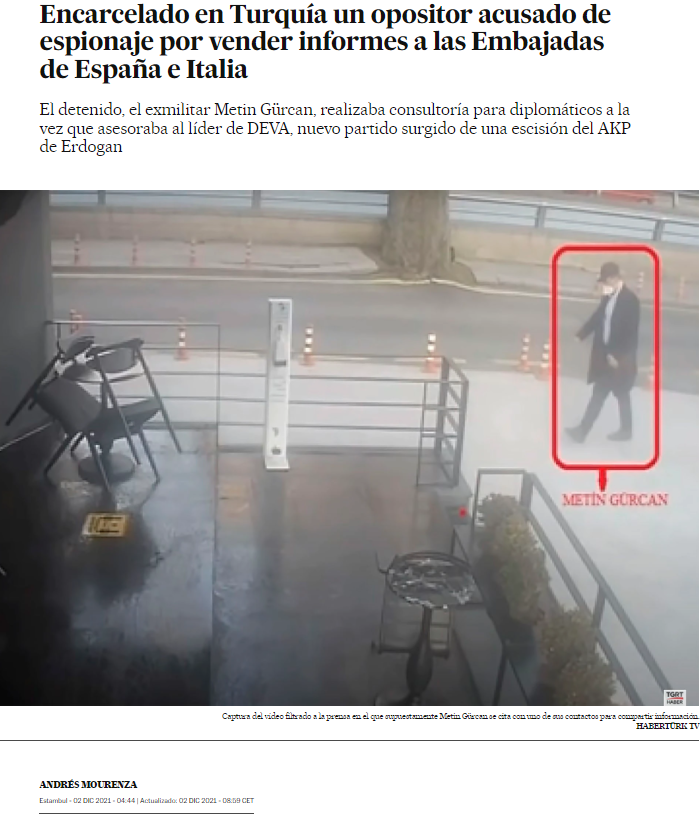
The second point diplomats draw attention to is this: Doing business with an embassy in a country is always dangerous. Because everyone knows that embassy staff are very likely followed by the counter-intelligence units of the country in which they serve. It is thought that Metin Gürcan may also have been caught in the counter-intelligence net of the police or MİT.
One of the most widely voiced possibilities is that this operation was carried out to intimidate the DEVA Party, which, it has become clear, would take a considerable share of votes from the AKP in a possible election. This detail did not escape the Spanish press either.
There are objections to this argument too. Metin Gürcan is among the party’s founders. But the fact that he has no political background large enough to harm his party and no strong influence on right-wing voters also raises the question: “Why would the DEVA Party be the real target?”
Gürcan does not hide that he provided consultancy to embassy officials. He also stated in his testimony that he handed over his computer to the police of his own accord. The information he gave may have come from open sources, or may have been military inferences drawn from his professional experience. That he was meeting serving officers, unfortunately, is a detail enough to cause reactions and curiosity (eyebrows-to-raise).
In conclusion, both his comments that displeased the government and his place among the founders of the DEVA Party evidently made Metin Gürcan an optimal target. Unfortunately, the fact that the fees he received were unregistered also played into the hands of those in power who are looking for spies in the opposite camp.
Monthly · free
Compass of the Month
PUGAT’s monthly newsletter.
Read next

What is PUGAT? A non-profit community publishing independent analysis from Europe on security, migration and society in Turkish, German and English.
Go to the homepage
