


The history of war is as old as the history of humanity, and war takes on a more hybrid character every day. The article compares the Russia–Ukraine war with past cases and assesses possible scenarios.
“There never was a good war or a bad peace,” said Benjamin Franklin. For wherever it may be, the losers are mostly not those who start the war but those at the front and the innocent children and women they leave behind. War always shows its merciless, harsh and terrible face. In this sense, however difficult, peace and the absence of war are the common wish of us all. But the history of war is as old as the history of humanity and, unfortunately, far from ending, it has evolved from the primitive and traditional into a more complex and hybrid form in its tools, methods and consequences.
In this respect, knowing the history of wars and conflicts in order to understand the present is important for anticipating the future. In this context, we will continue to assess the developments between Russia and Ukraine together with past examples, also bearing in mind the legal situation discussed in our previous article.
Examples of Military Intervention by the United Nations and NATO
In humanitarian interventions that include military intervention, the UN can cooperate with other international organisations when it deems necessary. In this sense, when the UN decides on military intervention in a crisis anywhere in the world, since it has no military organisation of its own and assembling a force from member states requires intensive coordination, it may in certain cases prefer to work with NATO.
However, looking at the external interventions carried out by the UN and NATO, although we can draw conclusions in broad outline, they do not follow a clear pattern. Although the main competent authority in this field is the UN, NATO, despite being a regional actor, has made its presence felt in many areas at the global level. In this context, we can give the following examples of prominent military interventions by the UN and NATO in recent history, some of which have been criticised particularly by Russia:
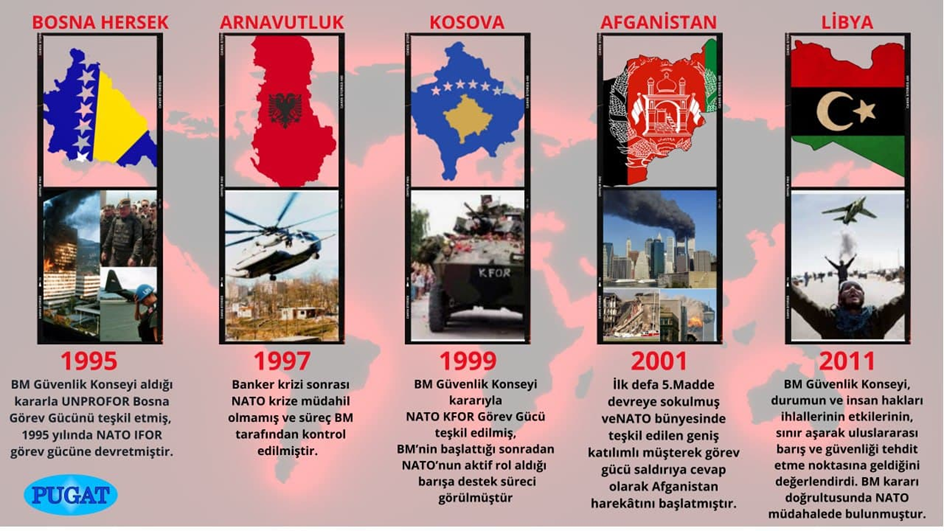
- Afghanistan:
The best known is what followed the terrorist attacks carried out with planes on the World Trade Center and the Pentagon headquarters on 11 September 2001. Meeting the very next day, the UN Security Council, in Resolution 1368, called on member states at the international level to review their counter-terrorism measures and relevant legislation, and on the same day NATO, meeting in extraordinary session, decided to invoke Article 5 for the first time in its history. (At first it was stated that the decision did not require the compulsory participation of all members of the alliance in military operations, and that what was really intended was to express clearly that all members stood together in solidarity and unity.) Following these developments, a broad US-led coalition launched the Afghanistan operation in response to the attack, and in 2003 NATO took over command of ISAF.
- Bosnia:
After the breakup of Yugoslavia in 1992, severe internal unrest broke out in Bosnia and Herzegovina. By its decision, the UN Security Council established the UNPROFOR Bosnia task force, which began working to ensure peace and stability in the region. After operations that continued for some time, in 1995 the UN handed this task over to a NATO-led international coalition force. From that date, peacekeeping activities continued under the name of the NATO IFOR task force.
- Albania:
Another example is the internal unrest that followed the pyramid scheme crisis in Albania. In 1997, when people who had lost their money through speculation realised they would not get it back, they began looting state investments, private companies and arms depots. With the breakdown of public order and the inadequacy of state authority, following Italy’s appeal to the UN Security Council, an international force to carry out the necessary intervention was set up by Security Council Resolution 1101. The peace force that took up its duties continued its activities for about four months, and once public order had been restored in the country, the task force left Albania. This intervention is an example in which NATO was not involved in the crisis and the process was undertaken entirely by the UN.
- Kosovo:
Another crisis in Europe that drew the attention of the whole world was the Kosovo War. Kosovo’s wish to break away from the Federal Republic of Yugoslavia and declare independence was harshly rejected by Yugoslavia, and intense fighting broke out in the region. In 1998 the UN Security Council tried to resolve the issue by peaceful means, but the negotiations produced no result. Thereupon NATO took the initiative to resolve the crisis, and in 1999 a joint task force established within NATO, after a 78-day air campaign, forced the Serbian forces to surrender and accept the peace terms. This intervention also raised debates about which state, organisation or body would be competent in the face of an urgent humanitarian intervention, and how and when the intervention would take place. Subsequently, to restore public order, UNMIK (the United Nations Interim Administration Mission in Kosovo) was established by UN Security Council Resolution 1244, and immediately after this resolution the NATO KFOR task force was established and began to provide the region’s security on the basis of the authority it had received from the UN. Looking at what happened in Kosovo, we see a peace support process that was started by the UN, in which NATO later took an active role, after which the UN came back in as decision-maker and finally handed over to NATO.
- Libya:
A recent example is the military intervention in Libya. In 2011 the UN Security Council, taking up the excessive use of force and civilian deaths in the suppression of civilian demonstrations demanding reform against Libyan leader Muammar Gaddafi, who had come to power in a coup in 1969, and his government, assessed that the situation and the effects of the human rights violations had crossed borders and reached the point of threatening international peace and security. In this context, also taking into account the concept of the “responsibility to protect”, it adopted Resolutions 1970 and 1973 with reference to Articles 41 and 42 in Chapter VII of the UN Charter and decided that sanctions, including the use of military force, could be applied against Libya. Subsequently NATO intervened in the security crisis in Libya in line with the UN decision.
In addition to the examples above, we can also recall the Korean and Gulf Wars, in which the UN became involved on the grounds that peace and security had been breached.
In short, when we consider the external interventions carried out so far by the UN and NATO, it will not be easy to examine the two organisations separately. This is because the two organisations often act together and their areas of activity overlap.
Citing the military interventions in Kosovo and Libya as cases of international borders being changed by military force, Russia annexed Crimea on 18 March 2014. And in the end, the mutual Russia–NATO accusations of expansion, which have turned almost into a paradox, became a conventional war on Ukrainian territory as of February 2022. With the addition of the aggressive and unpredictable attitude of Russia, which has not achieved what it expected in a short time, this war has the potential to spill over into the region and the world.
So far, in particular:
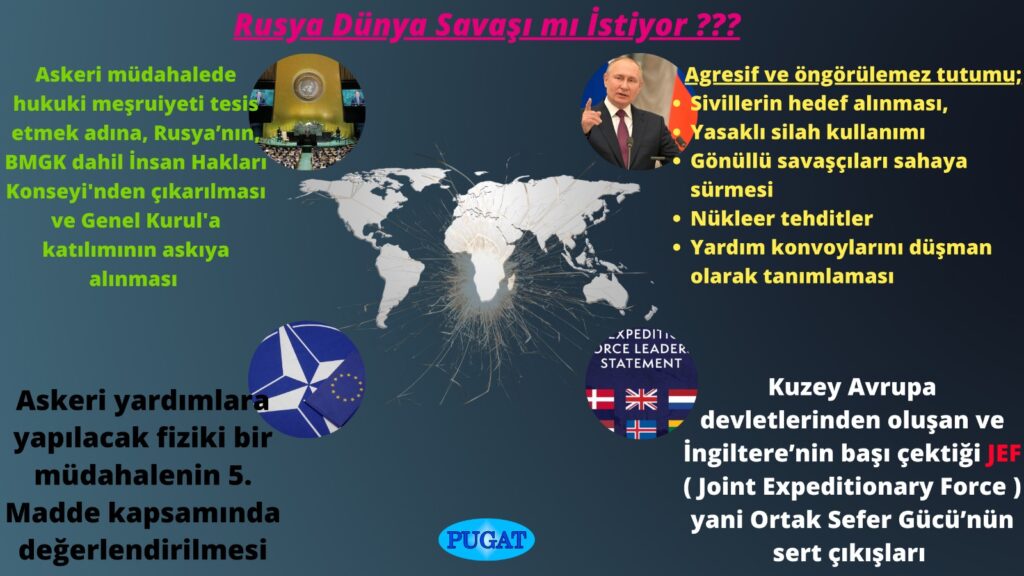
– The targeting of civilians and non-military buildings,
– Allegations of the use of banned weapons,
– Russia’s deployment of thousands of volunteer fighters, above all from the Middle East,
– Interference with nuclear facilities and repeated threats to use nuclear power as a deterrent,
– The fact that convoys from other countries, especially those carrying arms aid, will be defined as enemies, are other important reasons triggering concerns in this direction.
In this context, the UN, which views transnational security problems from the standpoint of human security rather than state security, is discussing options such as removing Russia from the Human Rights Council, including the UNSC, and suspending its participation in the General Assembly, both to overcome blockages and to establish legal legitimacy for a possible military intervention. (Update note, November 2026: On 7 April 2022 the UN General Assembly suspended Russia’s membership of the Human Rights Council.)
NATO, for its part, has raised its defensive posture to the highest level together with the countries it cooperates with since the start of the war, and frequently makes statements emphasising Article 5. However, since Ukraine’s accession to NATO, one of the reasons for the war, is impossible in the near future, it does not seem possible for this protective umbrella to be used on Ukraine’s behalf.
On the other hand, while NATO as an organisation does not speak of active intervention beyond defensive options, it is within the realm of possibility that one of its member states will take steps individually or in smaller partnerships. This possibility can be assessed in terms of a physical intervention by Russia against the military aid already under way. In that case, Russia’s intervention against a NATO member could again trigger Article 5. But in that case, it would open legal legitimacy to debate as never before.
At this point it would be appropriate to read the alternatives that countries could form individually or as coalitions together with the strong statements of the JEF (Joint Expeditionary Force), made up of Northern European states and led by the United Kingdom. (It would also be useful to address this issue separately, together with EU–NATO and US relations in the light of the latest war, the long-standing possibility of the US stepping back from the security of continental Europe, and the global balance of power.)
As can be seen, the developments may mean that preparations are being made for the worst-case scenario. Indeed, it is often said in the international community that the occupation and civilian deaths can be prevented only by a military sanction, and that reactions against Russia have been slow and inadequate. But the course of events turning into a world war is the last choice either side would want. (With the caveat that, should he lose, Putin might individually burn all his boats.)
In this context, the Western world, unlike the passive stance it adopted in the face of the occupation of Crimea, is seeking a solution in the sanctions it imposes.
The US, for its part, while stating at every opportunity that it is avoiding a hot conflict, has stressed that American soldiers will not be sent to Ukraine under any circumstances and has even withdrawn its military advisers and observer units serving in the region. It should not be forgotten that, although Russia and the US have confronted each other many times so far, they have emerged after wars and conflicts as “sharing actors”.
Although it is difficult to make definitive judgements about the process, in the end it seems that the attitude and actions in the near future of Russia, which started the occupation, will also determine the stance to be taken by the military forces and coalitions of other countries, and our future.
Monthly · free
Compass of the Month
PUGAT’s monthly newsletter.
Read next


What is PUGAT? A non-profit community publishing independent analysis from Europe on security, migration and society in Turkish, German and English.
Go to the homepage
