

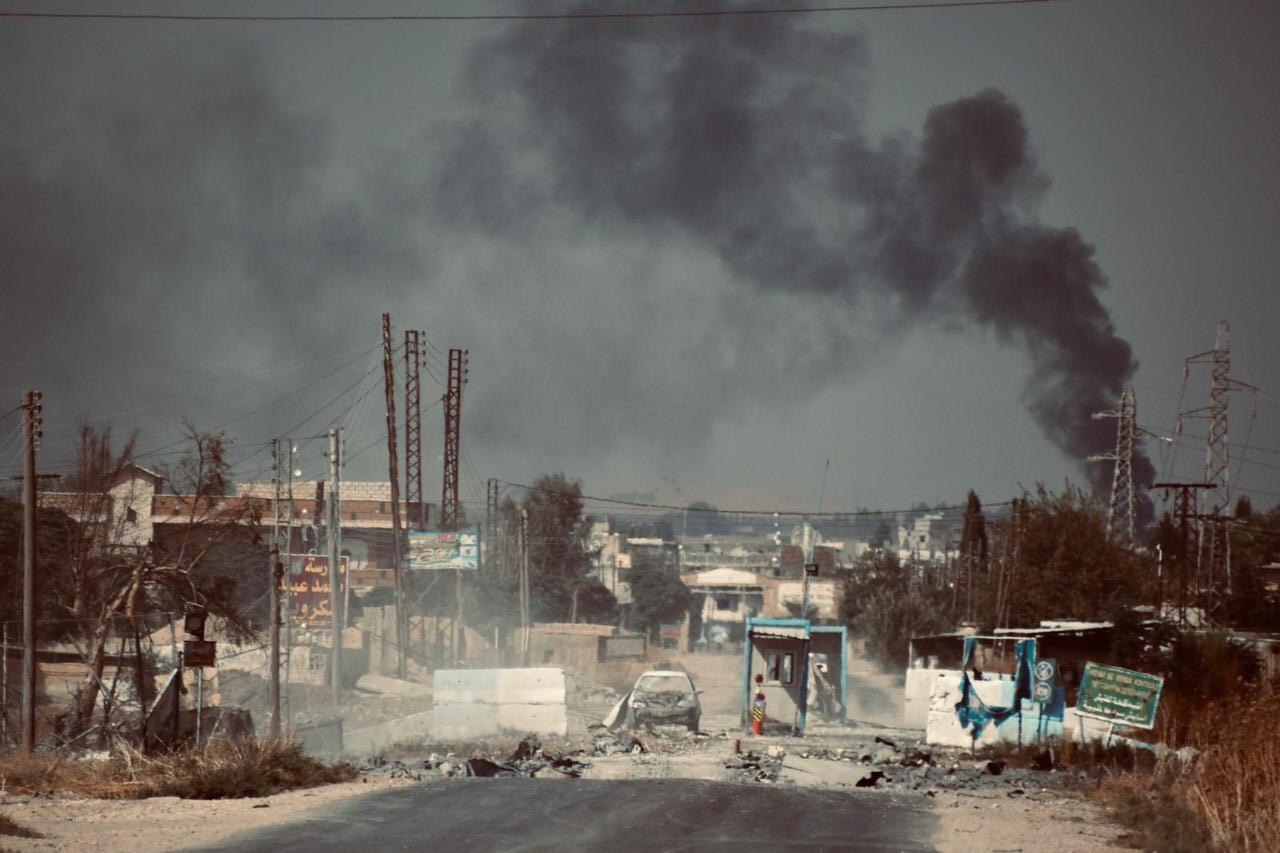
Operation Peace Spring, launched in October 2019, followed the US withdrawal from the region. Trump’s threatening letter to Ankara became one of the rare documents in the history of diplomacy.
Cross-Border Operations in Syria | 6
Turkey explained the rationale for the operation as pushing the SDF, which it designates a terrorist organisation because of its ties to the PKK, away from the border area, and creating a safe zone 30 kilometres deep in which to settle some 3.6 million Syrian refugees. Turkey aimed to create a safe zone over a wide area stretching east from Manbij to include the Tel Abyad and Ras al-Ayn regions, and 30 km deep to the south.

Having dealt the YPG the long-awaited blow thanks to Operation Olive Branch, Turkey had waited for calm to be established in Afrin before the operation towards the Manbij region it had signalled earlier. And just as the Turkish Armed Forces had pressed the button for Operation Olive Branch once Russia withdrew from the area, for Operation Peace Spring they waited for US forces to withdraw.
Trump’s “Twitter” Diplomacy
After Russia, the YPG forces had now been dealt a blow by the US as well, and were once again left alone on the ground. Although the US announced that it would not stand in the way of the operation, it had also refused to give Turkey intelligence support. There were fears that the complete destruction of the YPG, the backbone of the SDF, which was the strongest partner in the region against the ISIS threat, could pave the way for ISIS to regain strength. For this reason, shortly before the ground operation began, many countries, above all the US, reacted against it. Writing a letter rarely seen in the history of world diplomacy, then US President Trump openly threatened to destroy Turkey’s economy. Turkey’s response to this development was to launch the ground operation.

The Memorandum and Turkey’s Never-Ending Tasks
Having launched the operation on 9 October 2019 despite threats of sanctions and an embargo, Turkey began to take control of the area. Shortly after the operation began, the SDF forces asked the Syrian army, Russia and the US for help and received a positive response from almost all of them. The SDF commander Ferhat Abdi Şahin, a former PKK member code-named Mazloum Kobani, said they were ready for ceasefire talks and asked the US to mediate. Russia and the US said they would provide diplomatic support, and the Syrian army military support. When there was no positive response at first, the US and many countries announced that they were imposing sanctions on certain Turkish ministers. On 17 October 2019 an agreement with the US paused the operation for 120 hours. Under the Sochi Memorandum signed on 22 October 2019 at Russia’s initiative, the withdrawal of YPG forces from the border line and joint patrols were agreed. Trump, who had held talks with the Turkish government, announced the day after the Sochi Memorandum that a permanent ceasefire had been achieved and that the sanctions on Turkey would be lifted. During the operation 5 of our soldiers were killed and 86 wounded.
The agreements provided for the withdrawal of YPG forces from designated areas and the preservation of the existing situation in the Operation Peace Spring zone. The SDF said in a statement that the terms applied only to this area and that no general agreement had been reached. The return of Syrian refugees and migrants, one of Turkey’s goals, was not possible in the short term. On the contrary, every operation caused new waves of migration and the destruction of more residential areas. Rehabilitating and rebuilding the region so that migrants and refugees could return remained a task placed on Turkey’s shoulders.
After the end of Operation Spring Shield, Turkey has not carried out any cross-border operation into Syria. Turkey keeps the region under control through the outposts it maintains there and the regular patrols it carries out with both Russia and SNA units. Although there are clashes with the Syrian army and the PYD from time to time, no need for a new operation has arisen.
At the request of the AKP government, with the presidential motion adopted by the plenary of the Grand National Assembly, the Turkish Armed Forces’ mandate to send troops to Syria and Iraq was extended for the seventh time, and for the first time for two years.
(To be continued)
Monthly · free
Compass of the Month
Once a month: five points from Europe’s security and migration agenda and the month’s PUGAT articles, in your inbox.
Newsletter sign-up opens soon.
Read next


What is PUGAT? A non-profit community publishing independent analysis from Europe on security, migration and society in Turkish, German and English.
Go to the homepage
