

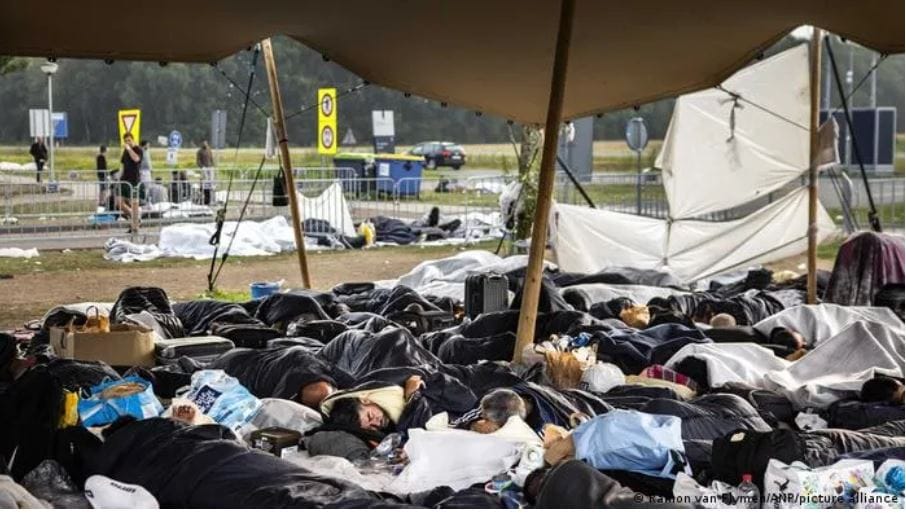
In the Netherlands, the asylum debate brought down two governments, in 2023 and in 2025. A two-status system, restrictions on family reunification and a reception crisis are changing the Dutch protection regime.
The Asylum Crisis Act
Political developments, capacity problems and new legislative initiatives, particularly in recent years, have pushed the Dutch asylum system into a process of fundamental transformation. In 2023–2025 the discourse of an “asylum crisis” was at the centre of politics and public debate across the country, paving the way for measures that hardened policy.
To put it in figures once again:
- In mid-2023 the government projected that the number of applications could reach 70,000 by the end of the year and announced that urgent measures were needed. In the end, the number of first-time asylum seekers in 2023 stayed below this projection at around 38,000, yet even this figure represented a very high level for the Netherlands.
- In 2024 the Netherlands received around 44,000 applications in total, including family reunification and repeat applications.
- In 2025, by contrast, first-time asylum applications fell markedly. Over the year, just over 24,000 first applications were lodged at Ter Apel, about 25% fewer than in 2024 and about 40% below the 2023 peak. Monthly fluctuations nevertheless continued: in June 2025, for example, a total of 3,454 asylum applications, including family reunification and repeat applications, were registered, and this figure was up on the previous month (May 2025: 3,090).
- Despite the overall decline in applications, the Netherlands is struggling to manage its asylum reception system because of capacity problems and is trying to solve the problem by distributing asylum seekers among municipalities.
According to the monthly trends report of the IND (Immigration and Naturalisation Service), 323 first applications were received from Turkish nationals in January–March 2025; the total was 1,868 for 2024 and 2,862 for 2023. In 2025 Turkey ranked third among first applications, after Syria and Eritrea.
In 2023–2025 the Netherlands was a country where talk of an “asylum crisis” was frequently heard. Asylum policy was one of the main reasons for the fall of the government in summer 2023. The right-wing coalition that came to power in 2024 after lengthy negotiations (PVV, VVD, NSC and BBB) described itself as “the strictest migration government in Dutch history” . On taking office, the new government announced that it would officially declare an “asylum crisis” and planned sweeping measures. However, this coalition collapsed on 3 June 2025 when the PVV withdrew from government over a dispute on asylum policy. After the elections of 29 October 2025, a minority government of D66, VVD and CDA led by Rob Jetten took office on 23 February 2026. The “Asylum Crisis Act” package prepared by the previous government provided for a two-tier asylum system:
- Those receiving “A status” would be people who fled individual persecution (e.g. those personally targeted because of their political views, ethnic identity, LGBT identity, religion, etc.). They would be granted refugee status. For example: members of the Gülen movement, Kurdish groups, Yazidis from Syria, etc.
- “B status”, on the other hand, would be granted to those fleeing general war, violence or instability; holders of this status would have more limited rights, and family reunification in particular would be restricted. For example, it would be harder for B-status holders to bring family members, and their residence permits would be shorter. For example: Yemenis, Afghans, Syrians, etc. (Ukrainians, by contrast, fall under a separate temporary protection regime.)
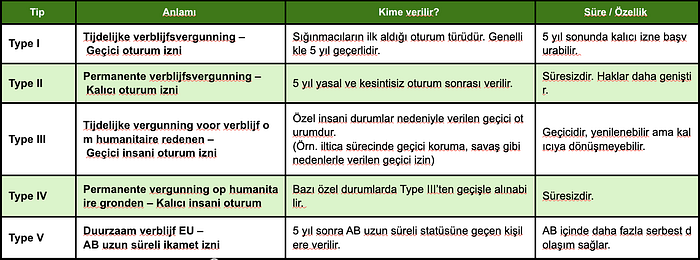
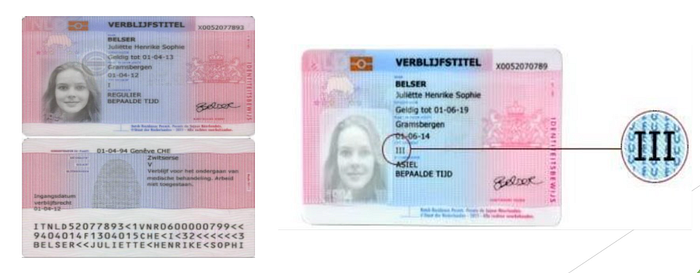
NOTE: The residence documents issued in the Netherlands bear the following wording:
A New Migration Policy
The new government stressed that Dutch asylum policy “should not appear more generous than that of neighbouring countries” and planned a series of tougher measures accordingly:
- Abolishing the possibility of permanent residence and granting only temporary protection statuses,
- Temporarily halting resettlement programmes, i.e. suspending the admission of UN quota refugees,
- Increasing returns and setting up “return centres”,
- Running information and deterrence campaigns in countries of origin to discourage asylum seekers,
- A change in reception policy: ending municipalities’ initiatives to open small shelters and housing all asylum seekers only in large collective centres. In this context, the government sought to repeal the “Spreidingswet” (Dispersal Act), which had entered into force on 1 February 2024.
These measures met different fates. On 21 April 2026 the Senate adopted the Two-Status System Act but rejected the Asylum Emergency Measures Act (Asielnoodmaatregelenwet), which included steps such as limiting residence permits to three years and abolishing the permanent asylum permit. From 12 June 2026 the EU Pact on Migration and Asylum also began to apply. Even so, the political direction of the Netherlands is clearly restrictive and deterrence-oriented.
As the number of applications rose, the Netherlands faced a serious reception crisis. In 2024 legislative attempts were made to distribute asylum seekers among municipalities, but the crisis deepened in early 2025 as local initiatives declined.
- As of 1 January 2025, local initiative reception places had fallen to 4,115 people. This means a 30% decrease compared with 2021.
- With an occupancy rate of 94%, the system reached “breaking point”.
The extraordinary powers the government wanted to introduce under the “Emergency Act” were sharply criticised by human rights organisations and the opposition. Warnings were issued that these arrangements could undermine the rule of law. Indeed, in October 2024 the Dutch Senate adopted a motion describing the use of emergency powers as an “undesirable route”.
In conclusion, in 2023–2025 the Netherlands tightened its migration and asylum policy under the banner of an “asylum crisis” and planned far-reaching steps such as a two-tier status system, restrictions on family reunification, deterrence campaigns and changes to the reception model. Struggling with application numbers and capacity problems, the country is undergoing significant changes in refugee rights. For advisers, this picture makes it essential to follow political developments as closely as legal ones, and makes it critical to prepare clients’ files thoroughly, document individual risks convincingly and plan strategically in line with the new rules.
We have described the German and Dutch systems. In our next article we will turn to two other important destination countries, Belgium and France.
Sources
- IND – Asylum Trends ind.nl
- COA coa.nl
- Rijksoverheid – Asylum policy rijksoverheid.nl
Monthly · free
Compass of the Month
Once a month: five points from Europe’s security and migration agenda and the month’s PUGAT articles, in your inbox.
Newsletter sign-up opens soon.
Read next


What is PUGAT? A non-profit community publishing independent analysis from Europe on security, migration and society in Turkish, German and English.
Go to the homepage
