

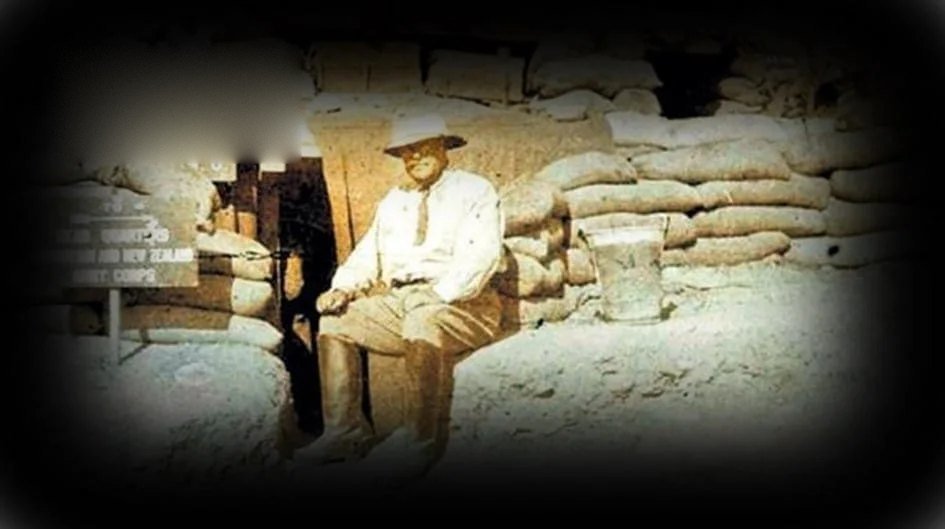
The story of Australian military doctor Charles Ryan at Gallipoli was told to Türkiye’s first ambassador to Australia at a dinner. An extraordinary tale linking the two sides of the war.
While listening to a friend who is an expert on the Gallipoli campaign tell the stories behind the rare photographs in his archive, I was deeply moved by the extraordinary story of a three-dimensional picture taken at the time. Here is the story of an extraordinary soldier…
Some time after taking up his post, retired Staff Colonel Baha Vefa Karatay, appointed in 1967 as Türkiye’s first ambassador to Australia, attends a dinner at which the Governor-General of Australia, Lord Casey, and his wife, Lady Casey, are also present. Lord Casey takes our ambassador to a quiet spot in the room and tells him the true story of Doctor Charles Ryan, the subject of this article, in the Gallipoli campaign. Our ambassador is hearing the story for the first time.
At the time Lord Casey was serving as aide-de-camp to the commander of the 1st Australian Division. The day before the battle began, a cocktail dinner is given for the officers on board ship in the evening. Among the guests, those who see that the division’s chief medical officer, Doctor Charles Ryan, is wearing a large Ottoman medal on his chest are astonished. An officer wearing on his chest the medal of the enemy state they will fight the next day!

Doctor Charles Ryan answers the reactions calmly and firmly: “I won this medal in the famous defence of Plevna, under the command of Osman Pasha, fighting shoulder to shoulder with the heroic Turkish soldiers. If today, nearly forty years later, I am going to fight against them, it is not out of hostility towards the Turks, with whom I have always been proud to have been comrades in arms at Plevna, but only to carry out the orders I have received as a soldier.”
When Lord Casey finishes his account, his wife Lady Casey turns to Colonel Karatay with tears in her eyes and says: “Ambassador, do you know, that Doctor Charles Ryan was my father!”
After completing his medical training in Britain in the 1870s, Charles Ryan goes to Italy to look for work. Falling into financial difficulty in Rome, Dr Ryan, sitting in a café, sees an advertisement in The Times saying the Ottoman government is looking for twenty military surgeons. Dr Ryan, an adventurous character, will write in his memoirs that he read this advertisement with joy, that he asked his friend Garcia for money to go to the Turkish consulate in London, and that had it not been for Garcia’s gold watch he would never have been able to go to Plevna. Thus Dr Ryan takes the first step of an adventure that will lead first to Istanbul and from there to Plevna.
In the war he behaved almost like a Turkish officer, and this caught Osman Pasha’s attention too. He is fearlessly active on the firing lines. He takes his place among the officers awarded medals during the war. Sent to Erzurum after Plevna, Dr Ryan served in the Ottoman army for about two years.
About twenty years after leaving Plevna, in 1897, Charles Ryan published a book called “Under the Red Crescent” in which he recounted his experiences at Plevna and in Erzurum. The book sheds light on Gazi Osman Pasha, on what happened at Plevna and on the state of the country at the time. Known especially for his deep love and respect for the Turks, Ryan expresses his admiration for them in his book:
“In all my medical life I have never seen men who bore great suffering and torment like the Turkish soldiers, nor have I met men who recovered so extraordinarily well from terrible, grave wounds.”
“My experiences among the Turks over more than two years had taught me that the opinions and convictions formed by nations reputed to be more civilised about the morals and character of the Turks are entirely wrong and misleading. There was no doubt that at that time there was widespread corruption in Türkiye’s official departments; but I am sure that, just as I found the true examples of the national character, that is, the soldier in the army, to be simple-minded, courteous, conscious of his honour and honest in peacetime, so on the battlefield there was no braver soldier on the European continent than those who fought under Osman Pasha at Plevna.”
The Secret of the 3D Photographs
After the attack of 19 May, one of the bloodiest days of the Gallipoli campaign, a brief armistice is declared so that both sides can collect the dead. In the extreme heat the bodies are decomposing much faster and the smell has become unbearable. One of the officers who go to the battlefield on behalf of the Anzacs is Dr Ryan.
While Dr Ryan is doing his duty, Turkish officers on the same duty see the Ottoman decorations on his chest and cannot make sense of them, thinking he took them from a dead officer; when he tells his story in broken Turkish, there are moments like a reunion of old friends. Invited to the Turkish trenches, Charles Ryan chats with our officers for a while and tells his memories of Plevna. He is offered refreshments. There are emotional moments, and after a warm farewell everyone returns to his post, to his own front.
Charles Ryan holds an important place in the Gallipoli campaign not only as a “doctor” but also for the photographs he took. With the photographs he took first in Egypt and then at Gallipoli until June, he shed light on history. In particular, the photographs he took on the day of the armistice after the 19 May attack with his stereoscopic camera (a kind of 3D), just then coming into use, have survived to the present day and lay bare the events in all their starkness. As he said at dinner that evening, he never harboured hostility towards the Turks and did not remove his Ottoman medals from his chest until the end of the war. Some time after returning to Australia in 1919, he retired with the rank of general. Dr Charles Ryan died of a heart attack on board ship on 23 October 1926 on his way back from a trip to Europe.
Monthly · free
Compass of the Month
PUGAT’s monthly newsletter.
Read next


What is PUGAT? A non-profit community publishing independent analysis from Europe on security, migration and society in Turkish, German and English.
Go to the homepage
