

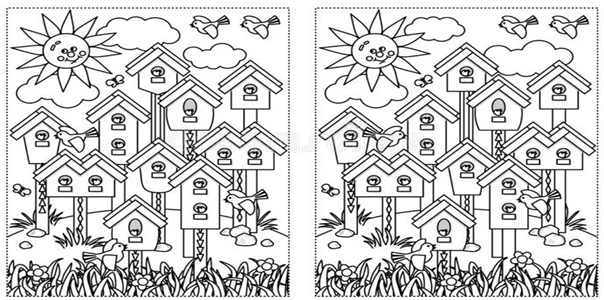
Like “spot the seven differences between two pictures” puzzles, situational awareness begins with a clear mental picture. The second part of the series describes the mental picture and selective perception.
Many of us have solved puzzles of the “Spot the 7 differences between the two pictures” kind. When solving such a puzzle, one of the pictures is usually taken as the reference and the differences in the other picture are found. The situational awareness process broadly works on this logic. First, one forms a clear and detailed MENTAL PICTURE of any person, place, venue or object. At this stage the foundation of the awareness process is laid. In this way one gains knowledge of what is normal and routine in the pictures we will compare. But acquiring this ability is not easy; it requires patient attention and frequent practice.
In our daily lives the brain does not actively record everything we see around us. It deletes information it does not consider important and that will not be useful later, after keeping it in memory briefly. For example, many people cannot answer the question “What did you have for dinner on this day last week?”. In fact this is a good thing. Unnecessary information does not take up space in our memory for nothing. Attention and concentration mean, in a sense, pressing the RECORD button of our memory. With the instruction given, we begin storing records in a qualified way. If we teach our brain well when and where to record, this is called SELECTIVE PERCEPTION. So we will begin to obtain automatically the MENTAL PICTURES that are so important for situational awareness.
The way to obtain mental pictures is to be a good observer. And that requires practice. For example, there is a café you often go to to pass the time. What you need to do is ask yourself certain questions.
- How many people work here?
- On average, how many customers sit at the tables at the same time?
- How many windows and doors are there inside?
- Who is at the till?
- How many tables and chairs are there in total?
and so on. We will treat this as an exercise. When you go to the same café at a later time, ask yourself the same questions and try to see whether anything has changed. Similarly, you can repeat this exercise in many places you go whenever you have the chance. It is best to continue until you acquire the ability to obtain high-resolution HD pictures.

On the other hand, we can carry out a similar operation on people and various publications too. The character, worldview and approach to certain issues and events of the person before us will give us a mental picture of that person’s normal. Or the same applies to a writer, news channel, newspaper, news portal or Twitter account. These sources, after all, also reflect an institutional personality. What is the editorial line? Which values are brought to the fore? How are friend, foe and neutral defined? With similar questions we can have the opportunity to form clear reference pictures.
Monthly · free
Compass of the Month
PUGAT’s monthly newsletter.
Read next



What is PUGAT? A non-profit community publishing independent analysis from Europe on security, migration and society in Turkish, German and English.
Go to the homepage
