

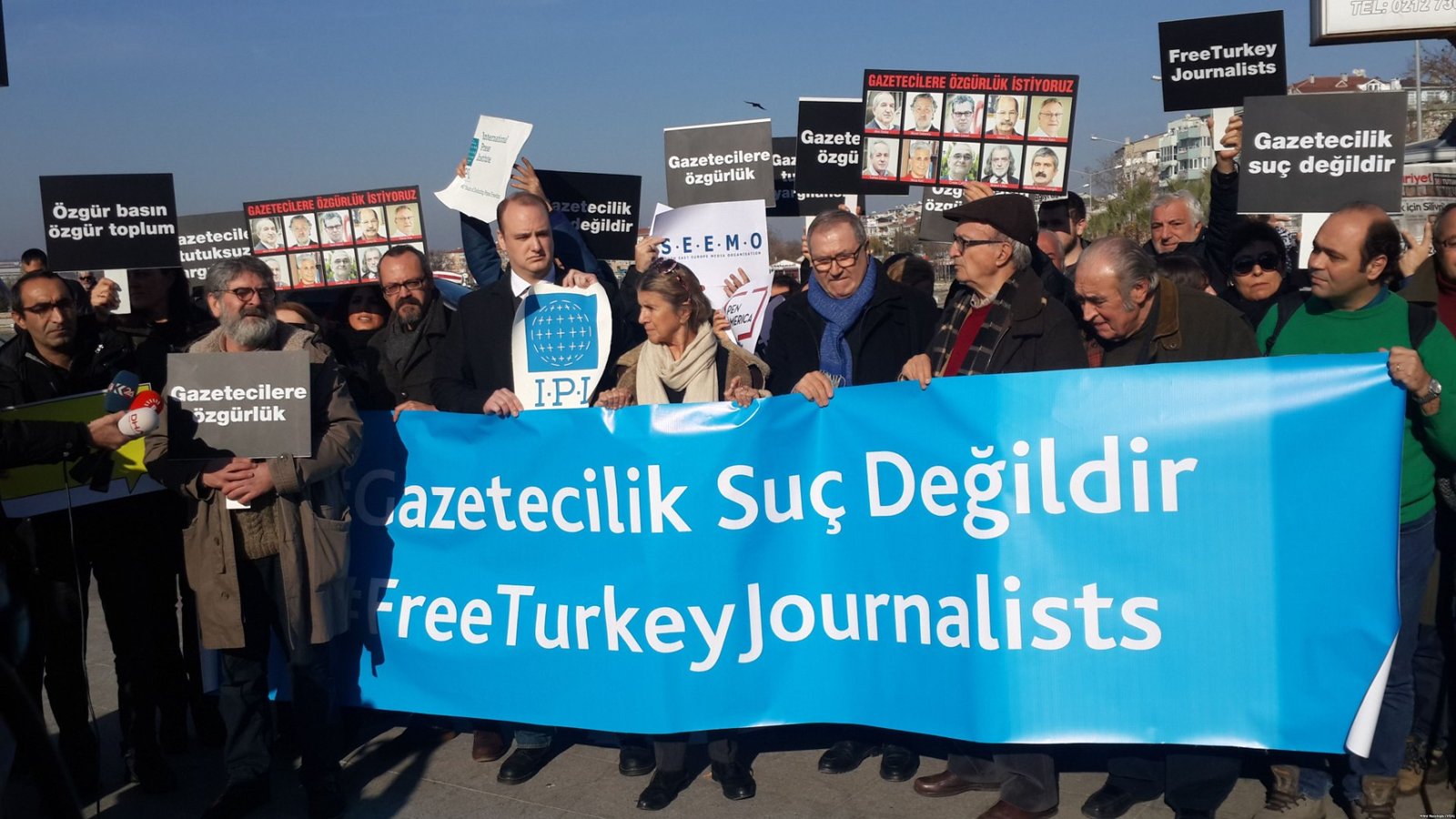
Is it possible in a country to be declared a terrorist, a traitor or a patriot with a few sentences? The author questions polarisation through the labels pinned on artists and journalists.
Image: Hilmi Hacaloğlu / Wikimedia Commons, Public domain
Is Sedef Kabaş a terrorist or a traitor?
Is Sezen Aksu a provocateur or an enemy of religion?
Are Cem Yılmaz, Tarkan, Athena Gökhan, Atilla Taş and some other artists enemies of the state?
Are Yavuz Bingöl, Hülya Koçyiğit and Hülya Avşar homegrown, national patriots?
Is it possible in a country to be all of these at once with two lines of writing or a few sentences of statement?
In my view, the answer to all of them except the last question is, of course, “No.” But at the point we have reached, this is not how things are in Turkey. The closeness or distance of one’s ideas to the government should not divide people into such distant poles. Those who call even the government’s mistakes right for the sake of their own interests and benefits should not be declared heroes and patriots.
Recently we have seen posters at airports and on advertising billboards in some countries about how easy it is to become a citizen of the Republic of Turkey. One can easily become a citizen with the purchase of real estate worth 250,000 dollars. I cannot tell whether this being so cheap is due to the depreciation of our money or the lack of value placed on our people. But becoming a Turkish citizen should not be so cheap.
Where becoming a citizen is so cheap, stripping citizenship should be just as cheap, shouldn’t it… It seems that is exactly the case… After all, some will have to leave to make room for the new ones. So far, apart from a few attempts, the official mechanism of stripping citizenship has of course not been put into operation. This task has mostly been taken on, in a moral sense, by social media warriors. On social media platforms they first exasperated and then stripped of citizenship almost everyone who expressed views about the current government, voiced concern or tried to describe the hardships they were going through.
According to a recently published news report, the EU Counter-Terrorism Coordinator Ilkka Salmi said that technological terrorism, including the internet and social media, had now been included in definitions of terrorism. This news seems like a welcome decision to many citizens who support the current government. They will not need to tire themselves or spend hours to send to prison those who view their party and leaders negatively or criticise their actions. The courts will act on their own initiative and do what is necessary. But fortunately, the reality is not as they think or wish.
Are Two Lines of Writing Enough to Be a Terrorist?
For the situation to be clearly understood, and to determine who supports terrorism and who is a patriot, one must look at the meaning of the term at the heart of the matter.
Terrorism is any criminal act undertaken by a person or persons belonging to an organisation, by using force and violence through any of the methods of pressure, intimidation, deterrence, suppression or threat, with the aim of changing the characteristics of the Republic as defined in the Constitution, its political, legal, social, secular and economic order, damaging the indivisible integrity of the State with its territory and nation, endangering the existence of the Turkish State and the Republic, weakening, destroying or seizing State authority, eliminating fundamental rights and freedoms, or damaging the internal and external security of the State, public order or general health.
This definition is found in the Anti-Terror Law. It is also the provision courts cite as the basis for their decisions. It is already a very broad term, much criticised for its scope, and one that makes things difficult for our country regarding EU membership. Since we are talking about today’s Turkey, let us make our assessment on the basis of this definition.
The first and most important point is the use of “force and violence”. Looking at the definition of terrorism, in no situation where there is no force or violence have you committed the act of “terrorism”. Moreover, your statements and activities must be aimed at the integrity of the state or at overthrowing the constitutional order. According to this definition, if you have not sold the state’s vital institutions to foreigners, if you are not attempting to change the unamendable articles of the constitution, and if you have not polarised society and subjected those who disagree with you to othering, you should have no need to fear these articles.
Another important aspect of terrorism is that it involves the elements of pressure, intimidation, deterrence and suppression. With two lines of writing it is hardly possible to put society under pressure, try to overthrow the state and use force and violence all at once.
The Organisation That Best Fits the Definition of Technology Terrorism: ISIS
Technology terrorism, as a new field of use, seems likely to change certain definitions. The best example in this field is the ISIS terrorist organisation. Social media is the platform ISIS turns to most often in recruiting members, spreading the organisation’s propaganda and disseminating execution footage intended to spread fear.
What is meant by internet terrorism covers more extensive and organised activities. Let us try to clarify the situation with another example. While it is possible to quietly end a coup attempt known about in advance, it can also be magnified through social media and television and cause the deaths of hundreds of people. Through visual media, fear and pressure can be created in society on the one hand, and people incited to violence on the other. Subsequently, attempts are made to intimidate a section of society through torture, ill-treatment, imprisonment, threats and othering.
Besides this, we must also not forget those created on social media for influence and power, financed by the government, who appear whenever there is anything against the government and declare people terrorists and traitors. What I find interesting is that those declared terrorists and traitors broadcast fearlessly on various media platforms under their real identities, while those who say they are patriotic and national use fake accounts and details.
I do not know whether it falls within the definition of terrorism, but in my view jailing pregnant mothers and mothers with babies together with their babies, trying to make people confess to crimes they did not commit by torture and threats against their families, and arresting family members because the person sought cannot be found are more than enough for this crime.
Is Terror Being Carried Out by Official Hands?
If these days people stay silent when criticising the government, thinking that “Silivri is cold”, if they are afraid to express their views on the government’s actions for fear that “I’ll lose my job”, if even journalists cannot ask their questions for fear of arrest, then the question of who the terrorist is in that country has become debatable.
Especially in recent years, many soldiers, police officers and civil servants have been subjected to such accusations and targeting. It is of course sad that people who served their country day and night for years are dismissed from their professions on baseless grounds and accused under the labels of traitor and terrorist. That those who do this are people who use the state’s resources as if they were their own and never refrain from insulting the nation at every opportunity is also something to be considered separately.
Monthly · free
Compass of the Month
PUGAT’s monthly newsletter.
Read next

What is PUGAT? A non-profit community publishing independent analysis from Europe on security, migration and society in Turkish, German and English.
Go to the homepage
