


Woken by the alarm on the night of 15 July, the cadets followed their commanders into the streets without knowing what was happening. The story of young students caught between absolute obedience and the unknown.
They had just fallen asleep or were getting ready for bed. At the sound of the alarm they leapt out of bed and hurriedly gathered in the inner courtyard. This situation, likely familiar to anyone who has done military service, brought nothing else to their minds than the usual annoying, ordinary exercise. Until they were startled by these words from the duty officer who had assembled them on the parade ground: “There is an uprising in Ankara. You will therefore be given tasks and sent to certain areas of the city to put down the uprising!”[1]
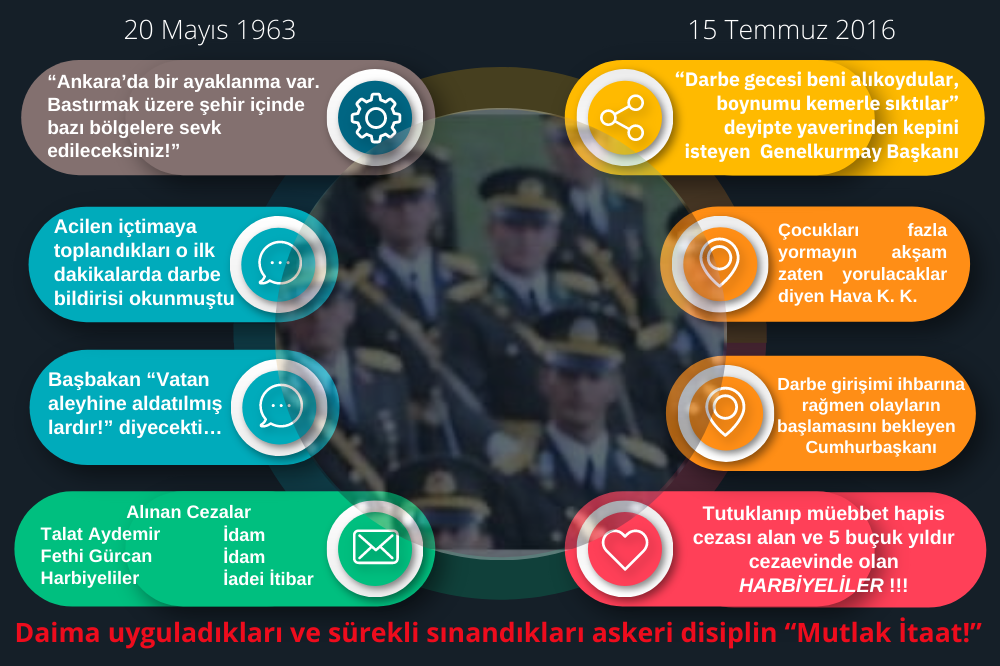
Unaware of what was happening, they walked into the unknown behind the commanders they were following. What made them walk that road was the most basic military discipline they had been taught for years and tested on every time: “absolute obedience”. They took up positions where their commanders showed them and began watching what was happening in the direction they pointed. The instruction they received was clear: “If resistance comes from anywhere, return fire.” They did what they were told. They returned the fire directed at their area by another group of soldiers stationed on the other side[2]. Meanwhile, when they saw warplanes flying low at supersonic speed over Ankara bombing some nearby areas, the fear within them would turn to terror.
Tense minutes were unfolding in many parts of the city, but they could make no sense of what was happening. By the time they realised they were part of a coup attempt launched by a group of soldiers within the Turkish Armed Forces, the first light of day had begun to illuminate the streets of Ankara and the mystery of the night was coming to light.
In the first minutes when they had been urgently assembled, a coup declaration had been read, and after a while it was answered with a counter-declaration. This would go back and forth several times, and the broadcasting room where the declaration was read would change hands several times. Some of their comrades, carrying out the tasks given to them, had brought certain generals they had detained to the barracks and handed them over to the commanders from whom they had received their orders. Because of the clashes during the night and the fire from aircraft, dozens of people had been killed or wounded. The smell of blood hung over the streets of Ankara…
The broadcasts during those tense minutes had played very critical roles in the course of the coup attempt. A military official speaking on behalf of the Chief of General Staff said that the Turkish Armed Forces were at the service of the Turkish nation, and efforts were made to prevent military units from supporting the coup attempt. Later the Prime Minister’s voice would be heard, and in his speech he would say of those who took part in the coup attempt: “They have been deceived against the homeland!”…
If you think all I have described happened on the night of 15 July, you are mistaken…
The events I have tried to depict above are the story of the second failed coup attempt in the history of the Republic of Turkey, carried out on the night of 20-21 May 1963 by a group of officers and War Academy cadets led by Talat Aydemir. Talat Aydemir, who had carried out the first on 22 February 1962 while holding the rank of staff colonel and serving as Commander of the Army War Academy, was pardoned after the first coup attempt by then Prime Minister İsmet İnönü and retired, with no criminal proceedings brought against him. Arrested after the second coup attempt in May 1963, Talat Aydemir was sentenced to death, the heaviest penalty of the time, together with Major Fethi Gürcan, who had played an important role in the attempt with him.
So what do you think happened to the military students, in other words the cadets, who were at the centre of events and carried out the tasks their commanders gave them?
If you think they went through exactly what the 355 military students arrested after the 15 July coup attempt, sentenced to life and in prison for five and a half years, have been subjected to, then:
- you are for a moment forgetting the Air Force Commander who allegedly said “Don’t tire the kids out too much, they’ll be tired enough this evening” and drove the military students entrusted to him into the fire,
- the Chief of General Staff who said “On the night of the coup they held me, offered me the chain of command, tightened a belt round my neck”, and then, in camera footage that emerged, left the General Staff headquarters so relaxed that he asked his aide for the cap he had forgotten, and who is alleged to have set a trap for his own soldiers,
- the President who, although the coup attempt had been reported, allegedly waited for events to begin without taking sufficient measures and, after organising everyone from municipalities to mosque imams in 81 provinces, left citizens and soldiers between two fires, and
- that law was once applied in Turkey one way or another.
After Talat Aydemir’s second coup attempt, all the cadets of the classes of 1963 and 1964, whether or not they were involved in the events, were expelled from the Army War Academy. A total of 1,459 cadets were brought before the court, including those who on the night of the coup attempt had gone, with their weapons and equipment as ordered, to the areas of Ankara shown to them and had even engaged in armed clashes with those intervening against the coup. All the cadets, who were obliged to carry out their superiors’ orders, were given certain minor sentences as reason, conscience and law require, and many were released directly, some after prison sentences of one or two years.
And it did not stop there: in 2000, exactly 37 years later, the 1,459 cadets whose ties with the army had been severed because of the coup attempt had their honour restored. Special military identity cards were prepared and handed to them, which would also give them the right to enter officers’ clubs and military facilities.
In the rank section of the identity cards, the words “CADET” were written in capital letters[3].
After the first coup attempt, Prime Minister İnönü would say in a statement: “The movement attempted on 22 February was the movement of those who deceived the units they commanded, misled the students of the school by portraying the senior commanders at the head of the army as being with them, and wanted to take charge of a revolutionary government.” Two days after this statement, 22 cadets, offended by it, laid a wreath at the Atatürk Monument in Taksim. On the wreath was written: “The cadet is not deceived!”…[4]
Yes, as long as the force commanders to whom they entrusted their lives do not deceive them, as long as they do not drive the young children of the homeland into the fire with a pat on the back and then disappear themselves, and as long as a Chief of General Staff does not set a trap for his own army, The Cadet Is Not Deceived!
(In the hope of meeting on those fine days when the rights of the 355 cadets sentenced to life imprisonment, and of all our comrades in arms condemned, though innocent like them, to spend their lives between four walls, are restored and their honour is rehabilitated.)
Sources
- (Bitmeyen Karanlık Heves: Darbeler 15:30-16:04) youtube.com
- (Talat Aydemir İkinci Darbe Girişimi 11:30-11:50) youtube.com
- hurriyet.com.tr hurriyet.com.tr
- (Biz aldatılmadık aldatılmadığımızı da ispatlarız) youtube.com
Monthly · free
Compass of the Month
PUGAT’s monthly newsletter.
Read next


What is PUGAT? A non-profit community publishing independent analysis from Europe on security, migration and society in Turkish, German and English.
Go to the homepage
