

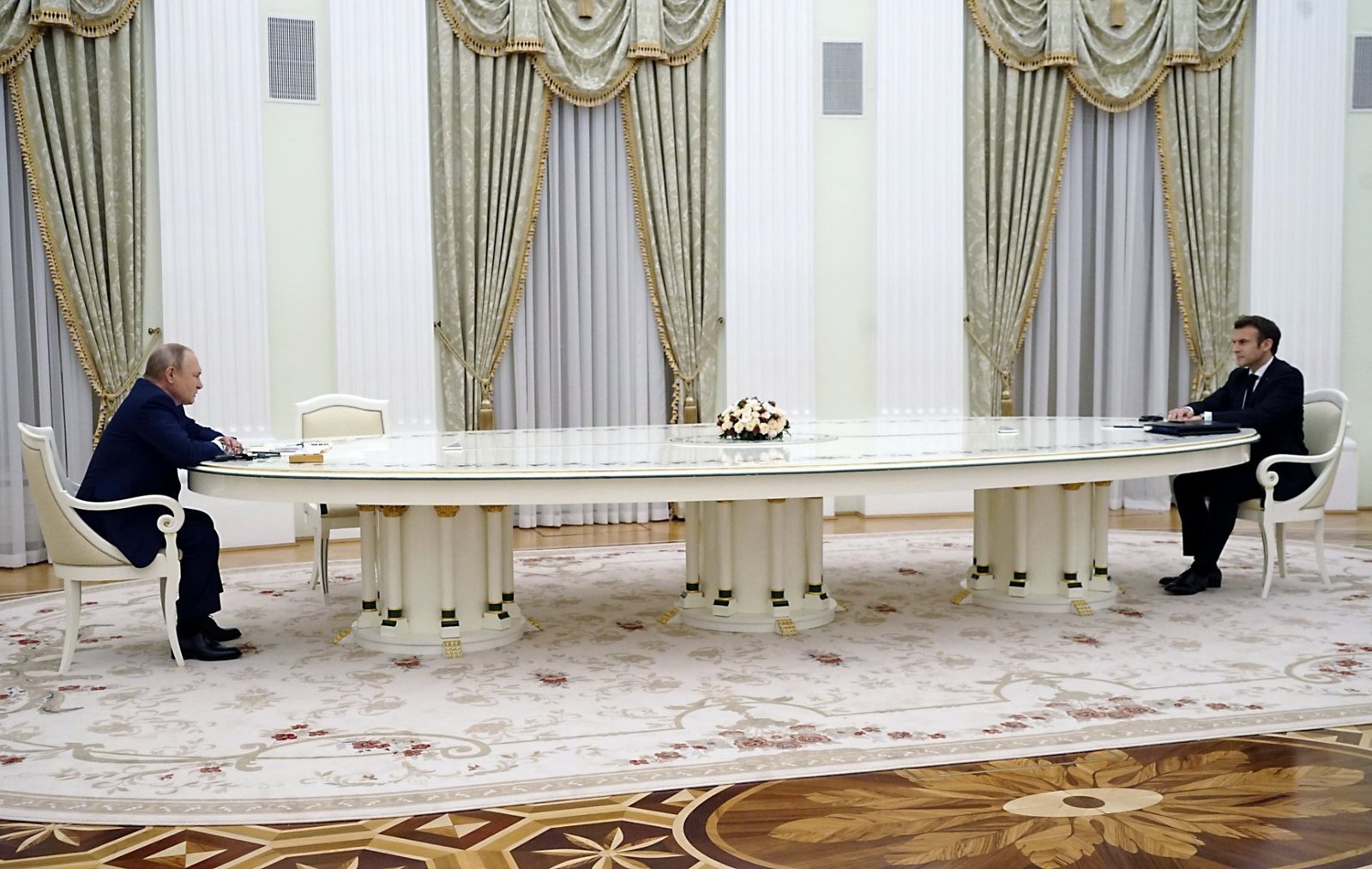
Macron, who went to Moscow to mediate, met with Putin’s unusual style. The author warns that the same treatment could be meted out to Ankara.
Image: kremlin.ru / Wikimedia Commons, CC BY 4.0
French President Emmanuel Macron, who went to Moscow to meet Vladimir Putin in order to mediate in the crisis between Ukraine and Russia, encountered a style he had probably never seen before in his political life. Russian President Putin, contrary to the customs of meetings between leaders, sought at every opportunity to put Macron in his place. Macron, not expecting such an attitude, tried to fend off Putin’s attacks without knowing what to do, but did not succeed and experienced a state of complete helplessness.

To explain: some heads of state, like Macron, are seeking to resolve this crisis between Ukraine and Russia, now the hottest item on the world agenda, through diplomacy. The heads of state’s sole aim here is not to end the crisis but to go down in history as the leader who turned a possible war into peace through diplomatic success.
EU officials and member countries had earlier announced that they would take a very tough stance against a possible Russian invasion of Ukraine. Having set out their red lines, the EU countries also decided to launch diplomatic initiatives to resolve the crisis.
Although it is not the only reason, there is no doubt that Europe, dependent on Russia for energy, would face a major problem in a possible Russia–Ukraine war if Russia restricted or completely cut off energy.
This Is Not the First Meeting
The fact that France, rather than Germany, the locomotive of the European Union, is attempting to end the Russia–Ukraine crisis by establishing diplomatic relations with Russia can be explained as follows.
Putin and Macron had previously met in France on 19 August 2019 and posed very warmly for the cameras. After this meeting, a prisoner exchange took place between Russia and Ukraine.
In addition, the meetings of the “Security and Cooperation Council” between the two countries, suspended in spring 2014 after Russia’s annexation of Crimea and not held for five years, resumed.
Tatiana Stanovaya, a member of the Carnegie Moscow Center and director of Institut R.Politik, founded in France, stressed the importance of this meeting in an assessment for the magazine L’Express with the words: “The Kremlin had been waiting five years for this day.”
At the time, there were comments about Macron’s visit to Moscow such as: “Since the day he was elected two years ago, Macron has been seeking a geopolitical success. Taking advantage of the vacuum left by Germany’s loss of momentum in this field, he wants to be the first Western leader in the G7 to take the initiative in the geopolitical arena.”
Macron, who said “Pushing Russia away from Europe would be a very big mistake”, which contributed to Russia’s renewed influence, seems to have taken courage from this last meeting and decided to go to Moscow to meet Putin in order to position himself once again as Europe’s leader.

He Did Not Greet Him and They Sat at a Long Table
What happened during the Moscow visit was the kind of thing that will take its place in the literature of interstate relations.
The meeting was said to have lasted about five hours. During these five hours, the press was allowed to film for only a very short time. I think everyone has seen the footage. Putin, contrary to diplomatic procedure and custom, receives the visiting head of state with his hand in his pocket. He then does not greet him and points to the chair set aside for him at the table. The most interesting part is the length of the table. It is almost impossible for those sitting at the two ends of the table to hear or understand each other easily if they speak in a normal tone of voice.
Putin’s recklessness does not end there: the information that the leaders would hold a press conference is shared with the news agencies by the Kremlin. Continuing his threatening rhetoric against France at the press conference, Putin, at its end, again leaves the hall without shaking hands with the visiting head of state. As he leaves, he gestures with his hand for him to follow, practically carrying out a character assassination of Macron before the eyes of the whole world.
Although all these images raise the question what is Putin’s problem with France or Macron, it is very clear that the issue is not limited to France or Macron. Putin’s real target is NATO. For although Russia is preparing for a hot war on its border with Ukraine, it is also currently waging a cold war struggle with NATO. And it is well known that in a cold war the most important element is to gain psychological superiority. Since Putin knows where the Russia–NATO relationship will evolve from now on, and that this depends on how the problem with Ukraine is resolved, he wants to keep a tight grip on the reins.
The Real Target Is Not Macron
Although Macron came to the meeting to consolidate his own leadership, France is ultimately the second most important country in the European Union and also a NATO member. And Macron is the president of this country.
With his aggressive attitude, Putin signalled to NATO and the European Union how important the Ukraine issue is for Russia. It would surely not be an exaggeration to say that Putin’s attitude towards Macron was more effective in showing how serious he is than massing more than 100,000 soldiers on the Ukrainian border, and that after this meeting psychological superiority shifted to Russia.
So will we continue to see similar outbursts from Putin from now on? I think the answer to this question is “yes”. Indeed, it is highly likely that at their first meeting he will behave in a similarly humiliating way towards President Erdoğan too. The reason is not very different from the situation of France and therefore of Macron. Indeed, let us merely recall that Putin has more reasons than with France to make such humiliating moves towards Turkey.
Erdoğan’s Visit to Ukraine and Other Developments
President Erdoğan recently visited Ukraine. During this visit, while the development of bilateral relations was discussed, it was announced that agreement had been reached for the drone manufacturer BAYKAR to open a joint drone production facility in Ukraine with Ukraine.
After Turkey previously sold drones to Ukraine, Russia had warned Turkey that unmanned aerial vehicles carried a risk of “destabilising the region”. There is no doubt that drones will be one of Ukraine’s most important trump cards in a possible war.
Finally, on a live broadcast on NTV, Erdoğan announced that, if Russia attacked Ukraine, Turkey, as a NATO country, would take a stance in favour of Ukraine’s territorial integrity and sovereignty.
Even these two events could mean that Putin may again show an attitude damaging to President Erdoğan’s prestige.
Erdoğan had announced that Putin would come to Turkey in the coming days. When Putin comes to a NATO country, he will again want to give NATO covert or open messages. And there is no doubt that he will want to do so through Erdoğan, his interlocutor in the meeting.
Let us hope that the patriotic bureaucrats around Erdoğan, if there are any, have warned him about these possible moves.
The possible problem here is not Erdoğan’s prestige and respectability, which have already been reduced to zero, but the official offices of the Republic of Turkey, whose prestige Erdoğan has already been destroying for years. The other possible problem is that Erdoğan, because of his controversial actions, will also be worn down by other heads of state.
Putting all this together, we can say that Putin’s visit to Turkey is pregnant with many developments. I do not even want to think about what Putin, who only yesterday disgraced in front of the world the French president, who saw the official relations between them as an opportunity for his country, will do this time to Erdoğan, whom he kept standing at his door for minutes. (Update note, November 2026: About two weeks after this article was published, on 24 February 2022, Russia launched a full-scale attack on Ukraine.)
Monthly · free
Compass of the Month
PUGAT’s monthly newsletter.
Read next

What is PUGAT? A non-profit community publishing independent analysis from Europe on security, migration and society in Turkish, German and English.
Go to the homepage
