

The Dunning-Kruger effect, in which those who know little think they know a lot, can have grave consequences in politics and government. The author interprets its reflections in Turkey’s decision-makers.
In today’s world, with the effect of globalisation and, naturally, the spread of internet use, people’s psychological problems have become even more pronounced. It is plain to see in almost every section of society that people who really need serious psychological support, with problems serious enough to require hospitalisation, are walking among us and even holding very important posts.
To highlight this situation, one journalist uses the title “This week in the madhouse” when presenting news about Turkey on YouTube. The situation of politicians and administrators, unfortunately, is even graver, because the decisions they take directly affect millions of people. Should we look for the one who sees nothing wrong with a bureaucrat drawing salaries from 17 places, the one who says “We found natural gas, open the valves, turn the radiators on even in summer”, the one who says “We used to be unable to go to the doctor; now we can beat up doctors when we like”, the one who says “Our country is very free: you stab a man, you beat a woman, and no one interferes”, the one who kicks a cat on the street, the one who tries to run over a stray dog with his car, the journalist who believes the dollar will fall once 10 billion dollars are exchanged, the expatriates who think all the companies in Germany belong to Turks, the policeman who steals the gold in a house he is searching, the relatives who fight over wedding gifts, or the psychopaths who torture people?.. I do not know which to give as an example. At exactly this point, I want to talk about a theory that can explain some of the problems seen in society.
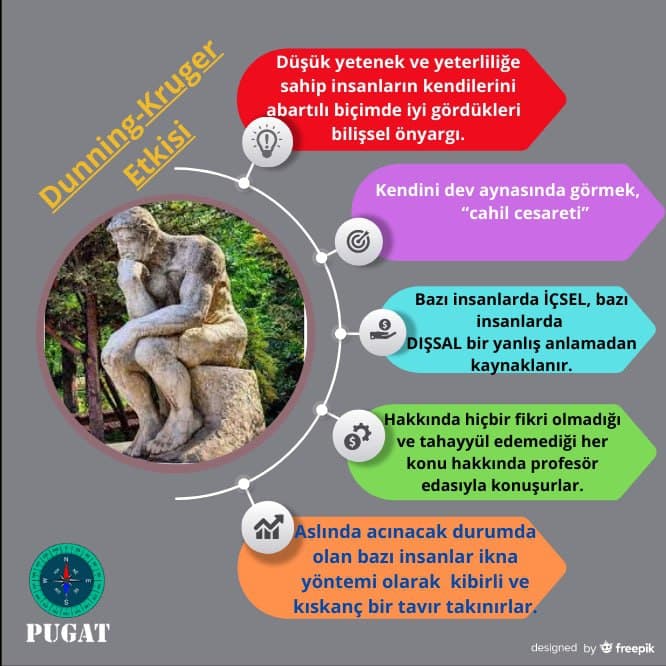
This phenomenon, which entered the literature as the “Dunning-Kruger Effect”, is in short a cognitive bias whereby people with low ability and competence see themselves as exaggeratedly good. For similar situations, expressions such as “living on Mount Stupid, seeing oneself in a magnifying mirror, acting as if one created the little mountains, the courage of the ignorant” are used.
According to the definition by the social psychologists David Dunning and Justin Kruger, the bias in people of low competence stems from an internal illusion, while in people of high competence it stems from an external misunderstanding. In other words, one stems from one’s own errors, the other from others’ errors. It is almost impossible for a person who imagines himself superior to analyse his shortcomings objectively and improve himself.
If you do a little research and reading on the popular website “Ekşi Sözlük”, you will see that the syndrome in question is more widespread than thought. Speaking with the air of a professor about a subject one has no idea about, cannot even imagine or foresee. Ruthlessly criticising, and of course insulting, the world’s best football teams, box-office hits, famous artists and writers are among the most common examples. People who are in fact in a pitiable state pitying others and, interestingly, being arrogant. In short, unqualified people are very far from noticing and understanding the outstanding qualities of truly qualified people. For example, they criticise a writer without reading any of his books, and they adopt such an attitude about it that sometimes even you are convinced.
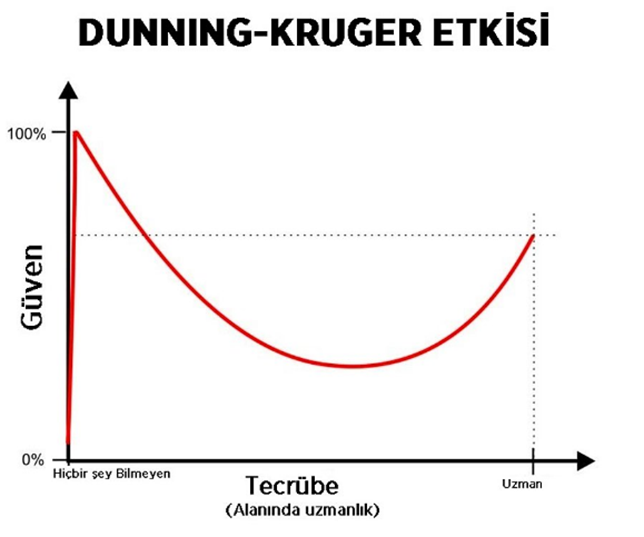
In this context, it is observed that the more a person learns, the more he realises how little he knows, and as his knowledge and experience increase, his self-confidence declines to a certain extent. In fact, the matter has deep dimensions, and when combined with other problems, such as jealousy, it can ruin the lives of many people and those around them.
The event that forms the starting point of the subject is as follows: on 19 April 1995, a man named McArthur Wheeler walked into two banks near his home in Pittsburgh and robbed them at gunpoint.
The robbery stands out as one of the strangest and most absurd crimes of all time. A man robbing two banks in broad daylight neither wore a mask to hide nor felt the need to conceal his face. He pointed his gun at the bank tellers, took the money and, after carrying out his robbery, left the scene confidently.
The most striking moment came when the police arrested Wheeler. Instead of claiming his innocence, Wheeler lamented in bewilderment something like: “How did you find me? I had rubbed lemon juice on my face.” Psychologists and sociologists found this very interesting.
The source of McArthur Wheeler’s motivation to rob a bank was his belief that lemon juice, with which one can write “invisible ink”, would have the same effect on his face. He believed he had robbed the bank as a kind of invisible man. Yet the tactic he used to hide his face was nothing more than a simple experiment done in primary school.
In conclusion, many of the people who anger us today are in fact nothing but wretches. So there is no need to go into detail, but whatever we do, let us not depart one iota from law and science.
Monthly · free
Compass of the Month
PUGAT’s monthly newsletter.
Read next



What is PUGAT? A non-profit community publishing independent analysis from Europe on security, migration and society in Turkish, German and English.
Go to the homepage
