

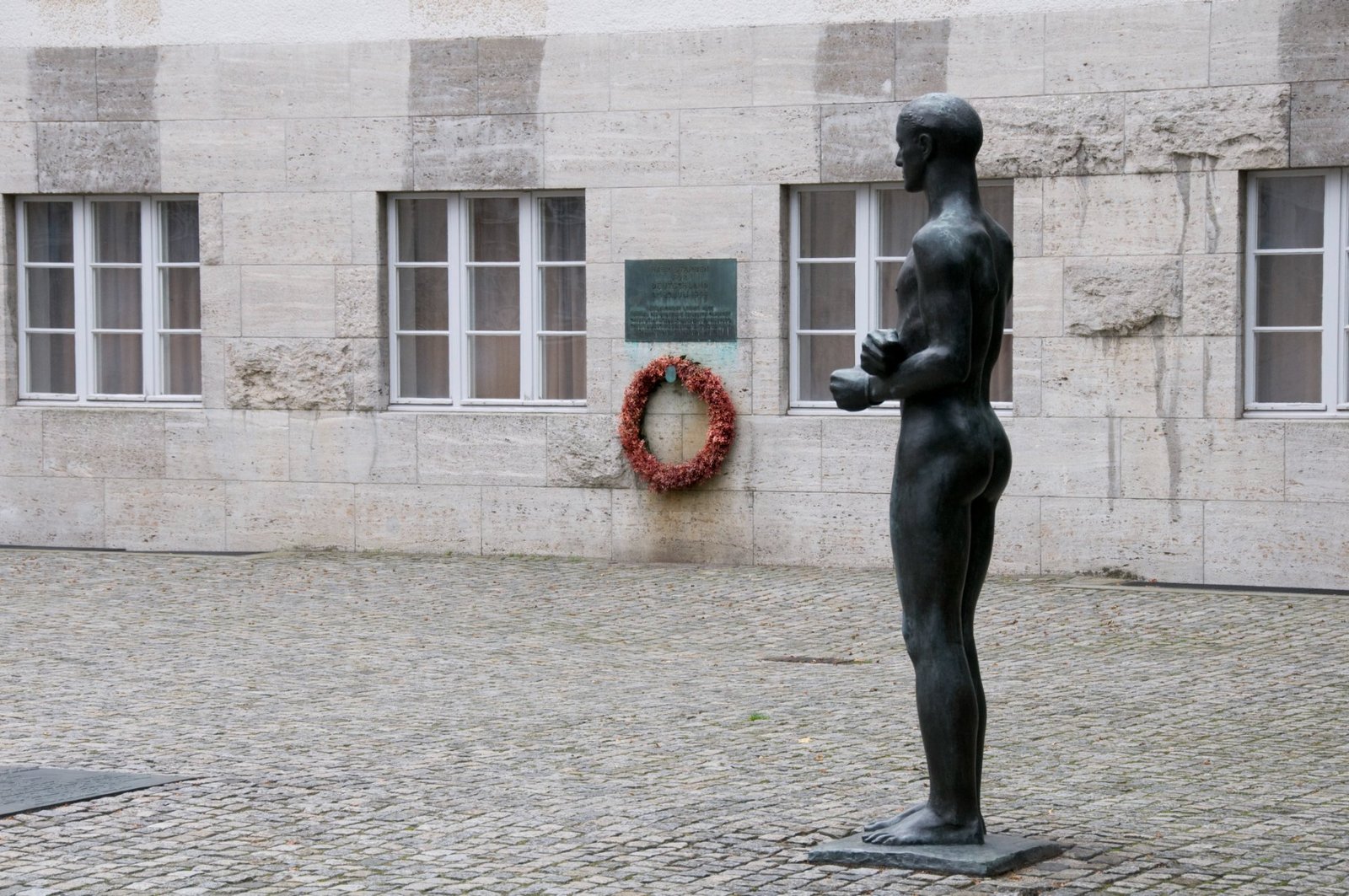
Every year on 20 July the German army takes its oath in memory of the 1944 attempt on Hitler’s life. A tradition that honours a coup attempt invites comparison with the 15 July narrative in Turkey.
Image: Hnapel / Wikimedia Commons, CC BY-SA 4.0
For a soldier, the day of the oath ceremony is a special moment never to be forgotten. With heartfelt emotion they swear to serve the homeland and the nation loyally, and after the oath they officially begin practising their profession.
Every year when the calendar shows 20 July, hundreds of soldiers take their oath at a ceremony held at the Bendlerblock in Berlin, which also houses offices of the Federal Ministry of Defence.
Addressing the soldiers about to take the oath at this ceremony in 2020, the then Federal Minister of Defence Annegret Kramp-Karrenbauer said: “The army you are about to join stands on the foundation of 20 July.” What the previous defence minister meant here was the attempt on Hitler’s life on 20 July 1944.
This year, as always, the ceremony was attended at a high level. Federal Minister of Defence Christine Lambrecht was among those present. In her speech at the ceremony, Lambrecht said: “For the German Armed Forces there is no more fitting day to commit those beginning their military service to loyal service to the values of our Basic Law and to democracy.” She stressed that the assassination attempt failed, but that the attempt in itself had a very high moral value. The minister also noted that 20 July 1944 left a legacy passed directly to the German Armed Forces and said: “Today German soldiers have a compass: conscience comes before obedience.”

The army’s official website states clearly that this date and this place were chosen deliberately for the oath ceremony. 20 July 1944 is the date of the attempt on Adolf Hitler’s life, while the Bendlerblock was the command centre of the soldiers who attempted to assassinate Hitler and also the place where they were shot.

These soldiers had once been part of Hitler’s regime; now they wanted to end the Second World War and to stop a tyrant who had lost his humanity and a dictatorship ruthless in all its parts. The act of Claus Schenk Graf von Stauffenberg and his comrades, who thus wanted to take sides on the thin line between obedience to the dictator and resistance, was described for the first time in post-Hitler Germany, on the tenth anniversary of the attempt, by the then Federal President Theodor Heuss as “not a betrayal, but on the contrary an honour”.
After Adolf Hitler survived the bomb attack with minor injuries, speeches were broadcast on the radio the very next day. In their speeches, Hitler and his Minister of Public Enlightenment and Propaganda Goebbels described those behind the attempt as “a very small clique of ambitious, unscrupulous and at the same time criminal, stupid officers” and turned it into propaganda material.


“Obedience Finds Its Limit in Conscience”
While society as a whole now seems convinced that those who tried to assassinate Hitler were not traitors, in Germany, which has drawn lessons from all of this, soldiers about to begin their careers are taught from the very start that “obedience finds its limit in conscience.” The German Soldiers’ Act draws the limits of obedience as follows: “A soldier is not obliged to obey in a situation that violates human dignity and does not have to carry out the orders given.”
Moreover, in Germany, which once experienced dictatorship to the full, the right of resistance is not granted to soldiers alone. The Basic Law grants all citizens a right of resistance.
Article 20 (4): “All Germans shall have the right to resist any person seeking to abolish this constitutional order, should no other remedy be available.”
In fact, we can say that this constitutional right of resistance granted to citizens is a symbolic article for Germany, a fully democratic state under the rule of law in which the separation of powers is ideally applied.
In a state governed by the rule of law, all powers are bound by law. Such a state is also one that provides its citizens with legal certainty. For example, if the executive, that is, those elected, are not bound by law, they must answer before the courts. In such a system, where an independent judiciary doing its job can hold everyone equally to account without exception, from a mayor to a prime minister, there is in practice no need to exercise the right of resistance.
The right of resistance is in fact as elastic as rubber. Purely for comparison, let us note that the right of resistance was once mentioned in the constitution in Turkey too. If you look at the preamble of the 1961 constitution, drafted after the 27 May coup, it states that the right of resistance was exercised in the name of the Turkish nation against a government claimed to have lost its legitimacy.
You can see how cheaply the right of resistance, a subject too complex to be clearly bounded by positive legal rules, is marketed to the public in countries like Turkey by looking at the praise and attempts at legitimisation offered so far for the 27 May coup in the name of the right of resistance.
Personally, I would never approve of a bomb or any other violent attack even against a tyrant. At the same time, I do not see myself in a position to judge Stauffenberg. I am not a historian, and I know that historical events should not be assessed out of the context of their time. I hope that even illegitimate rulers, or those who have lost their legitimacy, and tyrants will answer for their actions through democratic and legal means before independent courts. Finally, I want to stress another point I consider important. If the sense of justice is destroyed and people can no longer breathe under oppression, you lose control of some masses drifting into anarchism. The chaos of a situation in which everyone tries to secure their own justice breeds new injustices. And escaping such a vicious circle takes years.
Best that we remember the lines of Mehmet Akif[i] and not let history repeat itself. On the way to becoming a civilised society, let us also face our history and draw lessons sincerely before it is too late.
Man learns from the past, they say… What a fairy tale!
Did a tale five thousand years long teach half a lesson?
History, they define as repetition;
Had any lesson been learned, would it repeat itself?
Monthly · free
Compass of the Month
PUGAT’s monthly newsletter.
Read next



What is PUGAT? A non-profit community publishing independent analysis from Europe on security, migration and society in Turkish, German and English.
Go to the homepage
