

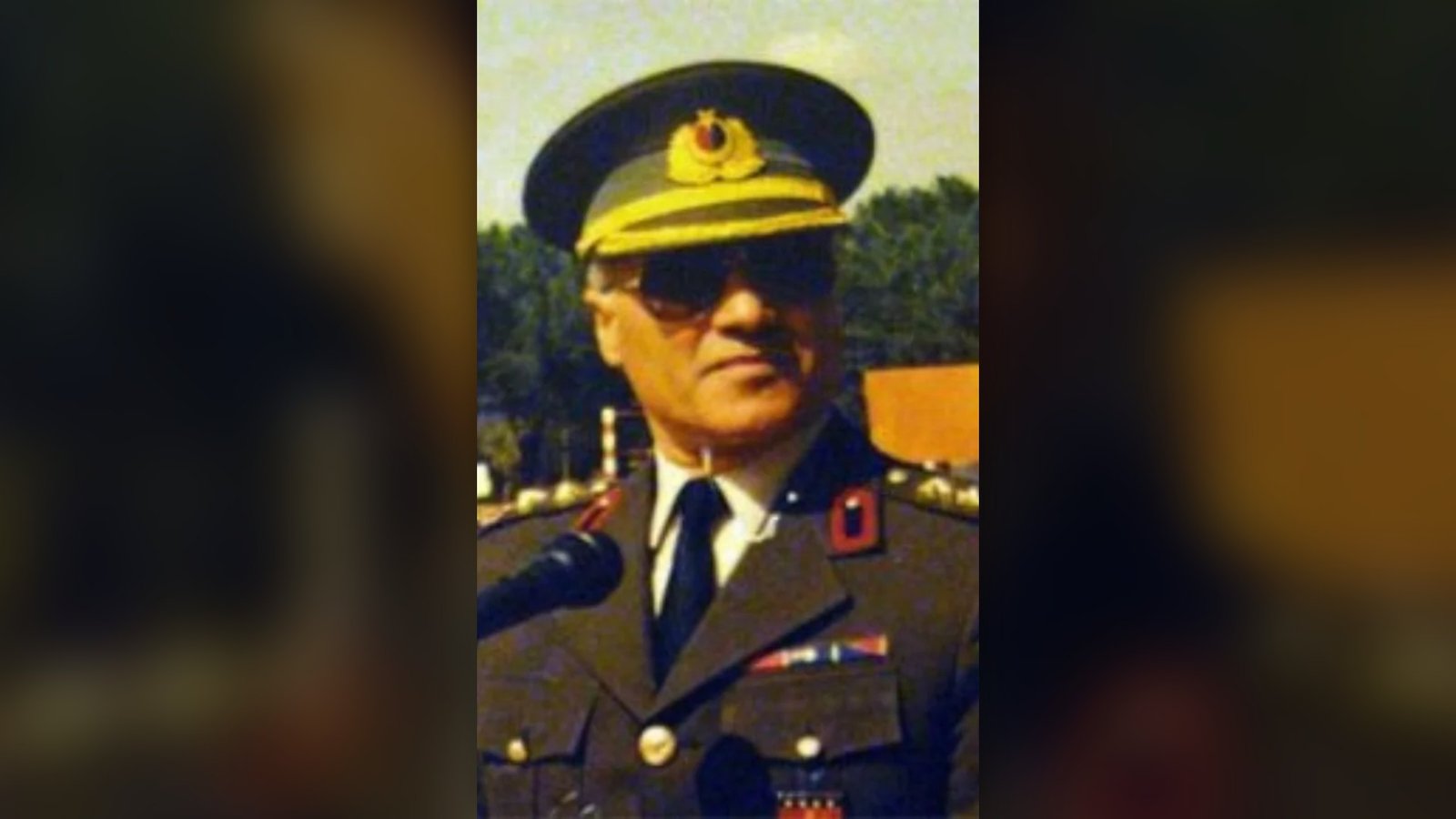
The shadow of the 1995 killing of Colonel Rıdvan Özden falls on today’s politics. Starting from a YouTube interview, the author questions the dark reckonings of an earlier era.
Never in the history of our Republic has there been a period in which everything was so entangled. The alliance of dirty men with dirty aims has become visible in every arena. Together we will see what they are prepared to risk in order to get through this last bend and hand their dirty order over to their next heirs.
An era is closing and a new one is opening, and as the actors of the old era hand the flag to the actors of the new, they also want to sweep their old sins under the carpet. Their methods of doing so are familiar: Homeland, Nation, Religion. Will the generation to whom they want to hand the flag put these sins in its saddlebag? Will it start new fights with the children of people who became victims of crimes they had no part in? Frankly, I do not know.
In this context, the interviews Oğuzhan Uğur has recently conducted on his YouTube channel “BaBaLa TV” drew attention. In the series of interviews, which began with Ümit Özdağ and continued with Ömer Faruk Gergerlioğlu, politicians whose names I consider it a waste even to write also took part and made fools of themselves. Oğuzhan Uğur, who then drew attention once again with an invitation to Hakan Şükür for an interview, withdrew the invitation after the backlash; announcing his decision, he also said he had had a long conversation with his father.
Oğuzhan, who once climbed over the wire fence of the district gendarmerie barracks to go and play with the children of the Kurds his father saw as enemies (in his own words), had this time been caught by his father and dragged home by the ear. This is a figure of speech, of course, but after the impact of the Ömer Faruk Gergerlioğlu interview, giving a platform to someone like Hakan Şükür would have meant shooting himself in the foot. And indeed they did not allow it. Since the subject was Hasan Atilla Uğur, the discussions and criticism naturally began to revolve around the “unsolved” (!) murders of the 1990s.
Hasan Atilla Uğur, who was tried in the Ergenekon case and was also a defendant in a separate case over unsolved murders and torture committed in the East and Southeast in the 1990s, was released in 2014 after the 17/25 December investigations, and the Ergenekon verdicts were overturned in 2016; it is claimed that this was the result of a deal between the AKP and the Ergenekon defendants. What is interesting is that the memory of that period, unfamiliar to those born in the 1990s, was revived by his own son through the YouTube channel “BaBaLa TV”.
The 1990s went down in history as a period of intense counter-guerrilla activity by Eurasianist, secular nationalist (ulusalcı) and nationalist groups that were powerful in every institution, above all in the Turkish Armed Forces. In 1990–95 alone, dozens of senior state officials lost their lives under suspicious circumstances. High-ranking officers such as the Mardin Provincial Gendarmerie Commander, Gendarmerie Colonel Rıdvan Özden, the Tunceli Provincial Gendarmerie Commander, Gendarmerie Colonel Kazım Çillioğlu, the Diyarbakır Regional Commander, Brigadier General Bahtiyar Aydın, Lieutenant General İsmail Selen and General Eşref Bitlis died under suspicious circumstances, and claims of sabotage and assassination behind these deaths were debated for years. Not only were the investigations never conducted properly, but the incidents were covered up despite thousands of pieces of evidence. I think it is important to pass on knowledge of this period, unfamiliar to those under 30, to the new generations and to thwart the dark plans being made for the post-AKP era.
In this context, I would like to say a few words about the suspicious death of the Mardin Provincial Gendarmerie Commander, Gendarmerie Colonel Rıdvan Özden.
Why Was Colonel Rıdvan Özden Targeted?
To understand the process that led to the assassination of Rıdvan Özden, it helps to look at his work before he was posted to Mardin and to identify whose interests his activities threatened. While serving as deputy provincial gendarmerie commander in Istanbul, Özden persistently pursued smuggling activities. He made considerable progress, especially in the fight against fuel smuggling. He established that vehicles used in fuel smuggling were being hidden in gendarmerie facilities and took the matter to court. In this file he had the names of prominent businessmen and some important commanders put on record. After his Istanbul posting, Özden was appointed Gendarmerie Regiment Commander in Mardin in April 1994.
Meanwhile, shortly before his death, Özden had met Colonel Kazım Çillioğlu, who was found dead in very suspicious circumstances in Tunceli (in February 1994) (probably executed), and had received important information about the Kurdish issue and the distorted relationships in the region. Eşref Bitlis had plenty of the same information; but after Eşref Bitlis’s death very few documents and little information reached Çillioğlu. Çillioğlu had shared this information with Rıdvan Özden.
Özden’s first task after his appointment to Mardin was to examine the issues in these reports. Allegedly, the files contained a list of state officials who helped Turkish Hizbullah and the PKK, along with important matters such as the PKK and its collaborators, the JİTEM links of village guards and some tribes, and fuel, drug and arms smuggling. Some of this information is said to have come from retired Gendarmerie Major Ahmet Cem Ersever, who was found near Elmadağ on 4 November 1993 with his hands tied and shot in the head. It is highly probable that Ersever was eliminated because he wanted to come forward and confess. So Colonel Özden took up his post in Mardin with this information in his briefcase.
Colonel Özden soon established that some PKK members and JİTEM personnel were working together at the centre of the drug smuggling in the region. He is certain of his findings, but to be completely sure he takes a risk, crosses into Northern Iraq in disguise and meets Kurds with whom he is in direct contact there. (Colonel Özden has connections because he had been in Northern Iraq before.) In this work Özden establishes that around 20 high-ranking military officers were profiting greatly, especially from drugs. He learns that a significant part of the JİTEM personnel were taking a share of the smuggling profits. He presents evidence against some individuals and ensures that cases are opened. He sends the other important information as a report to the General Staff. But where this report is remains unknown.
After this report to the General Staff in September 1994, Rıdvan Özden receives his first warning. In November 1994 he escapes an ambush on his vehicle by seconds. His wife Tomris Özden describes this incident and what followed as follows:
“In his sixth month they made an attempt on his life, and he did not die. I ran to him. He said: They are going to kill me. They are burning villages. Then they took him to the State Security Court. They are arresting all of them. A case was also opened against Rıdvan for neglect of duty as Provincial Gendarmerie Regiment Commander. Anyway, Rıdvan was acquitted in May [1995]. As soon as he was acquitted, they killed him because he would expose this affair. Fifteen days earlier he had said to me: ‘They are going to kill me, we don’t have a penny, you’ll just have to sell the house in the village.’”
Colonel Özden confronts those who come after him. This time he decides to open the file on unsolved murders. The file he opens becomes the last straw for him. Because many gendarmerie personnel are named in unsolved murders. Again allegedly, during this period cyanide is put in his food. Since he is full, Özden gives the meal offered to him to the dogs at the regiment. The two dogs that eat it die within a short time.
Where Is the Brown Briefcase?
Tomris Özden, who says her husband had a brown briefcase he never let out of his sight, says:
“Inside were his memoirs, his diary, his address book, his notes and his red-covered planner. He was going to turn his notes into a book when he retired. Only I knew the code. He had said, ‘It is a matter of life and death, you should know this code too.’ Until 15 days before his death the briefcase was at home. But he took it away, saying, ‘If I die they will break into the house like thieves and take the briefcase.’ He even said: ‘If I die, if something happens to me, take the briefcase and burn its contents under the house, and don’t dig too deep yourself.’ After my husband’s death, that briefcase became a mystery.”
Tomris Özden also raised the information about her husband’s missing briefcase during the Ergenekon trial:
“In my capacity as a journalist, I had given some of my husband’s documents to Tuncay Güney. To get my husband’s briefcase I went to the then State of Emergency commander, Mehmet Çavdaroğlu. He was a close friend of ours. I said, ‘Take me to the place where Rıdvan was killed.’ But he showed no interest in me at all. Later I called Çavdaroğlu Pasha again and asked about the briefcase. He replied: ‘Don’t bother me about this again.’”
I would like to digress briefly here. I did my first tour of duty in the East in Mardin. On one occasion I had the chance to see the spot where Colonel Özden is alleged to have been ambushed. Any soldier with a little knowledge of how an ambush is carried out and what is considered when choosing an ambush point would understand that the area was not suitable for an ambush.
According to official records, on 14 August 1995 Colonel Özden was ambushed by the PKK in the countryside of Ormancık village in the Savur district of Mardin and fell in the gunfire together with two of his bodyguards. (His wife Tomris Özden, however, maintains that he was actually killed on 12 August.) Don’t be misled by my saying “gunfire”: he and his bodyguards were each killed by a single bullet to the head. What a skilled man that sniper must have been, shooting moving targets in the head one after another with a single shot each, soldiers who would certainly have reacted to protect themselves after the first shot!
After Colonel Özden’s death his wife Tomris Özden never let the matter go. But since she faces a shadowy network that had infiltrated state institutions, she is blocked at every turn. She recounts that her husband Colonel Rıdvan Özden was on very good terms with General Eşref Bitlis, the former Gendarmerie General Commander who officially “died in a plane crash”; that they worked together in Ankara for 5 years (probably at the General Staff, since Eşref Pasha was an army officer); that in the years when the Gulf War began, Eşref Pasha sent Colonel Özden to the US as a courier officer; and that they were very close and saw each other as families even though they lived in different provinces.
Conclusion
How was Rıdvan Özden killed? Which truths were covered up in the investigation? Why were the autopsy reports of the soldiers killed alongside him never discussed? Dozens of questions remain unanswered. According to the allegations, Colonel Özden was abducted and executed after interrogation under torture. I think these allegations must be investigated seriously, because we have seen hundreds of times the torture, executions and abductions after 15 July and how the courts turned a blind eye to these concrete charges. When Colonel Özden was Mardin Provincial Gendarmerie Commander, the Kızıltepe District Gendarmerie Commander was Hasan Atilla Uğur. It is alleged that Hasan Atilla Uğur was among the officers Colonel Özden confronted; this allegation has not been confirmed by any court ruling.
Now let us go back to the beginning. If, on a BaBaLa TV programme whose guests were the children of the dozens of senior officers who, like Colonel Rıdvan, died under suspicious circumstances and of the thousands who fell victim to unsolved murders, they were asked “whom they would like to see as a guest”, whose names would come up? How many would write down the person who said to those he interrogated, for example, “I am the God of these parts”? Frankly, even the answer to this question should give pause to anyone with a conscience.
Monthly · free
Compass of the Month
PUGAT’s monthly newsletter.
Read next


What is PUGAT? A non-profit community publishing independent analysis from Europe on security, migration and society in Turkish, German and English.
Go to the homepage
