


Thousands of specialist posts opened by the Ministry of Health remain vacant, and in the earthquake-hit provinces there are almost no applicants. The emigration of doctors from Turkey is reaching ever more serious proportions.
It is obvious that in recent years things have not been going well in our country in many respects. Young people in particular are searching for a better future for themselves. The natural result is the reality of brain drain. Educated people are looking for their future abroad, especially in Western countries where the rule of law and democracy work comparatively better. The area where brain drain is felt most is the health sector, because it has become increasingly clear that something is wrong with health services.
The number of doctors leaving our country to work abroad has risen enormously in recent years. Since no diagnosis has been made of the causes of this migration and no measures have been taken, we can safely assume that the trend will become ever more serious. After all, the government’s view is this: “If they want to go, let them go.”
How Serious Is the Situation?
According to a media report, only 39 appointments were made to the 2,669 specialist doctor posts in the Ministry of Health’s first call for 2023. Although a total of 19,252 posts were opened across all fields, 6,792 people were appointed. Because of the vacant posts, the ministry issued a second call. In the second call, posts were opened in 19 provinces. Of 2,739 posts, 774 were chosen. In Adıyaman, devastated by the earthquake disaster, nobody applied for the 114 doctor posts opened in 36 specialties, nor for the 27 posts in Kilis. In Hatay 23 people applied for 213 posts, in Malatya 3 for 81, in Kahramanmaraş 4 for 127, and in Gaziantep only 20 for 310. Mardin received 4 applications for 111 posts, Osmaniye one for 76, and Şanlıurfa only seven for 315 posts.
Can Retirees Close the Gap?
To close this gap, the government has begun making various arrangements for retired doctors aged 65 to 72 to return to work. But is this normal for a country of 84 million people?
The report continues as follows:
“In six provinces, including those hit by the disaster, the application rate stayed at 10 per cent, while five provinces had occupancy rates of 10 to 20 per cent. Meanwhile Istanbul, İzmir, Antalya, Bursa and Kocaeli managed only around 40 per cent. Gaziantep, where violence against health workers is common, is among the provinces with the largest shortfall and the least preferred.
In Adana, although 52 posts were opened in 35 specialties, including critical ones such as intensive care, general surgery, pulmonology, ophthalmology, ear, nose and throat, neurology, paediatric surgery and paediatric haematology and oncology, there were no applications at all. In Gaziantep there was no demand for 176 posts in 55 specialties, including all paediatric subspecialties as well as haematology, cardiovascular surgery and thoracic surgery. In Kütahya all 53 posts in 24 specialties remained empty. In Erzincan, no appointments were made to any of the 17 posts opened in family medicine, brain and nerve surgery, general surgery, nuclear medicine, medical biochemistry, medical microbiology, medical pathology and intensive care.
Nobody applied for 19 posts in 15 specialties in Bartın, 73 in 33 specialties in Osmaniye, 92 in 35 specialties in Mardin or 77 in 44 specialties in Malatya. In Şanlıurfa, one of the provinces with the most violence in health care, the 261 posts opened for 63 specialties, including important departments such as urology and ear, nose and throat, remained empty. In all provinces, 22 specialties, mostly paediatric subspecialties, were not chosen at all. According to the results, nobody was placed in the five posts for paediatric pulmonology or the 12 posts for hand surgery. One person was placed in the 13 posts in paediatric haematology and oncology, and 23 people in the 123 posts in ear, nose and throat diseases.”
In the light of these data, it is plain that the “if they want to go, let them go” strategy is not a very sensible way of thinking. From the Health Minister’s statements we can also clearly see that the government is struggling to diagnose the cause of this problem (or avoiding a diagnosis). Answering a question from journalists, the Health Minister said the issue stemmed from financial reasons and that doctors going abroad chose to work there only for the money. More precisely, he implied this with a gesture of his hand. Yet the widespread lawlessness in the country, and the fact that violence against health workers in particular meets with no deterrent, emerge as very important factors. In short, to put it mildly, doctors do not look very happy. The suicide reported widely in the media on 28 September 2023 shows this.

Now let us look at other concrete data and compare Turkey with countries where blocking an ambulance’s path or using violence against a doctor is unthinkable.
The Numbers Speak
According to a report published by Euronews on 24 September 2023, based on 2021 data, and the statistics it gave, Turkey ranks last in Europe in the number of doctors per capita. (The statistics may not reflect the most recent figures.)
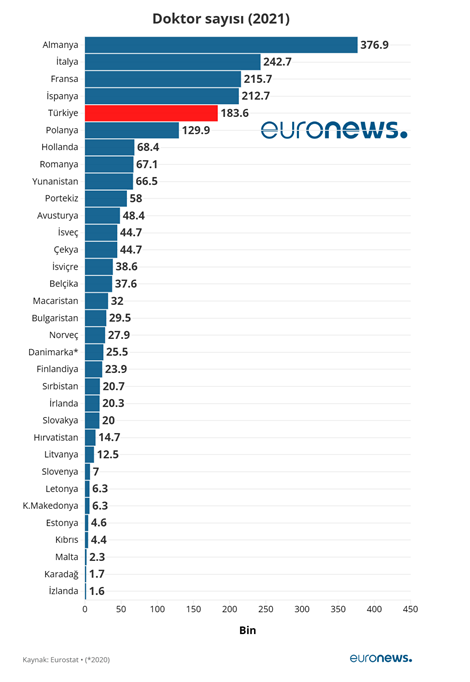
Turkey ranks fifth in the number of doctors after Germany (377,000), Italy (243,000), France (216,000) and Spain (213,000). But the picture changes when population is taken into account.
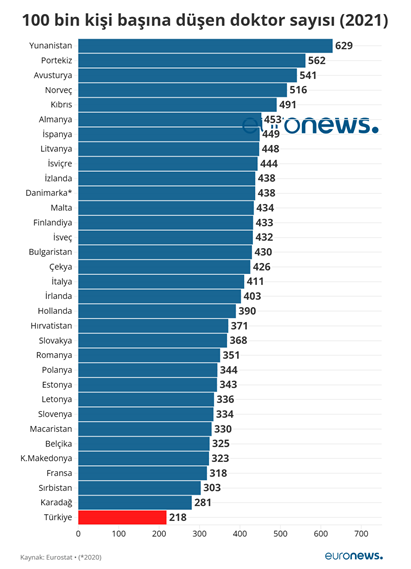
According to 2021 data, Turkish citizens visit a doctor for an examination 8 times a year on average. Turkey ranks near the top among European countries in this respect. Although Turkey again ranks high in the total number of doctors, the picture is the exact opposite once population is considered. In doctors per capita, Turkey ranks last in Europe.
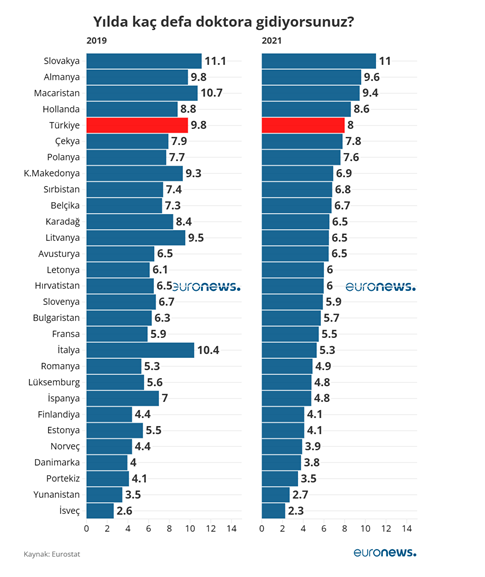
The number of doctor visits per year varies greatly from country to country. According to 2021 data published by Eurostat, the EU’s statistical office, it ranges from 2 to 11.
Why Do the Numbers of Consultations Differ?
According to a report by the Organisation for Economic Co-operation and Development (OECD), there may be various reasons for such large differences between countries in the number of consultations. Chief among them is that in some countries nurses and other health workers play an important role. Sweden and Finland are examples. This reduces the need for doctors.
In countries where doctors are paid per patient they treat, the number is higher. Slovakia and Czechia are examples.
How Many Doctors Are There in the Country?
According to Eurostat data, the total number of doctors in Turkey in 2021 was 183,569. Germany is at the top with 377,000.
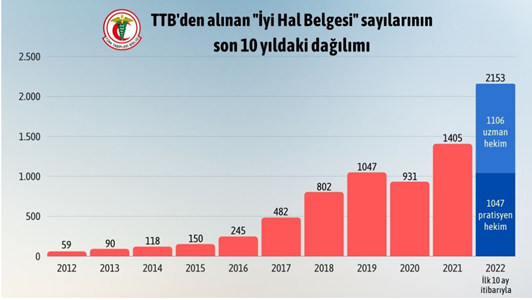
The countries’ populations differ greatly. The real measure, therefore, is the number of doctors per capita. According to 2021 data, Turkey is the country with the lowest number of doctors per capita in Europe. In Turkey there are 218 doctors per 100,000 people. Greece is at the top with 629. According to the Turkish Medical Association (TTB), more than a thousand doctors obtained from it in 2021 the “certificate of good standing” needed to work abroad. The TTB explains this by health workers leaving Turkey, where inflation was approaching 80 per cent, in the hope of “better working conditions and a better quality of life”. According to the association, hundreds of doctors left their jobs in Turkey to access better opportunities abroad.
“Now We Can Beat Up Doctors Whenever We Like!”
Meanwhile, the violence and harassment doctors suffer from patients’ relatives, and the fact that the perpetrators are not punished sufficiently, are cited among the important factors in health workers losing their motivation. In a street interview, a woman assessing developments in health care said: “We used to be unable to get health care; now we can beat up doctors whenever we like.”

How terrible a mentality this sentence represents, and how drunk on victory ignorance has become, lies outside our subject for now. But propaganda is very effective, and the Directorate of Communications and the pro-government “pool media” are doing their job very well, that much is certain.
A Rush of Turkish Doctors to Germany
According to another report, a new record has been set in the number of doctors going from Turkey to Germany. According to 2022 data, the number of doctors who had gone to Germany or completed their preparations to go was 2,417. Of these, 1,227 were reported to be specialists, and Germany thereby made significant savings instead of spending money on training doctors from scratch. If the rush of Turkish doctors continues like this, it is thought that Germany will largely close its gap by 2025.
In addition, according to data published by the Turkish Medical Association (TTB), 881 doctors applied for the certificate of good standing needed to work abroad in the first four months of 2023.
TTB Secretary General Prof. Dr. Vedat Bulut stated in an interview that doctor migration has many causes, but the first is “violence”:
“The first and most important cause of this migration is violence in health care. Violence in health care has worn doctors down.
The second is economic reasons. They leave for better economic conditions, to work in a more comfortable environment where they can see ahead, to give their children a good education, or because they see no future in Turkey.
Another cause is the sharp increase in malpractice suits, which have now become a form of abuse (lawsuits filed over the indifference, carelessness, inexperience or ignorance of the doctor or the health institution concerned). Should doctors deal with their patients, seeing 100 patients a day, one every 5 minutes, or should they deal with lawsuits?
Even though the courts have annulled security investigations, a 7- or 8-member commission set up at the Ministry of Health under the name of an archive search is delaying young doctors’ appointments. In the 1990s a graduate would start work within 6 to 8 weeks at the latest. Now there are doctors waiting 8 to 10 months. Those who do not want to wait, who lose hope, turn abroad.
Another reason is that doctors who go abroad teach their friends how to get there and find work. They explain the bureaucratic process. This recalls the migration to Germany in the 1960s. The one who leaves opens the way for family and friends too. They build a bridge.”
Conclusion
Health workers choosing to go abroad is not due to economic reasons alone. Legal concerns are also to the fore, and living in a country where democracy does not function is truly very hard.
The tendency of health workers to go abroad, and the resulting gap, is such an important problem, and will become an even bigger one, that it can be solved neither by retired staff returning to work nor by doctors coming from Syria, Pakistan or Afghanistan. Because doctors from abroad will also come to dislike working conditions in Turkey after a while and, like their colleagues, set off for Europe.
On the other hand, it should be noted that members of parliament and their families, or very wealthy people, have no problem accessing health services. Here we must ask: does the well-fed understand the hungry? A shortage of doctors also means a shortage of staff to train new doctors. If academic staff are not given special support, many teachers at medical faculties will also move to the private sector. This makes it essential to develop staff training strategies based on structural reforms rather than short-term fixes.
Sources
Monthly · free
Compass of the Month
Once a month: five points from Europe’s security and migration agenda and the month’s PUGAT articles, in your inbox.
Newsletter sign-up opens soon.
Read next



What is PUGAT? A non-profit community publishing independent analysis from Europe on security, migration and society in Turkish, German and English.
Go to the homepage
