

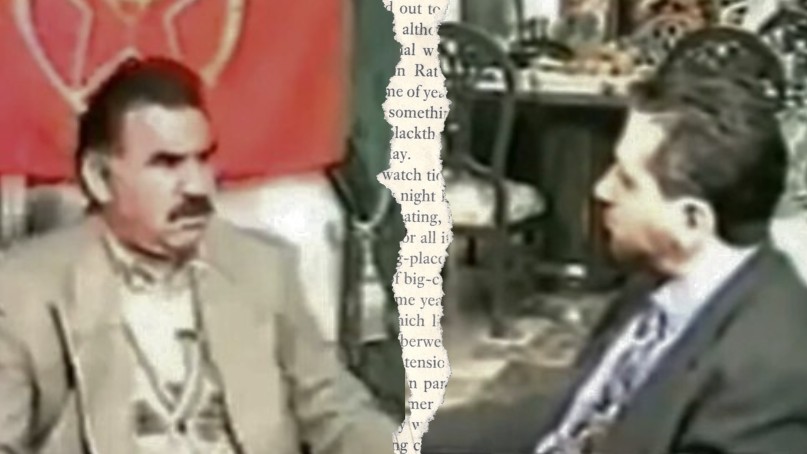
Fatih Altaylı’s 1997 interview with Öcalan was published 28 years later. The leader who said “I will not touch Turkey’s borders” turned, on İmralı, into a theorist of stateless democracy: contradiction or strategic evolution?
1997 Röportajlarından Demokratik Konfederalizme
The interview Fatih Altaylı conducted with Abdullah Öcalan in 1997 was published for the first time 28 years later on Ruşen Çakır’s YouTube channel. These interviews offer surprising content for the broad public who know Öcalan only as the founding leader of the PKK. For those of us who have read his books and followed the texts on the movement’s transformation, they carry important clues for understanding the spirit of that period, the harsh political climate Turkey was going through and the roots of the many-layered crisis we are still debating today.
Öcalan’s attitude in the interview, his choice of words and the way he positions himself may well have been perceived by many at the time as the typical propaganda discourse of an armed group’s leader. Looking back today, however, this discourse can be said to be a remarkable document on Turkey’s internal political balances, the power struggles within the state and the course of the Kurdish question. This interview should therefore not be seen merely as the statements of an organisation’s leader. It can also be read as an expression of a strategic battle of discourse waged between the parties to the conflict.
The 1997 Discourse: Susurluk, the Unitary Structure and the Claim to Be the Key to Peace
In the interview Öcalan describes himself as in favour of Turkey’s unity, as a “child of Anatolia” and even as a “Turkish patriot”. He argues that he has no aim of dividing Turkey and that, on the contrary, the source of the problem is not the state but illegal power structures within the state. His interpretation of the Susurluk accident as “one of the important turning points in Turkey’s history”, and his description of these structures as a dark rent-seeking mechanism that gains legitimacy through the war with the PKK, can be read as an attempt to explain that the issue is not merely a security problem.
In this context, Öcalan tries to position himself as the sole key to peace by tying the solution to political dialogue rather than armed struggle:
“Let the prime minister accept dialogue, and the next day we will silence the guns.”
Yet within the same discourse, his description of actions against civilian targets, and in particular of incidents such as the execution of 33 unarmed soldiers, as “guerrilla actions on local initiative” stands in stark contrast to his peaceful rhetoric. Can a leader claim to be the absolute authority and at the same time explain such actions away with “I had no knowledge”?
In my view, this contradiction looks like the most fragile point of the peace-leader profile Öcalan tries to build in the interview.
After İmralı: A Radical Paradigm Shift and Democratic Confederalism
After 1999, with his imprisonment on İmralı, Öcalan’s intellectual line underwent a fundamental transformation. He developed the paradigm of Democratic Confederalism, which rejects the nation-state model wholesale, defines centralism as the source of social regression and oppression, and is built on stateless democracy and governance from below.
This new approach, based on powerful concepts such as women’s liberation, ecology, local self-government, direct democracy and multiculturalism, stands in marked contrast to the 1997 rhetoric of a “solution within the unitary structure”.
In a sense: A political actor who said in 1997 “I will not touch Turkey’s borders” turns, on İmralı, into a theorist advocating “stateless democracy”.
The Strong Link Between Democratic Confederalism and the KCK Contract
This transformation does not remain at the theoretical level. The KCK Contract, proclaimed in 2005, forms the organisational and institutional framework of Democratic Confederalism.
In other words: If Democratic Confederalism is the ideological and paradigmatic framework, the KCK Contract is the organisational model and practical implementation guide of that framework.
Headings such as local assemblies, the commune system, the co-chair model, women’s assemblies, ecology-based policy-making and self-defence mechanisms were to be institutionalised through this contract. The canton system in Rojava can be seen as an example of this approach being applied on the ground.
Contradiction or Strategic Evolution?
Reading the gulf between these two periods, one cannot help asking:
Is this transformation the result of a deep ideological maturing, or an adaptation imposed by historical conditions?
The paradigm of Democratic Confederalism, which emerged at a time when the PKK’s military power was shrinking and the international conjuncture was changing, can be interpreted by some as a forced change of direction and by others as a historical move towards renewal.
In the same texts, Öcalan himself draws the profile both of an anti-centralist figure who says “let us shrink the state and enlarge society” and of a strong central actor who says “someone is needed to play the leader of Turkey”.
This is where the tension begins.
The Thought It Prompted in Me
Read together, these two periods remind me of Öcalan’s position as two different faces of one leader. One is a pragmatic war-and-negotiation actor at the centre of the crisis; the other a theorist building an ideological system on the island where he is confined.
This transformation contains many still unanswered questions about the future of Turkey and of the Kurdish political movement. Those that first come to my mind:
- Can Democratic Confederalism become a real political project in the harsh geopolitics of the Middle East, or will it remain a theoretical model?
- How will the gap between the PKK’s military-hierarchical structure and Öcalan’s theory of grassroots democracy be closed?
- If a negotiating table is ever set up again, which Öcalan will sit at it: the pragmatist of 1997 or the ideologue of İmralı?
- Will Turkish society be able to discuss this transformation calmly, or will it drown in slogans?
- How will political and organisational leadership take shape after Öcalan?
- Is a real break between violence and politics possible?
- Is Rojava a model for the future of Democratic Confederalism, or a historical parenthesis?
Öcalan’s discourse and transformation stand like a mirror not only of the Kurdish question but also of Turkey’s problem of democracy.
Watching this series of interviews recorded 28 years ago, I understood once again that in Turkey no issue is simple enough to be explained with one-word labels. And of course no actor is one-dimensional either. Update (October 2026): Since this article was written, the process has moved on considerably. After Öcalan’s call of 27 February 2025, the PKK announced its dissolution and its decision to lay down arms in 2025 and announced that it had withdrawn its forces from Turkey. On 10 August 2026 the Grand National Assembly passed the framework law governing the process (the Law on Strengthening National Solidarity and Social Integration); the law does not cover Öcalan personally.
Sources
- Fatih Altaylı – Interview with Abdullah Öcalan (1997), YouTube youtube.com
- Öcalan, Abdullah: Democratic Confederalism, Mezopotamya Yayınları, Cologne, 2011
- KCK Contract (Koma Civakên Kurdistan), 2005
- Cemal, Hasan: Delila – Bir Genç Kadın Gerillanın Dağ Günlükleri, Doğan Kitap, Istanbul, 2011
- Ruşen Çakır / Medyascope: series on Kurdish politics, the PKK and Rojava, 2016–2024
- Yetkin Report: Parliament passes the framework law (August 2026) yetkinreport.com
Monthly · free
Compass of the Month
Once a month: five points from Europe’s security and migration agenda and the month’s PUGAT articles, in your inbox.
Newsletter sign-up opens soon.
Read next


What is PUGAT? A non-profit community publishing independent analysis from Europe on security, migration and society in Turkish, German and English.
Go to the homepage
