

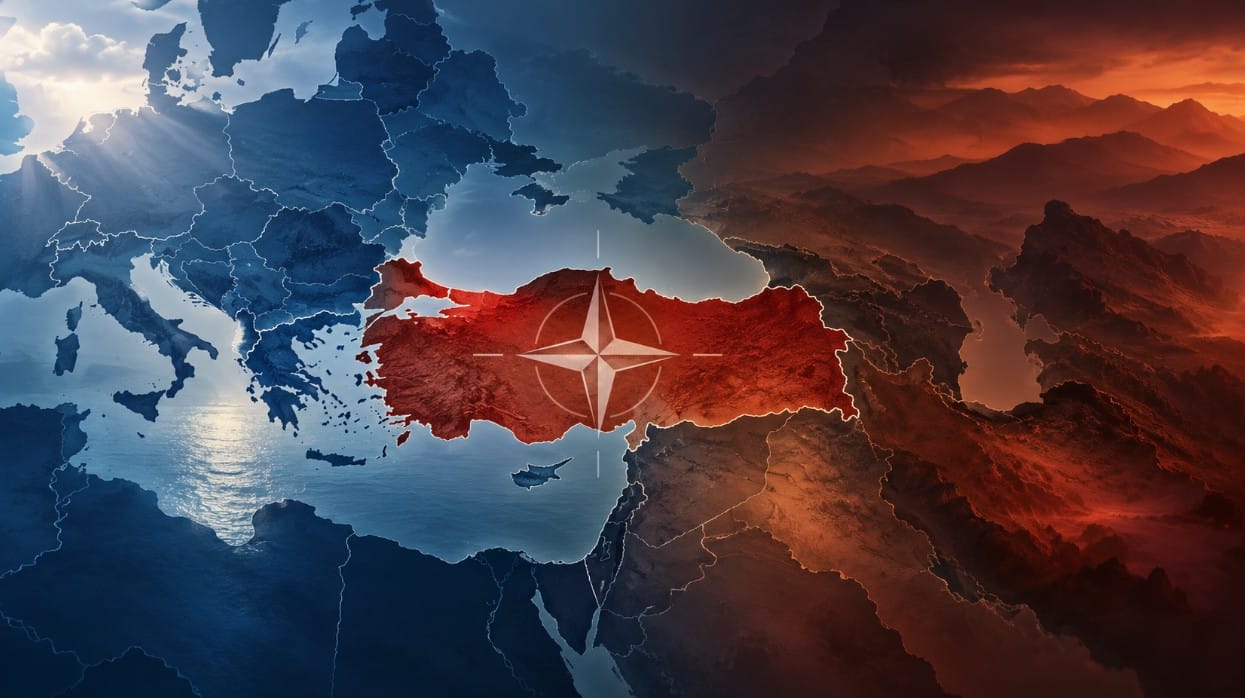
Membership won with blood shed in Korea, missiles bargained over in the Cuban crisis, embargoes and the S-400. Turkey’s NATO journey is a story of trust and suspicion spanning more than seventy years.
NATO–Turkey Relations: Past and Present
In late 1950, the war in Korea was not being fought only at the front. Thousands of United Nations soldiers captured by North Korean and Chinese forces were caught up in a different struggle in the prisoner-of-war camps.
Americans, Britons, Turks and soldiers from other countries were held in the same camps. Hunger, disease, harsh living conditions and efforts to break the prisoners’ resistance were part of camp life. Among the groups of Turkish prisoners, however, something different could be observed.
Even after capture, Turkish soldiers had largely tried to preserve their military order. Rank and the chain of command had not disappeared entirely, and many tasks, from sharing food to caring for the sick, were carried out together. The stronger helped the weaker, what little food there was was shared, and the group moved as one, even in captivity.
After the war, studies of the captivity of United Nations soldiers would single out this trait of the Turkish soldiers. Their ability to preserve group cohesion and military discipline even as prisoners would be cited as one of the features that set the Turkish units apart from some other groups of prisoners.
The Turkish soldiers fighting in Korea were not just trying to survive. Turkey, too, was trying to carve out a new place for itself in the Western world.
The Korean Peninsula lay thousands of kilometres from Turkey. Turkey had no border dispute with North Korea, nor any territory of its own to defend in Korea. Even so, Ankara sent a brigade of around 5,000 troops to the war.
Because Turkey’s real security problem was not in Korea but on its own northern border.
And to earn a place in the Western security system, Turkey had to prove itself in the East.
Next Door to the Soviet Union
When the Second World War ended, to Turkey’s north lay the Soviet Union, ruling over some 22 million square kilometres. Moscow’s demands concerning the Turkish Straits and Turkey’s eastern borders became one of the main issues shaping Ankara’s post-war security policy.
Turkey first received American support under the Truman Doctrine and was then included in the Marshall Plan. Yet when NATO was founded in 1949, Turkey was left outside the alliance.
Ankara’s first attempts to join NATO did not bring the hoped-for result either.
For Turkey, then, the Korean War that broke out in 1950 was not simply a new war in a faraway place. After the United Nations’ call, the decision was taken to send troops to Korea. The Turkish Brigade took part in heavy fighting, above all at Kunu-ri, and suffered serious losses.
Its military performance in Korea strengthened Turkey’s hand in its bid for membership. But Turkey’s success on the battlefield alone does not explain NATO’s interest.
Turkey had a large land army. It controlled the Straits linking the Black Sea to the Mediterranean, shared a direct border with the Soviet Union and sat between the Balkans, the Caucasus and the Middle East. From NATO’s perspective, Turkey opened up a vast military space on the Soviet Union’s southern flank.
For Turkey, NATO was the way to avoid standing alone against the Soviet Union.
On 18 February 1952, Turkey joined NATO together with Greece. NATO’s own historical records also list Turkey’s strong land forces, its bases and its geographical position south of the Soviet Union among the main military gains of its membership.
After accession, the Turkish army began to be integrated into NATO’s military structure. NATO’s Allied Land Forces South-Eastern Europe headquarters was set up in İzmir. US military aid increased, and weapons, communications and training systems were reorganised to NATO standards.
Turkey had joined the security alliance it had been seeking. The United States and NATO, in turn, had gained a new ally south of the Soviet Union with a large army, military facilities and a strategically important geographical position.
But Turkey’s closeness to the Soviet Union would bring another consequence besides the security that NATO membership provided.
Turkey’s Missiles on the Bargaining Table
The nuclear arms race of the Cold War soon reached Turkey. US Jupiter intermediate-range ballistic missiles capable of striking the Soviet Union were deployed in Turkey. These nuclear-capable missiles were an important part of the nuclear deterrent built up against the Soviet Union.
In 1962, however, the roles were reversed.
When it emerged that the Soviet Union had placed nuclear missiles in Cuba, the United States and the Soviet Union came to the brink of war. Washington was not prepared to accept Soviet nuclear missiles some 150 kilometres from its shores.
Moscow, for its part, reminded Washington of Turkey.
The Jupiter missiles the United States had placed in Turkey, right on the Soviet Union’s doorstep, and the missiles the Soviets had placed in Cuba were now part of the same crisis.
The US administration refused to accept a public, direct trade of the Soviet missiles in Cuba for the Jupiters in Turkey. In secret talks between Washington and Moscow, however, it was agreed that the Jupiters in Turkey would later be removed.
The Soviet missiles in Cuba were dismantled.
A few months later, the Jupiters in Turkey were removed as well.
Barely ten years had passed since Turkey joined NATO. The nuclear weapons of the alliance it had joined to secure itself against the Soviet Union had been stationed on its soil and had then become the subject of a secret bargain between two superpowers.
The limits of NATO membership would become even clearer for Turkey two years later, over Cyprus.
The Johnson Letter
As clashes between the Turkish and Greek Cypriot communities on Cyprus escalated from 1963 onwards, Ankara began to consider military intervention on the island.
On 5 June 1964, US President Lyndon B. Johnson sent a letter to Prime Minister İsmet İnönü.
For Turkey, the contents of the letter were very harsh.
Johnson warned that a unilateral Turkish intervention in Cyprus could prompt the Soviet Union to move against Turkey, and he did not give Ankara the assurance it expected about how NATO allies’ obligation to defend Turkey would work in such a case. He also objected to the use in Cyprus of military equipment supplied by the United States without Washington’s consent.
One of the main reasons Turkey had joined NATO was the guarantee of collective defence against a possible Soviet attack. Johnson’s letter raised serious doubts about how that guarantee would work if Turkey came into conflict with the Soviet Union as a result of its own policies.
İnönü later travelled to the United States and met Johnson. The crisis eased for a while, but the Cyprus problem did not go away.
Ten years later, Turkey would indeed send troops to the island.
The Cyprus Operation and the Arms Embargo
In 1974, following a coup in Cyprus backed by the military junta in Greece, Turkey launched a military operation on the island.
The situation was highly unusual for NATO as well. Turkey and Greece were both NATO members. Two countries that were part of the same defence plans against the Soviet Union had come to the brink of war over Cyprus.
After Turkey’s operation, the US Congress imposed an arms embargo on Turkey in 1975.
Ankara responded by restricting the activities of American military facilities in Turkey. İncirlik was kept under a different status because of NATO obligations, while some other American facilities were placed under the control of the Turkish Armed Forces.
Turkey, which had paved its way into NATO by fighting alongside the West in Korea, could no longer buy weapons from the alliance’s strongest member, a quarter of a century later.
Even so, Turkey did not leave NATO, and military relations with the United States did not break off completely.
The embargo was lifted in 1978, and relations gradually recovered.
Because despite all the disagreements, little had changed on the map.
The Soviet Union was still to Turkey’s north.
The Last Years of the Cold War
In 1979 the balance around Turkey shifted again. The Shah’s regime in Iran was overthrown. In the same year, the Soviet army entered Afghanistan.
The geographical position of Turkey, on NATO’s south-eastern flank, had once again gained importance.
After the military coup of 12 September 1980, Turkey’s relations with Western countries ran into problems over democracy and human rights, but military relations within NATO continued.
In the same period, Greece’s return to NATO’s military command structure came onto the agenda. Greece had left NATO’s integrated military command after the 1974 Cyprus operation. When it sought to return in 1980, Turkey initially objected. After negotiations, Ankara lifted its objection and Greece rejoined the military command structure.
The problems in the Aegean and on Cyprus, however, remained unresolved.
Turkey and Greece clashed from time to time in the years that followed. NATO membership was not enough to resolve the problems between the two countries.
In 1991, the most important reason for the alliance’s existence disappeared.
The Soviet Union collapsed.
No Soviet Union, Turkey Still in NATO
With the collapse of the Soviet Union, the Soviet threat, one of the main reasons Turkey had joined NATO in 1952, came to an end.
But Turkey did not leave NATO.
Because with the end of the Cold War, NATO too began to look for new areas of activity. In the 1990s the wars in the Balkans took the alliance to Bosnia and Kosovo. Turkey sent troops to these operations as well.
After the attacks of 11 September 2001, Article 5 was invoked for the first time in NATO’s history. The alliance’s area of operations then extended as far as Afghanistan.
Turkey joined the ISAF force in Afghanistan and took over command responsibility at various times.
Turkish soldiers who had been sent to Korea under the United Nations flag in 1950 were, half a century later, serving in Afghanistan as part of a NATO-led mission.
But the disappearance of the Soviet Union had not removed the problems between Turkey and its Western allies.
This time, the disputes centred on Turkey’s south.
The 1 March Motion and the Iraq War
In 2003 the United States was preparing to enter Iraq to topple Saddam Hussein’s regime.
One of Washington’s plans was for American troops to enter northern Iraq via Turkey. This required the approval of the Turkish parliament.
In the vote on 1 March 2003, the motion failed to reach the required majority.
American troops could not enter Iraq through Turkey.
The decision seriously strained relations between Ankara and Washington. But the Iraq War was not a joint NATO operation, and NATO members themselves disagreed about the war.
Interestingly, while Turkey refused to let American troops cross its territory into Iraq, it had asked NATO for help against a possible attack from Iraq.
Turkey called for consultations with its allies under Article 4 of the North Atlantic Treaty.
The request sparked a dispute within NATO. France, Germany and Belgium initially objected, arguing that early military preparations would encourage war. In the end, measures for Turkey’s defence were approved. AWACS early-warning aircraft and Patriot air defence systems were sent to Turkey.
Turkey and the United States disagreed about the invasion of Iraq.
Yet NATO’s military assets to counter a possible attack on Turkey from Iraq were, once again, in Turkey.
A similar situation would arise on the Syrian border about ten years later.
The Syrian War on Turkey’s Border
The Syrian civil war that began in 2011 soon reached Turkey’s border.
On 22 June 2012, a Turkish Air Force RF-4E reconnaissance jet was shot down by Syria. Turkey called its allies to consultations under Article 4 of the North Atlantic Treaty.
A few months later, artillery shells fired from Syria hit Akçakale, a district of Şanlıurfa, killing five Turkish citizens.
Turkey once again called NATO to consultations.
At Ankara’s request, Patriot air defence systems belonging to NATO countries were deployed in Turkey.
The collective security system Turkey had sought against the Soviet Union when it joined NATO in 1952 was being used sixty years later because of a threat on the Syrian border.
As the Syrian war went on, however, the groups regarded as threats by Turkey and, above all, by the United States began to diverge.
The PKK–YPG Dispute
After ISIS took control of large areas in Syria and Iraq, the United States began working with the YPG, which was fighting ISIS in Syria, and later with the Syrian Democratic Forces.
Turkey, however, regarded the YPG as the Syrian offshoot of the PKK.
While the United States saw its relationship with the YPG/SDF as part of the fight against ISIS, Ankara argued that the weapons and military support provided posed a threat to its own security.
In this way, the priorities of two NATO allies in Syria drifted apart.
For Turkey, the PKK/YPG presence on its border was one of its main security problems. For the United States, the SDF was the force it worked alongside on the ground in the fight against ISIS.
NATO membership did not lead the two countries to pursue a common policy on this issue.
On the contrary, another military problem was soon added to the dispute over Syria.
The S-400 and F-35 Crisis
Turkey had long been looking for an air defence system. After talks with the United States and other NATO countries failed to produce results, Ankara turned to Russia.
In 2017 an agreement was signed to buy the S-400 air defence system from Russia. The first systems arrived in Turkey in 2019.
At the same time, however, Turkey was one of the partners in the US-led F-35 fighter jet programme.
Washington argued that the Russian S-400 posed a security risk to F-35 technology and was not compatible with NATO’s air defence system.
Ankara, for its part, said it had been unable to meet its air defence needs from its allies on suitable terms and would not back down on the S-400.
The United States then removed Turkey from the F-35 programme. Later, sanctions were imposed on Turkey’s Presidency of Defence Industries under CAATSA.
The Turkish army, rebuilt with American weapons in the 1950s, had been expelled some seventy years later from one of the United States’ most important fighter jet projects because of an air defence system bought from Russia.
But the relationship between Russia and Turkey was not an alliance either.
The war in Ukraine that began in 2022 would show this.
The Russia–Ukraine War
When Russia launched its full-scale attack on Ukraine on 24 February 2022, Turkey found itself facing a highly complex geopolitical situation.
On one side stood seventy years of NATO membership.
On the other were relations with Russia spanning many areas, above all energy, trade, tourism, Syria and the Black Sea.
Turkey supported Ukraine’s territorial integrity and did not accept Russia’s attack. The Bayraktar TB2 drones Ukraine had earlier bought from Turkey were used in the war.
Ankara, however, did not join all the sanctions Western countries imposed on Russia and maintained diplomatic relations with Moscow.
Turkey also applied the wartime provisions of the Montreux Convention on the Straits, restricting the passage of warships through the Straits. Talks between Russian and Ukrainian delegations were held in Istanbul. Later, through the efforts of Turkey and the United Nations, the Black Sea Grain Initiative was set up.
Turkey was supporting Ukraine on one hand while continuing to talk to Russia on the other.
Russia’s attack on Ukraine had another consequence for NATO.
Finland and Sweden, which had long pursued a policy of military non-alignment, knocked on NATO’s door.
This Time, Turkey Was at the Door
For Finland and Sweden to join NATO, all member states had to give their approval.
Turkey initially objected to the membership of both countries.
Ankara criticised in particular Sweden’s stance towards the PKK and other groups Turkey regards as terrorist organisations, and demanded steps in this area.
Finland’s membership went ahead in 2023 after Turkey gave its approval.
For Sweden, the process took longer. Ankara and Stockholm held talks on counter-terrorism and Turkey’s extradition requests. After the Turkish parliament’s approval, Sweden became NATO’s 32nd member on 7 March 2024.
And here lay the irony of history.
Turkey, which in the early 1950s had wanted to join NATO and waited for its Western allies’ approval, was seventy years later on the side that would approve other countries’ membership.
An Alliance of More Than Seventy Years
Looking back at more than seventy years of Turkey’s relations with NATO, Turkey’s relationship with the alliance has been neither an indispensable friendship nor one of constant conflict.
Turkey joined NATO in search of security against the Soviet Union. The Turkish army was rebuilt to NATO standards, received substantial American military aid and became one of the largest military forces on NATO’s south-eastern flank.
NATO, in turn, benefited from Turkey’s large army, the Straits, its military facilities and its geographical position south of the Soviet Union.
But shared interests did not mean a shared policy on every issue.
The Jupiter missiles in Turkey became the subject of a secret bargain between the United States and the Soviet Union. The Johnson letter raised the question of the conditions under which NATO would protect Turkey against a Soviet attack. After the Cyprus operation, the United States imposed an arms embargo.
After the Cold War ended, the problems changed their names.
Over Iraq, Syria, the YPG and the S-400, the security policies of Ankara and Washington clashed once again.
Even so, Turkey did not leave NATO, and NATO did not want to lose Turkey.
Perhaps one reason is easier to grasp by going back to where this article began: the map.
In 1950, the Soviet Union lay to Turkey’s north.
Today, much of the same territory belongs to Russia.
To Turkey’s south, wars were fought in Iraq and Syria. To its east lies the Caucasus. And across the Black Sea to its north, the war between Russia and Ukraine goes on.
Over more than seventy years, Turkish governments, American presidents, NATO strategies and the threats facing the world have changed many times.
Turkey’s location has not.
The Turkish soldiers sent to Korea in 1950 were fighting thousands of kilometres from home. But what Ankara was really looking at was not Korea; it was the Soviet Union to its north and the Western security system being built against it.
Turkey had proved itself in the East in order to join the West.
The next seventy years were shaped by the opportunities and problems that came with this position between West and East.
Sources
- NATO – Relations with Türkiye nato.int
- Turkish Ministry of Foreign Affairs – NATO mfa.gov.tr
- Office of the Historian – Cyprus crisis 1964 history.state.gov
Monthly · free
Compass of the Month
Once a month: five points from Europe’s security and migration agenda and the month’s PUGAT articles, in your inbox.
Newsletter sign-up opens soon.
Read next


What is PUGAT? A non-profit community publishing independent analysis from Europe on security, migration and society in Turkish, German and English.
Go to the homepage
