

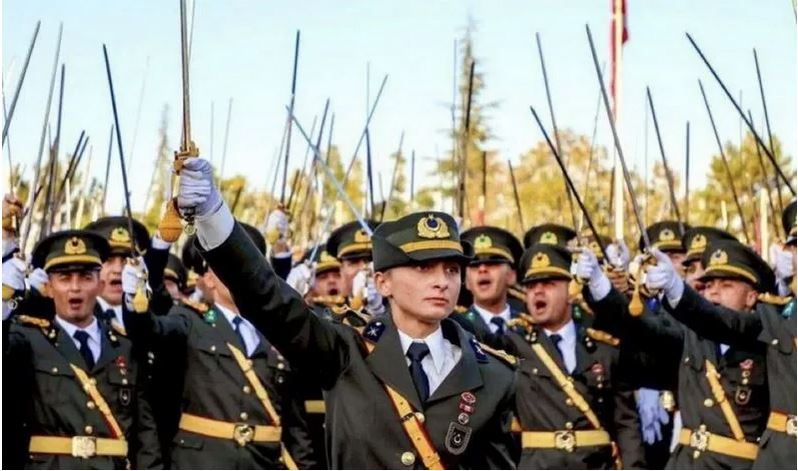
Behind the debate over the lieutenants lies a deeper issue: the militarism Turkey has carried since the late Ottoman period. A reading that stretches from the birth of the idea of the nation in arms to the coups.
Michael Mann, after defining militarism as “seeing military matters as taking priority over all other issues, and accepting war and preparation for war as normal and desirable”, regards conscription as a form of militarist development. Cynthia Enloe, one of the theorists of the subject, describes militarism as “the adaptation of societies and citizens to military values, hierarchy, unquestioning obedience to the state and the use of force”.
When the model of militarism defined at the outset of nation-state building was blended with nationalism, the idea of the “nation in arms” emerged. The first country to realise this transformation was France. France is one of the first examples of both the nation state and the nation in arms.
From the beginning of the 19th century, across a Europe that took France as its model, imperial armies based on mercenaries began to give way to national citizen armies based on conscription. These armies were both the result and the instrument of nationalisation. In the words of the historian Eugen Weber, in France military training centres “played an important role in the process of turning peasants into Frenchmen.”
As the Ottoman state turned into a nation state, it went through experiences parallel to developments in Europe. Through military, educational and economic cooperation agreements with Germany, whose militarist practices went back to the 1700s, the Ottoman elites became acquainted with the nationalist-militarist model. Especially after the cadres of the Committee of Union and Progress seized power, concrete measures aimed at turning the nation into an army can be seen to increase.
In the primary school curriculum prepared in 1913, a “military training” course for boys [etfal-i zükûra talim-i askerî] and games such as “charge, capture the flag, take prisoners” in physical education lessons were added. Europe’s long-established states completed their nationalist-militarist evolution and entered an arms race.
While German officers serving in the Ottoman army instilled in the cadets at the military academies the idea of being prepared for the coming wars, German militarism was presented as the ideal method. The militarist school shaped culture, the press and public opinion.
Newspapers portrayed military leaders as invincible heroes, depicted rival countries and minorities as dangerous aggressors, and regularly speculated about the possibility of war.
However, with the outbreak of the First World War in 1914 and the Ottoman Empire’s defeat, the Ottoman army of a million men entered a process of disarmament and the emotionally exhausted soldiers began to return home. Every area of society was going through a period of destructive turmoil. Anatolia was under occupation. As officers with war experience lost hope in the Istanbul government, they crossed into Anatolia as a result of the political process. Following the war of survival waged under the leadership of Mustafa Kemal and his comrades in arms, our new nation state, the Republic of Turkey, was founded.
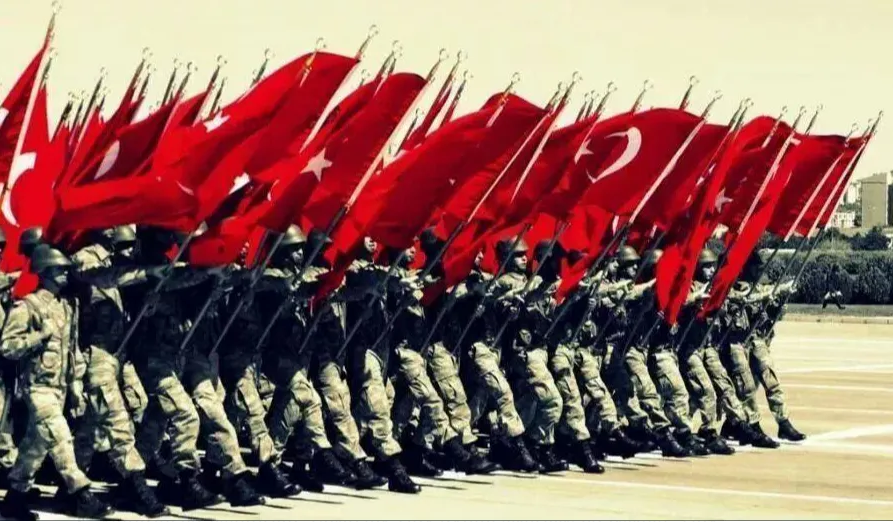
The war was over, but anger had not subsided and accounts had not been settled. The founding cadre, who read world politics well, could foresee that new wars were coming. The unease about the approaching Second World War also contributed to the continuation of nationalist-militarist practices in the early years of the Republic.
Having embraced the official state discourse of post-Atatürk Turkey shaped along the axis of militarism and nationalism, the army showed with the 1960 coup that it was the sole owner of the country. Although there were different factions within the army, the dominant structures hardened Mustafa Kemal’s definition of nationalism further and adopted a construct of ethnically based (racist) nationalism. According to this construct:
“Soldiering is an extension not of defence, of the army or of state organisation in general, but of culture; being a warrior is an unchanging characteristic of the Turkish race and a proudly borne quality of Turkish culture.”
In this formula, we can say that this constructed understanding of nationalism was placed at the centre of Kemalism.
During the Cold War, army-centred nationalist-militarist formations, turning NATO’s support into an opportunity, carried out social engineering operations coordinated by structures such as the Mobilisation Investigation Board (Seferberlik Tetkik Kurulu). At the end of these periods, which ended in coups, the country’s direction continued to follow a militarist line through constitutions drawn up at the behest of the coup-makers.
With the end of the Cold War, the nationalist-militarist reason of state, broadening its definition of the internal enemy, put the danger of “religious reaction” (irtica) on its agenda. This de facto situation gave the hard-line laicist, secular nationalists, elements of the nationalist-militarist reason of state, the opportunity they had been waiting for. The Turkish Armed Forces were fighting separatist terrorism on one front and “religious reaction” on another. With one difference: the mass classified under the label of carrying reactionary potential potentially made up nearly eighty per cent of society. The secular structures that interfered with the headscarf of the mother of the very conscript under their command did not realise that nationalist militarism was sawing off the branch it sat on. The question on the minds of a significant part of society was: How could the army that won the Battle of Sakarya meddle with the headscarf of the conscript’s mother?
With the 28 February intervention and the economic crisis that followed, the useful political parties of the existing system were all but wiped out, and the AKP came to power on its own. Under the influence of the secular nationalist junta then in a strong position within the Turkish Armed Forces, the army did not take long to take a stand against the AKP. While the army’s deep involvement in politics drew reactions from different parts of society, coup plans that launched the Ergenekon trials came to light. The “National Army” part of the phrase “Conspiracy against the National Army”, which the defendants used to criticise these trials, was a message to a society carrying nationalist-militarist codes within it. But although the majority of society was nationalist and militarist, it did not respond to this message, because the trauma created by the 28 February postmodern coup was still affecting society.
This is exactly where Tayyip Erdoğan’s pragmatism came into play. The events of 15 July, about which actors such as Hulusi Akar and Hakan Fidan are alleged to have had prior knowledge and in which they are alleged to have been involved, gave Erdoğan the opportunity he was looking for. The Turkish Armed Forces were all but dismantled: some 40,000 personnel, including 50% of the generals and 90% of the staff officers, were removed from the army. Military high schools were closed, the military academies were redesigned as a university, and admission was tied to non-objective criteria. The armed forces became a propaganda apparatus of the political power. Intense propaganda was broadcast about military operations carried out and units set up in countries such as Syria, Libya, Azerbaijan, Somalia and Qatar. Society was all but bewitched by nationalist-militarist TV series with military themes. And it was very easy for society to buy into the new Islam-flavoured nationalist-militarist system. What remained was to bring this transformation to completion. And an unregulated process of packing the cadres began.
In this context, we can regard the attempt to expel from the army the young officers who, at the graduation ceremony of the National Defence University, recited the oath text read since 1995 as an act of intimidation. Whether the oath crisis was artificial or real is debatable, but the incident led to different interpretations in different parts of society. Some saw the young officers’ action as a symbol of resistance, while others interpreted it as behaviour contrary to military discipline and as a message to those in power. Update: In January 2025 five lieutenants were expelled from the Turkish Armed Forces by decision of the Supreme Disciplinary Board; as of October 2026, the lawsuits against the expulsions and new investigations launched against the lieutenants are still ongoing.
When the reactions of both sides are examined, it can be clearly seen that their mental worlds are fed by nationalist-militarist reflexes. But the real question is whether the division is taking place across the layers of society or on another plane. I do not think there is a sharp division in society on this issue. The division is rather between the partners in power running the country and the secular nationalists (Ulusalcılar) who have supported them since 15 July. It could also be said that the spread of this division to society is particularly desired.
Yet this picture shows that the parties do not dream of a state with more civilian and democratic institutions. This is also the main reason why it will be difficult for Turkey to become civilianised in the near future. For both the government and the opposition, the Turkish Armed Forces remain the element of power at the centre of the struggle. The parties believe that losing control over the armed forces would mean the end of their own struggle.
In conclusion, we can say that the real reason behind the storm created by the lieutenants’ oath crisis is this deep structural problem. In Turkey, government and opposition still pursue a politics centred not on democracy but on military power. This makes building a civilian order based on democracy and the rule of law in the country even more difficult.
Sources
- Michael Mann, The Sources of Social Power
- Cynthia Enloe, Globalization and Militarism (2007)
- Eugen Weber, Peasants into Frenchmen (1976)
- Ayşegül Altınay and Tanıl Bora: Ordu, Militarizm ve Milliyetçilik, in Modern Türkiye’de Siyasi Düşünce, vol. 4: Milliyetçilik, İletişim Yayınları, 2002
Monthly · free
Compass of the Month
Once a month: five points from Europe’s security and migration agenda and the month’s PUGAT articles, in your inbox.
Newsletter sign-up opens soon.
Read next

What is PUGAT? A non-profit community publishing independent analysis from Europe on security, migration and society in Turkish, German and English.
Go to the homepage
